
Washington has Become the Court of Nero
© By Senator Claude Malhuret
President, Mr. Prime Minister, Ladies and Gentlemen, Ministers, My dear colleagues,
Europe is at a critical turning point in its history: the American shield is crumbling, Ukraine risks being abandoned, Russia is being strengthened.
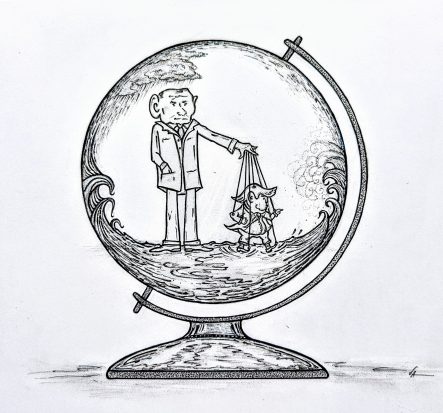
Putin’s puppet? Illustration © 2025 by Linda Arkelian.
Washington has become the court of Nero, with a fiery emperor, submissive courtiers, and a ketamine-fueled jester in charge of purging the civil service. This is a tragedy for the free world, but it is first and foremost a tragedy for the United States. Trump’s message is that there is no point in being his ally since he will not defend you, he will impose more customs duties on you than on his enemies, and he will threaten to seize your territories while supporting the dictatorships that invade you. The king of the deal is showing what ‘the art of the deal’ is all about. He thinks he will intimidate China by lying down before Putin; but Xi Jinping, faced with such a shipwreck, is probably accelerating preparations for the invasion of Taiwan.
Never in history has a president of the United States capitulated to the enemy or supported an aggressor against an ally. Never has any president trampled on the American Constitution, issued so many illegal decrees, dismissed judges who could have prevented him from doing so, dismissed the military general staff in one fell swoop, weakened all checks and balances, and taken control of social media. This is not an illiberal drift; it is the beginning of the confiscation of democracy. Let us remember that it took only one month, three weeks, and two days to bring down the Weimar Republic and its constitution.
I have faith in the strength of American democracy, and the country is already protesting. But in one month, Trump has done more harm to America than in four years of his last presidency. We were at war with a dictator, now we are fighting a dictator backed by a traitor. Eight days ago [on February 24, 2025], at the very moment that Trump was rubbing [French President Emmanuel] Macron’s back in the White House, the United States voted at the U.N. with Russia and North Korea against the Europeans and many other nations who were demanding the withdrawal of Russian troops from Ukraine. Two days later, in the Oval Office, the military service shirker was giving war hero Zelenskyy lessons in morality and strategy before dismissing him like a groom, ordering him to submit or resign. Tonight [on March 4th], he took another step into infamy by stopping the delivery of weapons that had been promised to Ukraine. What to do in the face of this betrayal? The answer is simple: face it.
And first of all, let’s not be mistaken. The defeat of Ukraine would be the defeat of Europe. The Baltic States, Georgia, and Moldova are already on the list. Putin’s goal is to return to Yalta in 1945, when half the continent was ceded to Stalin. The countries of the global south are waiting for the outcome of the conflict to decide whether they should continue to respect Europe or whether they are now free to trample on it. What Putin wants is the end of the order put in place by the United States and its allies 80 years ago, with its first principle being the prohibition of acquiring territory by force. This idea is at the very source of the U.N., where today Americans vote in favor of the aggressor and against the attacked, because the Trumpian vision coincides with that of Putin — a return to spheres of influence, with the great powers dictating the fate of small countries: mine is Greenland, Panama, and Canada; you get Ukraine, the Baltics, and Eastern Europe; and he gets Taiwan and the China Sea. At the parties of the oligarchs of ‘the Gulf of Mar-a-Lago’, this is called “diplomatic realism.”
So we are alone. But the talk that Putin cannot be resisted is false. Contrary to the Kremlin’s propaganda, Russia is in bad shape. In three years, the so-called second largest army in the world has managed to grab only crumbs from a country three times less populated. Interest rates at 25%, the collapse of foreign exchange and gold reserves, and the demographic collapse show that it is on the brink of the abyss. The American helping hand to Putin is the biggest strategic mistake ever made in a war. The shock is violent, but it has a virtue. Europeans are coming out of denial. They understood in one day in Munich that the survival of Ukraine and the future of Europe are in their hands and that they have three imperatives.
First, accelerate military aid to Ukraine to compensate for the American abandonment, so that it holds, and, of course, to impose its presence (and that of Europe) in any negotiation. This will be expensive. It will be necessary to end the taboo of the use of frozen Russian assets. It will be necessary to circumvent Moscow’s accomplices within Europe itself by a coalition of only the willing EU countries, with, of course, the United Kingdom. Second, demand that any agreement be accompanied by the return of kidnapped children and prisoners and by absolute security guarantees. After Budapest, Georgia, and Minsk, we know what agreements with Putin are worth. These guarantees require sufficient military force to prevent a new invasion. Finally, and this is the most urgent because it is what will take the most time, we must build the neglected European defence, which had the benefit of the American umbrella since 1945 and then has been scuttled since the fall of the Berlin Wall.[i]
It is a Herculean task, but it is on its success or failure that the leaders of today’s democratic Europe will be judged in the history books. Friedrich Merz[ii] has just declared that Europe needs its own military alliance. This is to recognize that France has been right for decades in arguing for ‘strategic autonomy.’ It remains to be built. It will be necessary to invest massively, to strengthen the European Defence Fund outside the Maastricht debt criteria, to harmonize weapons and munitions systems, to accelerate the entry into the European Union of Ukraine, which is today the leading European army, to rethink the place and conditions of nuclear deterrence based on French and British capabilities, and to relaunch the anti-missile shield and satellite programs. The plan announced yesterday by Ursula von der Leyen[iii] is a very good starting point. And much more will be needed.
Europe will only become a military power again by becoming an industrial power again. In a word, the Draghi Report[iv] will have to be implemented. For good. But the real rearmament of Europe is its moral rearmament. We must convince public opinion in the face of war weariness and fear — and especially in the face of Putin’s cronies, as well as the extreme right and the extreme left. They argued again yesterday in the National Assembly, Mr. Prime Minister, before you, against European unity, against European defence. They say they want peace. What neither they nor Trump say is that their peace is capitulation, the peace of defeat, the replacement of a de Gaulle Zelenskyy by a Ukrainian Pétain at the beck and call of Putin. Peace for the collaborators who have refused any aid to the Ukrainians for three years.
Is this the end of the Atlantic Alliance? The risk is great. But in the last few days, the public humiliation of Zelenskyy and all the crazy decisions taken in the last month have finally made the Americans react. [Trump Administration approval] polls are falling. Republican lawmakers are being greeted by hostile crowds in their constituencies. Even Fox News is becoming critical. The Trumpists are no longer in their majesty. They control the executive, Congress, the Supreme Court, and social networks. But in American history, the freedom fighters have always prevailed. They are beginning to raise their heads.
The fate of Ukraine is being played out in the trenches, but it also depends on those in the United States who want to defend democracy and here [in Europe] on our ability to unite Europeans, to find the means for their common defense, and to make Europe the power that it once was in history and that it hesitates to become again. Our parents defeated fascism and communism at great cost. The task of our generation is to defeat the totalitarianisms of the 21st century. Long live free Ukraine, long live democratic Europe.
With a background in both medicine and law, Claude Malhuret has represented the department of Allier in the Senate of France since 2014. He has also served France as Secretary of State for Human Rights, Mayor of Vichy, Deputy in the National Assembly, and Member of the European Parliament.
Copyright © 2025 by Claude Malhuret.
Illustration © 2025 by Linda Arkelian.
Claude Malhuret delivered the foregoing address to the French Senate on March 4, 2025 and has authorized its publication in Artsforum Magazine.
[i] The fall of the Berlin Wall took place on November 9, 1989.
[ii] Friedrich Merz heads Germany’s Christian Democratic Union (CDU) party. Following the 2025 federal elections, he became presumptive Chancellor of Germany.
[iii] Ursula von der Leyen has been President of the European Commission (the executive branch of the European Union) since 2019.
[iv] The “Draghi Report” is the September 2024 report entitled “The Future of European Competitiveness” authored by former European Central Bank president and former Prime Minister of Italy Mario Draghi.
*************************************************
Signs and Portents:
Intimations of the End of the World as We Know It?
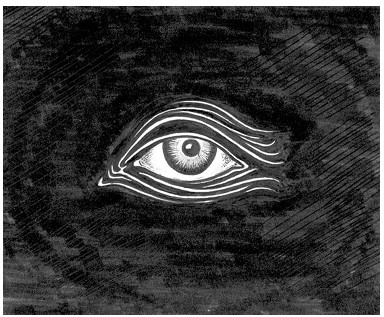
All hearts were chill’d…no Love was left; All earth was but one thought – and that was Death… The winds were wither’d in the stagnant air, And the clouds perish’d; Darkness had no need of aid from them – She was the Universe.” (Byron,“Darkness”) – Illustration © 2024 by Linda Arkelian.
© By John Arkelian
“Turning and turning in the widening gyre / The falcon cannot hear the falconer; / Things fall apart; the center cannot hold; / Mere anarchy is loosed upon the world, / The blood-dimmed tide is loosed, and everywhere / The ceremony of innocence is drowned; / The best lack all conviction, while the worst / Are full of passionate intensity. / The darkness drops down again; but now I know / That twenty centuries of stoney sleep / Were vexed to nightmare by a rocking cradle, / And what rough beast, its hour come round at last, / Slouches towards Bethlehem to be born?” (W.B. Yeats)
“Where is the horse and the rider? / Where is the horn that was blowing? / They have passed like rain on the mountains, / like wind in the meadow. / The days have gone down in the West, / behind the hills… into shadow.” (J.R.R. Tolkien)
A Prologue: Have the days truly gone down in the West? Recently, a scholarly friend expressed despair about the state of the world. While his perspective was entirely secular, there was something decidedly apocalyptic about his bleak tone: “I think, unfortunately, that what’s happening in the United States is no longer of a political nature: it is the fight of Good vs Evil. I find it very symbolic that the bridge that collapsed in Baltimore on March 26, 2024 bore the name (Francis Scott Key) of the writer of ‘The Star Spangled Banner,’ which is the American national anthem. In 1986, Denys Arcand made a movie called ‘The Fall of the American Empire.’ We may be witnessing such a momentous historical event. I hope not. But, history teaches us that all empires come to an end… and they don’t tend to die a pleasant natural death. Didn’t ‘the Unnameable One’ already talk about a ‘bloodbath’ in America?”
Are all nations, empires, and societies doomed to fall? Thus far in human history, they all have perished — at the hands, variously, of external enemies, internal rot, or natural disaster. Some have been conquered, others have disintegrated from within through internal disunity or sectarianism run amok. Imperial overreach ends some polities, the collapse of national vigor seals the fate of others. Nations may exhaust their natural and human resources or fall victim to pandemics, climate changes, or recurring catastrophic crop failures. Natural calamity in the form of a Great Flood brought down the Atlantis of myth; in the real world, it is likely that a violent volcanic eruption in the 16th century B.C. on the Aegean island of Santorini and an ensuing tsunami mortally wounded the maritime Minoan Empire centered on Crete. Some societies simply grow decadent, with personal and public virtues superseded by personal and public vices. Some polities deserve to go, others do not. But, thus far, go they all do — without exception. In Homer’s “The Illiad,” the Trojan priestess Cassandra foresaw the violent fall of the great city-state of Troy. Her urgent warnings went unheeded, and the city was entirely eradicated. Of course, for every Cassandra, there are innumerable crackpots proclaiming that the end is nigh. Theology has a whole branch, known as eschatology, devoted to the subject of the end of the world. But, from a purely secular perspective, is it possible to discern if we are in the proverbial End Times? How do we know if (and when) it’s happening? Might it be happening to us right now? Are there signs and portents from across political, historical, moral, ethical, social, spiritual, psychological, educational, and economic disciplines that might augur danger and activate caution or concern? Or, does our vantage point, in the midst of the here and now, inevitably deny us a sufficiently objective perspective to see the oncoming locomotive of history until it hits us head-on?
Our civilization, currently led by the United States, is a blend of Greco-Roman and Judeo-Christian ingredients, leavened by the Renaissance, the Enlightenment, and the Industrial Revolution. Our resulting Western civilization has generally moved the human race onward and upward. On one side of the ledger, there has been war, colonial subjugation of less developed (or sometimes simply militarily weaker) people, exploitation, periods of great inequality of wealth, and egregious moral collapses like the Holocaust. On the other hand, there have been incremental improvements to our society — like democracy, universal suffrage, the rule of law, entrenched human rights, access to education, and vast improvements in human health and general prosperity.
Is our civilization and society, known as the West, now in decline? One school of thought has it that, by some measures, at least, things have never been better. Talking about the new PBS series “A Brief History of the Future” in April 2024, the series host, Ari Wallach, had this to say: “I know how bad things can get. Right now, things are pretty bad. But the fact of the matter is we are making progress. I’d rather be alive now anywhere on the planet, in any gender, in any race, than even 200 years ago.” The Canadian actor Jay Baruchel, talking about the current resurgence of films about a dystopian, post-apocalyptic future, put the human condition more colloquially: “As shitty as it is, this is the best it’s ever been.” They’re talking about things like literacy, longevity, and access to medical care and schooling. But, by a host of other measures, things are as bad as they’ve ever been. Wars, genocides, famines, oppression, intolerance, hatred or prejudice against the perceived ‘other,’ what amounts to slavery, gross inequality between the rich and the poor (even in the developed world those gaps have grown apace), and tyranny — to name but a few human-caused scourges — continue to plague us.
But are things worse than ever? And do they portend our decline and fall? “Wars and rumors of wars,” for instance, have always (lamentably) been a blight on humanity. And, it seems that every generation, as it ages, looks askance at the next. What grandparent has not wagged an admonishing finger saying, “In my day, we knew better!” Are there convincing reasons to conclude that things may really be different (and more ominous) now? Let us consider some signs and portents.
Signs of a dangerous unravelling are plain to see in the United States. That nation leads the Free World. If it fails, the rest of us will inevitably fall with it. And yet, that preeminent democracy, and the once trumpeted “Great Society” (a term coined by President Lyndon B. Johnson in 1964) it embodies, are deeply riven by sharp socio-political differences, and, increasingly, by the hateful view that those who have a different opinion are the enemy. Those partisan political animosities held up a fresh tranche of desperately needed aid to Ukraine for months — costing that beleaguered country precious lives and territory and undermining the reliability of the United States as an ally, let alone world leader. When political opponents become enemies, the objective becomes to vanquish them (one’s fellow countrymen) rather than to find common ground and compromise. One of the nation’s two political parties has prostrated itself before a self-serving demagogue who is given these days to proclaiming that “I am your retribution.” (More fully, with unchecked ego blazing, he contended: “I am your voice… I am your warrior. I am your justice… And for those who have been wronged and betrayed, I am your retribution.”) Buoyed by his astoundingly uncritical following of true-believers, Trump is seeking a return engagement in the White House. On March 16, 2024, he gave voice to a shockingly unspeakable thought (saying it twice for emphasis): “Now, if I don’t get elected, it’s gonna be a bloodbath for the whole… that’s gonna be the least of it, it’s gonna be a bloodbath for the country, that’ll be the least of it.” He later claimed that his threat was taken out of context and that he was simply referring to imports allowed by Biden Administration which Trump contends are “killing the automotive industry.” But a cunning rabble-rouser knows instinctively how to couch inflammatory words under a cover (however flimsy) of deniability: witness the self-same speaker’s exhortations that immediately preceded the January 6, 2021 assault on the Capitol Building.
The vileness of Trump’s “bloodbath” threat boggles the mind. But which is worse: the grotesque indecency of the creature who made the threat, or the incredible fact that half the population supports him despite his recurringly odious words and deeds? The same goes for the hateful language Trump has used about immigrants in recent months, calling them “animals” and even echoing the words of Adolf Hitler by saying that they are “poisoning the blood of our country.” It’s rabble-rousing at its most coarse, designed to appeal to his listeners’ worst instincts. That so many Americans are wilfully blind to the utter meanness and unfitness of Donald Trump is far more worrying than the man himself. It signifies a widespread implosion of good sense, good character, sound judgement, and civic virtue — and if those attributes are lost, can our society, our nation, and our civilization be far behind? ‘Good versus evil’ scarcely feels like overstating the case in view of such facts.
While wars are nothing new, mankind’s ability to completely obliterate itself through nuclear war is relatively new, with its genesis in the arrival of the atomic bomb in 1945. What has changed since then? Nothing good. We’ve slowed the proliferation of nuclear weapons but not stopped it. Two antagonists who are often at daggers drawn — India and Pakistan — each have nuclear weapons. They pose a danger not only to themselves but also to everyone else if their always simmering mutual animosity gets out of control. Something that’s as new as it is unwelcome are the recurring threats by Vladimir Putin to escalate his conflict with the West over Ukraine by initiating the use of nuclear weapons. It is irresponsible beyond measure — as is our own neglect in failing to concentrate our attention on the urgent need to reduce nuclear arms around the world. If the missiles start flying, our own complacency over arms control will have made us complicit in our own demise.
Something else is new in the current generation, and that’s the ubiquitous presence in the hands of every man, woman, and child of a miniature computer connected to the internet. Those devices are deliberately designed to be psychologically addictive; indeed, they are already well on their way to transforming us into Homer’s land of the lotus eaters. The internet can be a useful information and communication resource, but the fact is that its two most widespread uses are for pornography and gambling. As to the former, at no other time in human history have explicit video images, including those that combine sexuality with violence and all manner of crude perversions, been within easy reach of every human being, including, most alarmingly, minors, who ought never to be exposed to such images. The ease of access to material whose very raison d’être is to appeal to the prurient interest of its viewers, must have implications for human intimacy, not to mention personal and public virtue. When the virtual sea is awash with gambling and with sexual images that are explicit and sometimes deviant, the result can only be to normalize what should be marginalized and to desensitize society to what was rightly regarded as unhealthy excess during all of our species’ time on Planet Earth, until now.
As we have said elsewhere, too many of us rely too much on social media for the raw material upon which we shape our opinions about the world around us. Yet, that informational milieu is saturated with deliberate falsehoods and careless nonsense. Noxious governments (in places like Russia and China) are as eager to manipulate our views as greedy corporate behemoths (starting with the social media giants themselves) are to cash in on algorithms which generate more eye-time on screens by emphasizing extreme or inflammatory messages. That’s something new, something unprecedented, and something uniquely inimical to our continued well-being as a society. Too often, too many members of our society are rendered figuratively deaf and dumb to the truth — incapable of distinguishing between fact and fiction, reality and wild conspiracy fables, sound thinking and abject nonsense. According to a poll reported by ABC News, fully 38% of Americans don’t even believe that Joe Biden was legitimately elected president — proof positive that objective facts have been irrationally shrugged off by millions of Americans. That precipitous decline in individual discernment and responsibility carries with it a collective result in a dumbed-down populace who confuse decadence with normalcy and who are ready prey for demagogues, charlatans, and would-be autocrats. And, it’s not just a generational thing to notice the widespread coarsening of manners: civility is dead in some quarters, while the most vulgar of language springs easily to the lips of the many, including, shockingly, young children. A simple change in social manners and mores? Or, an indicator of a society in decline?
‘The best lack all conviction, while the worst are full of passionate intensity…’ Does it only seem like human readiness to commit unthinkable atrocities has grown ever more wanton? The mass murder in Israel committed by Hamas killers on October 7, 2023 is just the most recent example. True, horrific atrocities are nothing new in human history. But are they happening more and more often now, and with more gleeful abandon, than ever before? Instinctively (and, yes, subjectively), the answer feels like yes, but only a thorough search of the historical record could say for sure. One thing seems clear: things feel pervasively worse on the world stage in recent years than they have for a long time. And even the subjective perception of decline might well become a self-fulfilling prophesy if it is shared by a tipping point number of people in a society.
Drug addiction, environmental degradation, resentments born of growing economic divides between the ultra-rich and the rest of us, the weaponization of differences between people on the so-called ‘culture wars’ field of battle, falling numbers of people who exercise their hard-won franchise by thoughtfully voting in elections, and growing individual and national apathy about even our core values like democracy and freedom of speech — the trend lines are not good in any of these discrete fields. And other things are actively eroding our social cohesion and individual agency, as well. In his new book, “The Anxious Generation: How the Great Rewiring of Childhood is Causing an Epidemic of Mental Illness,” social psychologist Jonathan Haidt warns that “the nature of life for adolescents changed radically” in recent years. Their psyches are being rewired by “devices [which] were created to grab [onto] children’s attention and never let go.” The result is skyrocketing rates of depression, self-harm, and suicide (especially for girls), while “boys aren’t doing the things that will turn them into [psychologically and sociologically healthy] men.” A case in point is the near disappearance of traditional play. In the hurly-burly of outdoor play with their peer group, children learn how to face small risks without getting hurt, and, critically, how to sort out disagreements and form a workable consensus — essential developmental skills which have been usurped by solitary hours in front of a hypnotic screen in the ‘company’ of numerous but only virtual ‘friends.’ The “great rewiring” Haidt describes has profound implications for the development, functioning, structure, and cohesion of human society. So, then, are we on a collision course with disaster, one that threatens the continued viability of our society and, ultimately, Western civilization? As noted, the trend lines across many disciplines are worrisome. But no fate is irrevocably preordained. We have the free agency to heed the urgently sounding claxons, alter our reckless course, take corrective measures, mend our self-destructive ways, avert a catastrophic outcome, and bequeath our civilization’s blessings to posterity. The choice, in the end, is ours.
John Arkelian is a lawyer, journalist, and specialist in international relations who advised the federal cabinet on international and constitutional law and represented Canada as a diplomat in London and Prague.
Copyright © 2024 by John Arkelian.
The foregoing essay also appeared in the Summer 2024 edition of Grapevine Magazine.
*************************************************
Seeing Communism’s Fall in Europe as Liberation Rather than Collapse &
Implications for Russia’s War of Aggression Against Ukraine
© By Maria Popova
The events of 1989-91 became coded in the world’s imagination as “the collapse of communism,” in other words: the sudden demise of the Eastern European and Soviet regimes. Like the Berlin Wall, communism abruptly broke down from one day to the next — and for good. But that’s not the only way to interpret the historic juncture. Instead, liberation could have become the dominant conceptualization. Millions were liberated from dysfunctional communist dictatorships. In addition, the disbanding of the Warsaw Pact, the COMECON, and the Soviet state suggested that the Eastern European satellites and the Soviet republics were also liberated from Russian domination.
The choice to conceptualize the era as one of collapse rather than liberation has structured our understanding of the three decades that followed, our scholarly priorities, and even our interpretation of the current moment when we, as specialists on the region, are asked to decipher the meaning of Russia’s war against Ukraine for a wider audience. The “collapse” conceptualization was a mistake. It created the misguided impression of irreversibility and an artificial thick line between the past and the present. It overemphasized the end of communism while largely ignoring Russia’s imperial project.
The liberation lens would have more accurately captured the arduous, uneven, and slow process of extrication both from state socialism and from Russian imperialism and the dangers of reversal and revanche. If we had chosen the liberation lens, images of “The Baltic Way” protest of August 23, 1989 — in which up to two million people joined hands to form a 420-mile-long human chain across Estonia, Latvia, and Lithuania in peaceful protest against the forceable annexation of the three Baltic Republics by the Soviet Union in 1939 — might have become as iconic as the fall of the Berlin Wall later that same year on November 9, 1989.
If we had chosen the liberation lens, we might have seen the Belovezha Accords in December 1991 as Boris Yeltsin’s attempt to write new vows for the three countries’ “continued marriage” rather than, as Ukrainian president Leonid Kravchuk famously put it, a “civilized divorce.” If we had chosen the liberation lens, we might have looked more critically at the “Commonwealth of Independent States” (CIS) as a new vehicle for Russian imperialism rather than taking the name at face value. We might have acknowledged the significance of Yeltsin overshadowing Nursultan Nazarbaev, the host of the meeting in Alma-Ata, Kazakhstan which launched the CIS.
If we had chosen the liberation lens, we would have understood the “separatist” and “inter-ethnic” conflicts in the former Soviet space — from Moldova to Chechnya — as Russia’s attempt to suppress the liberation process. If we had chosen the liberation lens, we might have understood the economic and demographic crises of the 1990s as products of gradual and difficult extrication from the grip of a weakened imperial center, and the wounds as vestiges of the communist regimes’ economic dysfunction. If we had chosen the liberation lens, we would have better appreciated the exhilarating, new-found liberty of the post-authoritarian 1990s — the freedom of movement, speech, conscience, assembly, and cultural exchange. And we might have noted earlier that these winds of change vanished alarmingly quickly in Russia. If we had chosen the liberation lens, it would have been obvious to all that the countries of Eastern European turned to NATO and the EU because they finally had an opportunity to select their own alliances as sovereign states. And no one would’ve wondered why the Bulgarian foreign minister cried as he watched his country’s flag raised at NATO headquarters in 2004, a symbol of Bulgaria’s return to Europe.
Most importantly, we desperately need the liberation lens now. Millions in Ukraine have already lost their liberty to Russian occupation. Millions more, even beyond Ukraine, may yet fall under Russian domination either through military conquest or at the hands of Russian puppet governments in ostensibly independent states. Europe’s citizens writ large may lose democratic liberties as Russian interference accelerates democratic backsliding.
If we choose the liberation lens now, we will see that the best parallel for the current moment is 1944-46. At the end of World War II, the United States and Western Europe let the Soviet Union take Eastern Europe’s sovereignty. Without the consent of Eastern Europeans, the ‘Great Powers’ decided that these states were to have governments which were “friendly” to the USSR. We know how things turned out. Through occupation, show trials and executions, deportation, gulags, manipulated elections, crushing of the opposition, and the empowerment of local proxies, the USSR gradually established firm control over Eastern Europe, which lasted for the next 45 years.
Today, a revanchist Russia attempts a similar grab of Eastern European sovereignty and again seeks the complicity of Western democracies. Today, we are at a crossroads: will we avoid or repeat the mistakes of the 1940s? Through the liberation lens, we see Russia clearly as an expansionist empire. We should not allow Russia to manipulate world opinion through the euphemism of “security concerns.” Russia is in fact attempting to take away others’ security and freedom. What Russia aims for isn’t influence through soft power but through the violently enforced loyalty of the Warsaw Pact years.
If we choose the liberation lens now, we won’t repeat the mistake of accepting Russia’s demands for “friendly governments” in the region. “Putin wants a ‘friendly’ Ukraine. What’s so bad about that?” some ask today. Ukrainians understand all too well that a ‘friendly’ Ukraine means a subjugated one, where the Ukrainian language, national identity, and democratic institutions are slowly eradicated. We should also understand that any attempt by Western leaders to negotiate with Russia above Ukrainians’ heads is itself imperialist and unacceptable.
If we choose the liberation lens now, we will see that partitioning Ukraine and imposing “neutrality” on it in the name of compromise is not a solution. Feeding Ukraine’s territory and people to Russia piece by piece is not peace-making but letting Russia creep to victory. Each day that Ukraine is not in NATO and the EU is another day where Russia’s hope to conquer Ukraine stays alive. Only NATO and EU membership — the sovereign choice of an overwhelming majority of Ukrainians — can protect Ukraine from repeated Russian aggression.
If we choose the liberation lens now, we will see that Russia is seeking to impose its control in countries beyond Ukraine, most recently and clearly in Moldova and Georgia through election interference, disinformation, oligarchic corruption networks, energy blackmail, local proxies and sympathizers, and military threats. We should recognize that Russia’s repeated calls for NATO to roll back its enlargement to 1997 lines reveal its ambition to re-establish dominance all over Eastern Europe. If we choose the liberation lens now, we will understand that if Russia manages to win through force and nuclear blackmail, liberty and democracy all over the world will be in danger as nuclear-armed dictatorships decide to try this promising strategy for themselves.
Thirty-five years after 1989, the process of liberation from Russian imperialism is still unfinished. Fearful and indecisive Western leaders are sleepwalking into another betrayal of Eastern Europe and another division of Europe into free, sovereign states and Russian-occupied or dominated vassals. It is only Ukraine’s heroic resistance and dogged refusal, in President Volodymyr Zelensky’s words, “to give our freedom to this f***ing terrorist Putin,” that keeps Russian imperialism at bay and protects Europe.
Maria Popova is Associate Professor in the Department of Political Science at McGill University. She is scientific co-director of the ‘Jean Monnet Centre Montréal,’ which has a multidisciplinary team of experts who specialize in European studies and the EU, and she is editor of ‘Politics and Society from Central Europe to Central Asia’ for the Cambridge Elements series of concise studies. She is the co-author of “Russia and Ukraine” (Polity Books, 2024).
Copyright © 2025 by Maria Popova.
Editor’s Note: The foregoing paper was presented in the plenary remarks section of the annual conference of the Association for Slavic, East European, and Eurasian Studies (ASEEES) in Boston in November 2024. The plenary session can be viewed at: https://www.popovaprof.ca/keynotes/
*************************************************
How to Uphold Human Rights in War:
Lessons from Ukraine’s Fight for Justice and Dignity

Oleksandra Matviichuk (courtesy of the Center for Civil Liberties)
© By Oleksandra Matviichuk
I am a human rights lawyer, and I have been applying the law to defend people and human dignity for many years. I have often heard that freedom and human rights are important, but that economic benefits, geopolitical interests, and security concerns are even more significant. The fault of this approach is that freedom and peace are inextricably linked. States that grossly violate human rights pose a threat not only to their own citizens but also to security and peace in general. One clear example is Russia, which destroyed its own civil society step by step. But for a long time, the developed democracies turned a blind eye to this. They continued to shake hands with the Russian leadership, building gas pipelines and carrying on business as usual. In 2014, he world scarcely blinked at the annexation of Crimea by military force, which was unprecedented in post-war Europe.
And now as a human rights lawyer I am in a situation where the law does not work. Russian troops are destroying residential buildings, churches, museums, schools, and hospitals. They are shooting at the evacuation corridors. They are torturing people in filtration camps. They are forcibly taking Ukrainian children to Russia. They are abducting, robbing, raping, and killing in the occupied territories. The entire U.N. system cannot stop it. There is no legitimate reason for doing this. There is also no military necessity for it. Russians did these horrific things only because they could.
War turns people into numbers. The scale of war crimes grows so fast that it becomes impossible to recognize all the stories. But people are not numbers. People have names. That is why it is so important to tell them. This is a story of 10-year-old boy Illya Matviyenko from Mariupol. Russian troops surrounded the city and did not allow the International Committee of the Red Cross to open the green corridor and evacuate civilians. Hence, Illya and his mother hid in the basement of their house from the Russian shelling. Like many people in the city, they melted snow to have water and made fires to cook at least some food. When the supplies ran out, they were forced to go out and consequently they became exposed to shelling. His mother was wounded in her head, and the boy’s leg was torn. With the last of her strength, his mother dragged her son to a friend’s apartment. There was no medical assistance. Prior to this, the Russians destroyed the maternity hospital and the entire medical infrastructure in Mariupol. That is why in the apartment they lay down on the couch and just hugged each other. They were lying like that for several hours. Ilya’s mother died and froze right in his arms.
I have one question. How can we people, in the 21st century, defend human beings, their lives, their freedom, and their dignity? Can we rely on the law — or does only brutal force matter? It is important to understand this not only for people in Ukraine, or for those in Syria, China, Iran, Nicaragua, or Sudan. The answer to this question determines our common future. We must rethink our approach to global security. Because global security starts from human security. And human security is impossible without freedom.
Half of the population in the world this year goes to elections. But don’t be misled by illusion. More than 80% of people around the world live in ‘not free’ or ‘partially free’ societies. This means that people who have the right to vote for whom they want to vote are in the minority. The problem is not only that the space of freedom in authoritarian countries has narrowed to the size of a prison cell. The problem is that even in developed democracies, forces calling into question the Universal Declaration of Human Rights are gaining weight. There are reasons for this. The coming generations inherited democracy from their parents. They began to take rights and freedoms for granted. They have become consumers of values. They understand freedom as a possibility to choose between different cheeses in the supermarket. Yet, the truth is that freedom is very fragile. Human rights are not attained once and forever. It is the determination to act that defines a society that has a future.
First: We must defend our freedom and democracy
Ten years ago, millions of people in Ukraine bravely stood up against a pro-Russian corrupt authoritarian regime. They peacefully demonstrated just for the chance to build a country in which the rights of everybody are protected, government is accountable, courts are independent, and police do not beat peaceful student who are peacefully demonstrating. And they paid the ultimate price for this. The police shot more than 100 peaceful protestors. People died under the flags of Ukraine and the European Union. When the authoritarian regime fell to the Revolution of Dignity, Ukraine got its chance for democratic transformation. And to stop us on this path, Russia invaded. In 2014, Russia occupied Crimea and part of the eastern regions and in 2022 expanded this war into a full-scale invasion. Because Putin is not afraid of NATO. Putin is afraid of the idea of freedom.
Second: We are dealing with the formation of an entire authoritarian bloc
I live in Kyiv, and my native city, like thousands of other Ukrainian cities, is constantly being shelled not only by Russian missiles but also by Iranian drones. China is helping Russia circumvent sanctions and import technologies critical to warfare. Syria votes at the U.N. in support of Russia. North Korea sent Russia more than a million artillery shells and is preparing to send troops. All these regimes have something in common. They have the same idea of what a human being is. Authoritarian countries consider people as objects of control and deny them rights and freedoms. Democracies consider people, and their rights and freedoms, to be of the highest value. There is no way to negotiate this. The existence of the free world always threatens dictatorships with the loss of power.
Third: To prevent wars, we need justice
The 20th century brought millions of deaths and the dehumanization of humankind, which reached its most concrete form in the Holocaust. Responsibility for what had been perpetrated was codified in the slogan “Never again.” Governments created the United Nations system and signed international agreements. The idea that every person is free and equal in dignity and rights came to characterize the new postwar humanism.
Meanwhile, the totalitarian Soviet Gulag was never condemned or punished. That’s why in Russia, the end of the Second World War is celebrated with the slogan “We can repeat.” Unpunished evil grows. The Russian military committed terrible crimes in Chechnya, Moldova, Georgia, Syria, Mali, and Libya. They have never been punished for it. They believe they can do whatever they want. If we want to prevent wars, we have to punish the states (and their leaders) which start such wars. But in the whole history of humankind, we have only one precedent of punishment for the crime of aggression. It was the Nuremberg trials where Nazi war criminals were tried after the Nazi regime collapsed. But we are living in a new century. Justice should not depend on how and when the war ends. The global approach to crime against peace needs to be changed. We must establish a special tribunal now and hold Putin, Lukashenko, and other war criminals accountable.
Fourth: We have entered a period of turbulence
I don’t know what historians in the future will call this historical time. The world order, based on the U.N. Charter and international law, is collapsing before our eyes. The work of the Security Council is paralyzed. Now fires will occur more and more frequently in different parts of the world because the international wiring is faulty, and sparks are everywhere. We have to start reforming the international system to protect people from wars and authoritarian regimes globally.
Russia’s war of aggression against Ukraine is not just a war between two states. This is the war between two systems — authoritarianism and democracy. Russia wants to convince the entire world that freedom, democracy, human rights, and the rule of law are fake values because they do not protect anyone in the war. Russia wants to convince others that a state with a powerful military potential and nuclear weapons can break the world order, dictate its rules to international community, and even forcibly change internationally recognized borders.
If Russia succeeds, it will encourage other authoritarian leaders in various parts of the world to do the same. Democratic governments will be forced to invest money not in education, health care, culture, or business development, not in solving global problems such as climate change or social inequality, but in weapons. We will witness an increase in the number of nuclear states, the use AI as the method of the war, the emergence of robotic armies and new weapons of mass destruction. If Russia succeeds and this scenario comes true, we will find ourselves in a world that will be dangerous for everyone, without any exception.
Fifth: Democracies must win wars
People in Ukraine want peace much more than anyone else. But peace does not come when the country which was invaded stops fighting. That’s not peace, that´s occupation. Occupation is not about changing one state flag to another. Occupation means enforced disappearances, torture, rapes, denial of your identity, forcible adoption of your own children, ‘filtration camps,’ and mass graves. Russia is an empire. An empire has a center but no borders. An empire always strives to expand. People released from captivity tell us how Russians said that when Ukraine falls, Ukrainians will go to conquer the world together with the Russian army. The forced mobilization of Ukrainians into the Russian armed forces has long been in full swing in the territories occupied by Russia. Regardless of whether European countries have the courage to admit it or not, they are safe only because Ukrainians are still fighting. If we aren’t able to stop Putin in Ukraine, Russia will go further.
And last: Ordinary people can change the history
I have been working with the law for many years, and I know for sure that if you cannot rely on legal mechanisms, you can always rely on people. We are used to thinking in categories of states and interstate organizations. But ordinary people have much more impact than they can even imagine. I would never wish anyone to go through our experience. Nevertheless, these dramatic times provide us an opportunity to reveal the best in us – to be courageous, to fight for freedom, to take the burden of responsibility, to make difficult but right choices, to help each other. Now more than ever, we keenly feel what it means to be human. And I am here to say that despite everything, the story of Ukraine is a life-affirming story, because these are dramatic times that raise hope. When freedom is denied, it starts to powerfully break out. The future is unclear but not prewritten. Nevertheless, we still have a chance to fight for the future we wish for ourselves and our children.
Oleksandra Matviichuk is a human rights lawyer based in Kyiv. She leads the Center for Civil Liberties, which promotes human rights and democracy. In 2022, that non-governmental organization won the Nobel Peace Prize under her leadership. Ms. Matviichuk also coordinates the activities of the initiative group ‘Euromaidan SOS,’ which was established in 2013 to assist the peaceful protests known as the Revolution of Dignity. She has helped spearhead international campaigns like #LetMyPeopleGo and #SaveOlegSentsov to secure the release of political prisoners held by Russian authorities. And, in response to the unlawful full-scale war unleashed by Putin in February 2022, she and others launched the ‘Tribunal for Putin’ initiative to document war crimes and crimes against humanity being perpetrated by the Russian invaders.
Visit the Center for Civil Liberties at: https://ccl.org.ua/en/
Copyright © 2024 by Oleksandra Matviichuk.
Editor’s Note: The Nobel Peace Prize organization had this to say about the Center for Civil Liberties: ‘The 2022 Nobel Peace Prize was shared by three recipients: (i) human rights advocate Ales Bialiatski from Belarus, (ii) the Russian human rights organization Memorial, and (iii) the Ukrainian human rights organization Center for Civil Liberties. Those three award laureates represent civil society in their home countries. They promote the right to criticize power, and they protect the fundamental rights of citizens. They have made an outstanding effort to document war crimes, human right abuses, and the abuse of power. Together, they demonstrate the significance of civil society for peace and democracy.
In 2007, democracy and human rights activists founded the Center for Civil Liberties (CCL) in Kyiv, the capital of Ukraine. In its early years, the CCL pressured the authorities to ensure that Ukraine developed into a full-fledged democracy and a state governed by the rule of law. A key objective was Ukraine’s accession to the International Criminal Court (ICC) in The Hague. When Russia annexed the Crimean Peninsula from Ukraine in 2014 and unlawfully supported breakaway districts in eastern Ukraine (the so-called ‘republics’ of Donetsk and Luhansk), the CCL documented cases of unlawful imprisonment and other abuses against the civilian population in those areas. After Russia’s full-scale attack on Ukraine in February 2022, the CCL concentrated on documenting war crimes against the civilian population perpetrated by Russian soldiers in the occupied areas. That work was carried out in cooperation with bodies such as the ICC. The CCL also documented the forced relocation of civilians from occupied areas of Ukraine to Russia.’
Visit the Nobel Peace Prize organization at: https://www.nobelprize.org/prizes/peace/2022/summary/
And see “The Imperative of Defeating Aggression in Ukraine” at: https://artsforum.ca/ideas/in-depth
*************************************************
The Republic of Virtue
© By John Arkelian
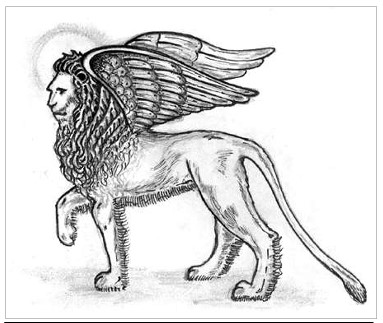
“To nurture the weak and confound the mighty.” That should be our credo, if we truly seek to build a humane world, a world based not upon the all too common practice that “might makes right,” but rather upon the nobler idea of “might for right.” Illustration © 2024 Linda Arkelian.
“And so we shall hold ever to the upward way and pursue righteousness with wisdom always and ever…” (From “The Republic” by Plato, 429-347 B.C.)
“Remember, caution and acceptance never change the world. If we do not dare to lead the way and dream of something different, nothing will ever change. Freedom demands sacrifice, bravery, and persistence.” (Roya Mahboob, September 2023)
“Wickedness is the root of despotism as virtue is the essence of the Republic.” (Maximilien Robespierre, 1794)
“We must not be afraid of dreaming the seemingly impossible if we want the seemingly impossible to become a reality.” (Vaclav Havel, 1997)
The Republic of Virtue is a mythical place, a notional construct of the imagination, a thing and place and idea that we long for but at whose distant shores we have never arrived. It’s the embodiment of the clarion call to our ‘nobler angels,’ a way of being that puts idealism into practice in the real world. And, naysayers notwithstanding, if we can imagine a better world, we can make it so. As J.R.R. Tolkien put it, “Where will wants not, a way opens.”
The bedrock of the Republic of Virtue, its very foundational principle, is its steadfast allegiance to core values and its citizens’ embrace of civic and personal virtue. What are those core values? Why, nothing more or less than democratic, transparent, and accountable governance, inalienable human rights (among them, the freedoms of speech, assembly, and belief), a free press, an independent judiciary, iron-clad safeguards against both arbitrary detention and cruel and unusual punishment, the rule of law, equal opportunity, and equality of all persons before the law. And, there is the freely accepted responsibility to protect others — in less fortunate principalities — from aggression, oppression, and crimes against our common humanity. For citizens of the Republic of Virtue know that there can be no liberty, justice, equity, and peace for some unless there is a full measure of those blessings for all.
And what are the virtues, both personal and civic, that the Republic of Virtue instills in its citizens from their childhood onward? Civility, tolerance, recognition of objective facts, accepting the responsibility to be well-informed and actively engaged in the polity’s affairs, resolute dedication to fairness and equally resolute opposition to injustice and tyranny under all of its guises, kindness and compassion for others, active stewardship of our shared natural environment, a personal responsibility to intercede on behalf of those who need an advocate and protector, curiosity about the wider world, the shunning of hyper-partisanship, and a commitment to both public service and lifelong learning. The credo of citizens in the Republic of Virtue is to improve (rather than enrich) themselves and their society.
Public and private virtues do not spring fully born from all of our bosoms. They need to be instilled through consistent education and the good example of virtuous men and women. And, if nature and education do not wholly suffice to instill virtues like civility, let alone empathy, there’s something to be said for practice making perfect: “Assume a virtue, if you have it not / That monster, custom, who all sense doth eat / Of habits devil, is angel in this” (William Shakespeare’s “Hamlet,” 1601). Perversely, in the world of the here and now, the discipline of civics, which teaches us about the working of our political system and our rights and responsibilities within that system, has been wholly absent from school curricula for decades, with ruinous results in an uninformed populace that’s too often bereft of any sense of civic duty.
In the Republic of Virtue all citizens are expected to perform national service, be it military or civilian in nature, at intervals throughout their lives. All citizens are expected to engage in lifelong continuing education. At least some of the legislators — at the national, state, and municipal levels — are selected for fixed terms of service by a lottery system akin to jury selection. Legislators who are still chosen by election are subject to popular recall provisions, obliged to defer to binding public referenda on important issues, and subject to strict term limits. As Sir Thomas More said in his book “Utopia” in 1510, “Anyone who campaigns for public office becomes disqualified from holding any office at all.”
In the Republic of Virtue there are no billionaires or multi-millionaires. No one needs or “deserves” to possess such extreme wealth. Improving society for the benefit of all is extolled as a good infinitely superior to the accumulation of fortune or fame. Workers have voting rights on the boards of all corporations in belated recognition as the ones who create wealth. Competition law is given strict and relentless effect. Mega-firms no longer exist, replaced by a multitude of smaller competing firms. Consumer protection is fiercely enforced, with offending businesses prosecuted, severely penalized, and, where appropriate, closed down. The maximum remuneration differential between the lowest and highest paid employee of any business is preset by law.
In the Republic of Virtue there is no question about how often to permit students to use personal telecom devices in school, for such devices are not permitted in classrooms from kindergarten through university. Scientific and engineering innovations deemed not to be in the public interest — such as artificial intelligence, all but very limited genetic engineering, self-driving vehicles, and autonomous weapons systems — are prohibited. The recreational use of mood-altering drugs is unlawful and taught to be socially unacceptable. Likewise, gambling is taught to be a social and personal vice; and its advertisement is prohibited. No one carries (or wants to carry) a firearm, as they are inimical to the general welfare and have no rational place in a peaceable society. Educators strive to teach their students not what to think but how to think. However, care is taken to teach students how to distinguish between quality and dross. Too few among us these days are sensible of the difference.
In the Republic of Virtue there is no business as usual with foreign abusers of human rights — be they outright foes (like Russia, China, and North Korea) or purported allies like Saudi Arabia. The Republic of Virtue puts its core values ahead of its economic interests and even, save in extreme cases, ahead of its temporary geopolitical advantage. In one such extreme case, the West allied itself to Stalin’s Soviet Union to defeat Nazi Germany in World War Two for practical reasons, even though there wasn’t much of a qualitative difference between the two totalitarian regimes. But, on far too many subsequent occasions, we let “the enemy of my enemy is my friend” excuse justify our support of noxious, murderous regimes throughout the Third World. As Vaclav Havel said, “One can imagine a foreign policy initiative that demonstrably does not merely pursue the selfish interests of a country, but instead displays a feeling of common responsibility for the fate of all of human society, its freedom, its plurality, and its life in peace.”
In the Republic of Virtue common cause is found with likeminded foreign allies, in a united federation of nations whose members freely cede some sovereign authority to a supranational organization in exchange for collective security and for a proactive agenda to forcefully intervene in places like Ukraine when it is the object of external aggression or in places like Cambodia, Rwanda, Bosnia-Hercegovina, and Sudan when they were subject to mass genocides. Foreign allies that stray from our core values, like Hungary, Turkey, Poland (until recently), Slovakia, and even Israel, are suspended from their status as allied partners and subjected to targeted sanctions to penalize retrograde behaviors.
In the Republic of Virtue quality, artfulness, and aesthetic and intellectual excellence are tangibly incentivized in mass entertainment: suddenly, plays, art, and literature can be seen on television again, while once ubiquitously mindless content is subject to a ‘stupidity tax.’ Our shared cultural environment is finally given the importance it deserves, with mandatory age restrictions on very vulgar language, sexual content, and extreme violence. People no longer anoint and fawn over purported celebrities. Imagination, innovation, creativity, and idealism are celebrated; but so are compassion, kindness, humility, and public service. Citizens read again, delighting in the marketplace of ideas offered by reborn newspapers and magazines. Journalists are valued for their irreplaceable role in holding governments, businesses, and whole societies to account. Art infuses the very streetscapes of the Republic of Virtue, for the performing and visual arts, together with literature, poetry, and learning writ large constitute the very soul of the Republic and its people. And quality is valued over quantity in all areas of human endeavor.
In the Republic of Virtue a market economy is understood and utilized for what it is — a useful way of organizing human economic affairs. As Vaclav Havel said, it is not “a world view, a philosophy, or an ideology. Even less does it contain the meaning of life… It seems both ridiculous and dangerous when for so many people… the market economy suddenly becomes a cult, a collection of dogmas, uncompromisingly defended and more important, even, than what that economic system is intended to serve — that is, life itself.” In the Republic of Virtue, a market economy based on free and fair competition serves the public interest, not the other way around. And planned obsolescence doesn’t exist: everything crafted by humans is built to last, with durability and beauty of equal importance.
In the Republic of Virtue an instinctive suspicion of hyper-partisanship is instilled at an early age. In 1796, George Washington, the first President of the United States had a warning that speaks urgently to us in the 21st century: “Let me… warn you in the most solemn manner against the baneful effects of the spirit of party.” Today, the world’s preeminent democracy is beset by the baneful effects of party affiliation run amok, and the hateful sectarianism they engender threatens the very future of America and its friends.
And if the Republic of Virtue needs an anthem, it might well be this: “To dream the impossible dream / To fight the unbeatable foe / To bear with unbearable sorrow / To run where the brave dare not go / To right, the un-rightable wrong / To love pure and chaste from afar / To try when your arms are too weary / To reach the unreachable star / This is my quest, to follow that star / No matter how hopeless, no matter how far / To fight for the right without question or pause… To reach the unreachable star.”
Copyright © 2024 by John Arkelian
John Arkelian is a lawyer, journalist, and publisher who conducted criminal prosecutions, taught media law, advised the federal cabinet on international and constitutional law, and represented Canada as a diplomat in London and Prague.
The foregoing essay also appeared in the Spring 2024 edition of Grapevine Magazine.
*************************************************
Whither Empathy? The Essential, Too Often Missing, Ingredient for Peace in the Middle East
© By John Arkelian
(I) Pride and Prejudice
It is a truth seldom acknowledged that more than one thing can be true at the same time. In the Middle East these days, several different things are true at the same time. It is true that the vicious attack on Israelis on October 7, 2023 by the militants who run the Gaza Strip was an act of mass murder and terrorism, a crime that cannot be justified in any way by real or imagined grievances. It is also true that the perpetrators of that heinous barbarity need to be brought to justice — by being apprehended, charged, and tried, or by being shot dead if they resist arrest — and that the militant organization (Hamas) that sent them is not fit to govern the people of Gaza. But some other things are true as well, things that in no way negate the horror perpetrated by Hamas but which nevertheless constitute legal and moral wrongdoing in their own right.
Israel’s military response to the attack on its people is killing thousands of innocent Gazans. About 229 innocent hostages were abducted by Hamas terrorists, and about 1,400 innocent Israelis were slaughtered by Hamas on October 7th. About 1,500 of those Hamas killers were slain on the Israeli side of the border. But Israel’s subsequent retaliation has wreaked havoc among equally innocent Gazan non-combatants. Citing figures compiled by Gazan health ministry officials, Associated Press (AP) reported on October 26th that 7,028 Palestinians, including 2,913 children, have thus far been killed in Gaza by the Israeli response. It goes without saying that what Hamas did was an abominable crime. But it is equally a war crime to target civilians or to be careless about civilian collateral damage. This is not to equate the motivation of the two opponents: Hamas was intent on bloody murder and savagery, fueled by a wretched ideology that denies Israel’s right to exist. In contrast, the Israeli response after October 7th was based on self-defense and justified rage over the atrocity perpetrated upon them. But, motivations ultimately do not matter in the face of actions — and dead civilians.
Bombing a densely packed urban area that’s home to 2.25 million people in order to root out the terrorists in their midst is unlawful and immoral. So is the demand that civilians flee in their hundreds of thousands to get out of the line of fire. So is stopping the flow of water, food, medicine, and electricity to millions of people, most of whom are completely innocent of any offense against Israel. Such actions fail to differentiate between the criminal few and the innocent many. Israel’s entirely justified anger against Hamas cannot and does not justify putting millions of Palestinian civilians in harm’s way. For its part, Hamas seems to be as callously indifferent to the well-being of its own civilians as it is to the lives the Israeli civilians it deliberately targets. There are other truths, too, foremost among them being Israel’s protracted failure to stop unlawfully building settlements on occupied lands belonging to Palestinians and its failure to do all it can to make the often talked about and never actually implemented ‘two-state solution’ a reality. Those failures obviously do not signify that Israel has somehow reaped what it sowed, but they do constitute wrongdoing on the Israeli side (there’s plenty on the opposing side, too) which fuels rancor and distrust and resentment. Mutual pride and prejudice, on the part of Israelis and Palestinians alike, has for too long impeded the nurturing of mutual empathy — and without mutual empathy, there will be no peace in the Middle East.
(II) A Measured Response
Hamas is cynically using Gazan civilians as human shields, deliberately hunkering down in their midst to force Israel to kill innocents to get at the guilty few. It’s a tactic that’s reminiscent of the Baader–Meinhof Gang (also known as the Red Army Faction), a terrorist group which was active in Germany in 1970-98. One of their goals was, through acts of violence, to provoke a draconian response from government, a response that would ultimately discredit said government in the eyes of its own people and the world community. Because Israel has such an overwhelming predominance of force in its dealings with Palestinians in Gaza and the West Bank, its efforts to defend itself against non-state opponents too often create very bad optics for Israel, sometimes making it look oppressive and overbearing even when it is legitimately acting to defend itself. In the present case, Israel should not take the bait offered by Hamas by attacking Hamas in the midst of the hospitals, apartment buildings, or other civilian settings where Hamas may be hiding. This kind of asymmetrical, unconventional warfare demands a measured response by a moral, law-abiding nation. A measured response to provocative acts of violence is not only a legal and moral imperative, it is also the only way Israel can hold onto the high ground in world public opinion.
In the present crisis, Israel has set forth these perfectly legitimate objectives: (1) to go after the perpetrators of the October 7th massacre (and that means all of Hamas), (2) to remove Hamas as the governing body of Gaza, and (3) to rescue the hostages taken by Hamas. But, as set out above, bombing a sprawling city, cutting off food, water, medicine, and electricity, and preparing for a full-scale invasion of that small, tightly-packed territory is raining death down upon the heads of thousands of innocent civilians. What to do? A measured, surgical response would be to send in small groups of elite commandoes to find the malefactors and their captives in order to apprehend (or kill) the former and liberate the latter. Meanwhile, Israel should focus all of its diplomatic efforts on building an international consensus to punish the radical regime of Iran for its presumed role in supplying missiles to Hamas (and to Hezbollah in Lebanon). Israel should work with Palestinians who are opposed to Hamas to depose Hamas and replace it with a moderate government. And, Israel should, however belatedly, start taking seriously the need to create a Palestinian state in the West Bank and Gaza in order to remove itself from the thankless, self-destructive role of occupier and to deprive groups like Hamas of their flimsy disguise as freedom-fighters.
(III) A Look Back
The connection of the Jewish people to the region we now call Palestine dates back 4,000 years. But, the Hebrews, as they became known, were repeatedly separated from their Promised Land over the ensuing centuries. During their long absence from Palestine, the Jews endured discrimination and worse in their adopted homes throughout Europe and beyond. During the 19th century, the Jewish population of Palestine numbered only 25,000. Those numbers increased to 60,000 by the start of the 20th century – starting with the first ‘aliyah’ (or large migration) prompted by the murderous pogroms against the Jews in Russia that began in 1881. Immigration was also given impetus by the birth in 1862 of the Zionist movement, which advocated for the creation of a Jewish state.
The pressures born of persecution and discrimination in Europe intensified before the Second World War, which saw an advanced nation, Germany, openly embrace hatred, racism, and mass murder as state policy. As a consequence, 170,000 Jews emigrated to Palestine in 1933-37, increasing their overall numbers there to 500,000 (compared to over a million Arabs). In 1935, Arab representatives formally petitioned the British government, which had administrative control over the area after the First World War, to halt Jewish immigration. Jews were fleeing persecution, which was becoming a matter of life or death. But, from the Arab point of view, it seemed like a colonization by Europeans which threatened to dispossess them physically and culturally.
After the British relinquished their responsibility for Palestine in November 1947, a United Nations resolution partitioned Palestine, assigning 5,500 square miles for a Jewish state and 4,500 square miles for an Arab state. One state became a reality; the other did not. The decades that followed have witnessed a succession of wars between Israel, neighboring states, and hostile paramilitary groups – as well as repression by one side and terrorism by the other. In the Six Day War of 1967, Israel won a decisive and admirable victory over invading forces from Egypt, Syria, and Jordan. In the process, it occupied the entire Sinai Peninsula, the Gaza Strip, the West Bank, and the Golan Heights. In victory, though, lay the seeds of future discord, rancor, repression, and intractable conflict. Israel became an occupying power justifiably, in the process of defending itself. But it has elected to continue to occupy most of those territories for 58 years. Israel withdrew from the Sinai in 1982 as part of the 1979 peace treaty with Egypt which stipulated return of that territory to Egypt in exchange for Egypt’s formal recognition of Israel. Israel unilaterally withdrew from the Gaza Strip in August 2005. Israeli military installations and forces were removed, and over 9,000 Israeli citizens living in 25 settlements were evicted by the Israeli government itself, over fiery opposition by Israeli settlers. In June 2007, Hamas took over the Gaza Strip from the Palestinian Authority based on the West Bank, and Israel responded with the imposition a tight embargo (of dubious legality) on that 139 square mile bit of arid coastline — an embargo that has continued to the present day. The 16-year long embargo means that Israel has remained very much engaged in controlling Gaza, even though it has not been physically occupying it.
Controlling territories without the consent of the people living there has been as detrimental to Israel itself as to the population under its imposed control. It has robbed Israel of the moral high ground; it has, depending upon your point of view, turned a David into a Goliath; and, it has stoked resentments, creating a handy excuse for acts of violence in response.
It was not always thus. Israel was the perceived underdog in the aforementioned Six Day War. It was likewise widely applauded (and admired) in 1976 when its forces successfully staged a daring rescue of hostages (94 Israeli civilians and twelve flight crew members) aboard a hijacked Air France passenger jet on the tarmac at Entebbe airport in Uganda. Israel needs to regain the moral high ground — for its own sake as well as that of disenfranchised Palestinians.
(IV) The Way Ahead
The West, led by the United States, should reiterate its unshakeable commitment to always defending Israel from external attack. But we can be Israel’s steadfast friend and defender without giving it free writ to pursue unjust policies itself. Perpetually occupying another people’s home against their will is as bad for Israel as it is for the occupied Arabs. On the one side, it fuels repressive policies, which undermine democratic norms and respect for human rights; on the other, it feeds an abiding sense of grievance and impels some to resort to violence. For years, the government of Israel has shown no real interest in pursuing a ‘two-state solution,’ which would see two sovereign states – Israel and an Arab Palestine – coexisting side-by-side. Israel’s friends need to vigorously encourage it (and, if necessary, compel it) to identify and implement the incremental steps needed to arrive at that goal. A legacy of mutual hostility means that such steps will, necessarily, be gradual and tentative at first. But forward momentum, however modest, is long overdue.
We can start by applying meaningful pressure on Israel to belatedly halt its unlawful colonization of the Occupied Territories. That means no more new settlements and no expansion of existing ones. If Israel balks, as it has done for decades under governments of different stripes, we need to impose sanctions and withhold enough aid to penalize unhelpful behavior. Likewise, no more Arab properties in Jerusalem should be seized by Israel. Fair accommodation needs to be made to share water resources. Once the current crisis is over, a loosening of the suffocating embargo of Gaza – to the extent that it does not endanger Israel – should allow the free passage of people, trade, and civilian supplies. The embargo seems to have been useless in any case, as it failed miserably to thwart Hamas from acquiring thousands of missiles.
The recurrence of violent conflict means that the status quo is not working. Israel should be obliged by its friends to vacate the West Bank. Instead, an international peacekeeping and policing force led by Western forces, perhaps supplemented by forces from some Arab or Muslim states, should take over control of the West Bank and Gaza, under a United Nations mandate, until stable civilian self-government by Palestinians can be established.
A generous move would be to declare the entire city of Jerusalem (Arab east and Jewish west) to be the common capital of both Israel and an incipient Arab state – with a joint city administration. An aspirational long-term goal would be an eventual common market between two interconnected sovereign states. And why not ask a respected NGO to assess the educational curricula on both sides with a view to breaking down entrenched preconceptions and increasing inter-sectarian understanding? Reconciling opposing points of view is an essential element of confidence-building and peacemaking. The first, essential, step is mutual empathy. Indeed, such efforts already exist in small ways with joint gatherings of Jews and Muslims, Israelis and Arab Palestinians, here in North America, in Israel, in the West Bank, and even in Gaza — cooperative associations of people who are devoted to amity and mutual understanding. For goodwill, like its polar opposite, knows no borders.
John Arkelian is a lawyer, an international relations specialist, and a former diplomat.
Copyright © 2023 by John Arkelian
The foregoing essay, written in October 2023, also appeared in the Winter 2023/24 edition of Grapevine Magazine.
*************************************************
The Shirtless Czar Who Became a Naked Aggressor and Cowed the West
© By John Arkelian
On February 24, 2022, the unthinkable happened: Vladimir Putin launched a full-scale invasion of Ukraine by land, air, and sea. Putin is now, irrevocably, the

Ukraine peace — Illustration © 2022 by Linda Arkelian
enemy of all free, law-abiding peoples of the world. His unprovoked invasion of a neighboring country is a crime against humanity, and he is guilty of the murder of innocents. Putin is and must remain a legal and moral pariah — until he is dead or behind bars. Our response should be swift and emphatic, comprising everything short of world war.
Europe is at war — and not just any war, but a war of premeditated aggression. The Prime Minister of Lithuania, Ingrida Simonyte, captured the grave magnitude of the situation: “Putin just put Kafka and Orwell to shame: [There are] no limits to [the] dictator’s imagination, no lows too low, no lies too blatant, no red lines too red to cross. What we witnessed… might seem surreal for [the] democratic world. But the way we respond will define us for generations to come.” Surreal is the word for it. With the appalling exception of the savage internecine conflict in the disintegrating Yugoslavia of the 1990’s, we all thought we were done forever with wars of aggression in Europe. And yet, for months, thanks to one ruthless autocrat, we have lived with the looming specter of the full-scale invasion of Ukraine, only to see those worst fears realized. It is an utterly pointless conflict, if ever there was one; and, we have done far too little to forestall it — or to respond to it now that it has come.
Since November 2021, Vladimir Putin, the autocrat who has been in charge of
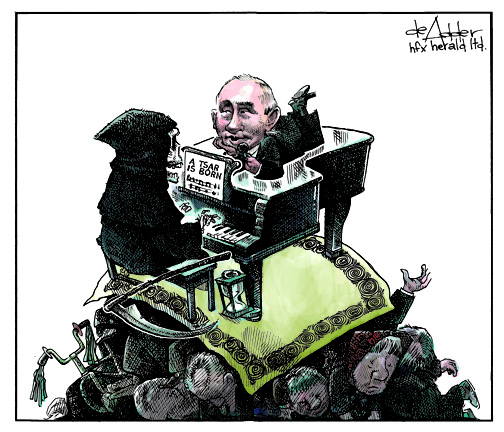
Copyright © 2022 by Michael de Adder
Russia since 1999, been assembling a large army on three sides of Ukraine (as well as on the Black and Baltic Seas) numbering over 150,000 soldiers. In the process, Putin may have quietly swallowed his erstwhile vassal state of Belarus whole, insofar as the end of purported joint exercises there have not seen a departure of Russian forces. In point of fact, a piecemeal invasion of Ukraine by Russia began eight years ago.
In modern times, after a brief period of independence in 1918-20, Ukraine regained its independence in December 1991, when all fifteen of the constituent republics of the Soviet Union (the biggest of which, by far, was Russia) became separate sovereign nations. In exchange for security guarantees from both Russia and the West (guarantees which purported to recognize and safeguard its independence), Ukraine relinquished the sizeable nuclear arsenal situated on its territory to Russia. Avoiding nuclear proliferation by restricting the nuclear weapons of the erstwhile Soviet Union to just one of its fifteen successor states was the wise thing to do; but, Ukraine may be wishing it had taken a different course: on the hard calculus of realpolitik, it is unlikely that Russia would be committing military aggression against a neighbor that had the ability to defend itself with ‘the Bomb.’
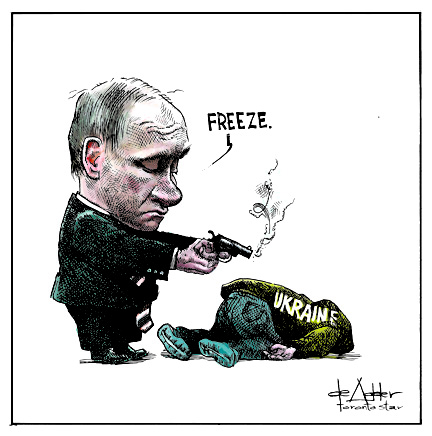
Copyright © 2022 by Michael de Adder
Later, faced with a choice between forging closer ties with Europe or being Russia’s junior partner, most Ukrainians opted for the former, in defiance of the Russia-friendly (and reportedly highly corrupt) government of President Viktor Yanukovych. Mass demonstrations, supported by the West (and named after Maiden Square in Ukraine’s capital Kyiv) began in November 2013 and toppled Yanukovych three months later in February 2014. The following month, the Russian military seized the Crimean penninsula from Ukraine by force; while in April of that year, ethnic-Russian secessionists seized control of portions of Ukraine’s southeastern Donbas region (which is home to much of Ukraine’s ethnic-Russian minority); and, by August 2014, they were openly aided by “paramilitary” forces from Russia (i.e. Russian soldiers who were not wearing their Russian army uniforms) in what amouted to a veiled invasion by Russia. The ensuing, eight-year-long low-intensity armed conflict between Ukraine and Russian-backed rebels has caused the deaths of over 2,500 Ukrainians. In July 2014, using a missile-launcher provided by the Russian army, the rebels shot down the civilian Malaysian Airlines Flight 17, killing all 298 people on board.
On February 21, 2022, Putin, backed by the entire Russian parliament, or Duma, shamelessly embraced the Orwellian and Kafkaesque by formally recognizing the secessionist enclaves (Donetsk and Luhansk) in Ukraine as “independent
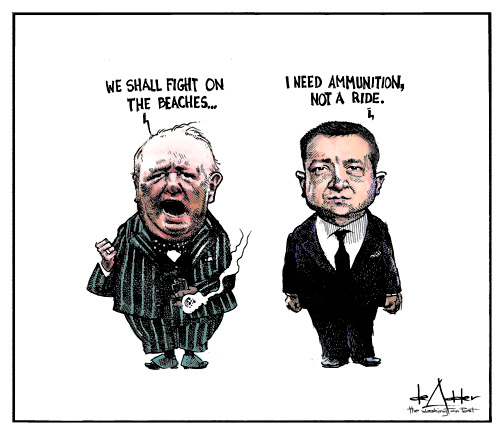
Copyright © 2022 by Michael de Adder
republics,” voicing support for their claim to much greater swathes of Ukrainian territory than they currently occupy, and sending in uniformed Russian army units as so-called “peacekeepers.” Two days later, he discarded that transparent pretence and invaded all of Ukraine. No matter the flimsy disguise, Putin’s actions are naked aggression; he has re-invaded a sovereign state and violated its territorial integrity. And it’s not for the first time, either. Not only did he unlawfully invade Ukraine in 2014, he has perpetrated nearly identical aggression against the former Soviet republics of Georgia and Moldova, likewise using the pretext of protecting the interests of ethnic-Russian minorities living in those countries as his fig leaf.
The Bully-in-Chief in Russia likes to cavort shirtless on horseback or posed next to a tiger. He seems to think that makes him all manly — a real tough-guy. Vladimir Putin doubtless indulges delusions of imperial grandeur, but the Shirtless Czar is nothing but a KGB thug. And his autocratic regime certainly knows how to act the part. Lawlessness, lies, and oppression are his modus operandi. Opponents, rivals, and even truth-sayers (prominent among the latter being journalists) have a distressing way of being jailed or killed in Putin’s Russia. And self-imposed exile in the West is no guarantor of impunity, either. Several Russian exiles in the U.K. have died in highly suspicious circumstances. In 2006, Alexander Litvinenko, a former KGB agent who defected to the West, died a slow, painful death after ingesting tea poisoned with the deadly radioactive isotope polonium-210. A subsequent British inquiry named the two Russian agents who came to Britain to kill Litvinenko, leaving a radioactive trail of evidence from Moscow in their wake. The inquiry ruled that the substance used is one that is only available to state-actors, and that it was inconceivable that the murder took place without the knowledge and consent of Russia’s autocrat himself.
Another victim was Boris Berezovsky, a Russian oligarch and outspoken Kremlin critic who was found inexplicably dead in his home in Britain in 2013. Then, in March 2018, a former Russian spy, Sergei Skripal, residing in Britain, and his daughter Yulia, fell deathly ill with poisoning by the nerve agent Novichok. A policeman who tended to the stricken pair was collateral damage. All three survived, though it was a near-run thing. (In July 2018, two more people fell deathly ill from the same chemical weapon; it is supposed that they inadvertently handled some object discarded by the killers.) Britain’s foreign minister promised Parliament that, “no attempt to take innocent life on U.K. soil will go either unsanctioned or unpunished.” Sending killers to a foreign county to commit murder is an act of state aggression, tantamount to an act of war. Arming them with chemical weapons is a war crime. Some Russian diplomats were expelled (the Russians reacted in kind by expelling some British diplomats); but the penalties imposed came nowhere close to fitting the crime.
We should not feign ignorance about the nature of the autocrat or his regime: Such studied naiveté is unbecoming. Putin presides over an undemocratic tyranny, where there is no free press. Independent voices in the media have been crushed, and independent journalists who criticize the regime are apt to be murdered. One of them, the highly respected war correspondent, Anna Politkovskaya (who covered the savage conflict in Chechnya), was gunned down outside her Moscow apartment building in a contract-style killing in October 2006. Rivals and dissidents are likely to be imprisoned on trumped-up charges: That was the fate of the oligarch Mikhail Khodorkovsky, the oil tycoon who was imprisoned for nearly a decade in a gulag for daring to oppose Putin. Two members of the political protest group Pussy Riot – Nadezhda Tolokonnikova and Maria Alyokhina – were sentenced to two years’ hard labor in March 2012 for doing a satirical song and dance in a Moscow cathedral. Their harmless act of political dissidence earned them a draconian punishment. But, then, imposing savagely harsh punishments on anyone who dares to oppose the regime, let alone assert their inalienable right to freedom, is the tyrant’s favorite way of crushing dissent. Putin’s political rivals, including reformers like Alexei Navalny, Yevgeny Roizman, and journalist Aksana Panova, have all faced trumped-up charges. In Panova’s case, it was for alleged “extortion,” which, in January 2014, earned her a two-year ban from practicing journalism. Boris Nemtsov, a Russian politician opposed to the Putin’s government, was assassinated on a street in central Moscow on February 27, 2015. The killer fired seven or eight shots, four of which hit Nemtsov in the head, heart, liver, and stomach, killing him almost instantly — mere hours after he had urged the public to join a march against Putin’s war in eastern Ukraine.
For his part, the prominent Russian opposition leader Alexei Navalny was poisoned with a Novichok nerve agent in August 2020. He was lucky enough to be taken to Germany for treatment. Very narrowly surviving, an undaunted Navalny returned to Russia on January 17, 2021, where he was promptly arrested and held without bail for failing to report to authorities, as stipulated by an earlier parole, during his time in intensive care. His arrest, and the release of his documentary “Putin’s Palace” about Putin’s corruption, prompted mass protests in Russia. But, scarcely two weeks after his return to Russia, Navalny found himself sentenced to more than two-and-a-half years in a corrective labor camp. Amnesty International has recognized him as a prisoner of conscience.
Most recently, in late December 2021, in the relentless campaign to silence independent voices, Russia’s Supreme Court ordered the country’s oldest human rights organization to disband. The group, “Memorial International,” documents the crimes of Joseph Stalin’s “Great Terror” in 1937-38. That work has nothing to do with modern Russia or with Putin; but, questioning the not-so-good name of Russia’s predecessor state (the Soviet Union) is verboten in Putin’s playbook. A prosecutor told the court that “Memorial” had promoted what he called a false image of the U.S.S.R. as “a terrorist state” and blackened its memory. Without any offering any evidence, he suggested that the West was behind the effort and that the widely respected “Memorial” organization was their “treacherous” pawn.
To maintain his prolonged grip on power, Putin contrived a lawless game of musical chairs, by swapping roles between the presidency and prime ministership to subvert the law and evade constitutional term limits that would (and should) have removed him from power years ago. Further afield, Putin’s direct military intervention in Syria was the only thing that kept the murderous regime of Bashar al-Assad from falling. Putin has singlehandedly turned Russia into an authoritarian autocracy at home and a bad actor abroad.
How then are we to respond to Putin’s noxious actions? And how ought we to respond to his threatened invasion of Ukraine. Respond we must — and strongly! At stake is the rules-based international order that has maintained peace and stability in Europe (and in many other places) since 1945. At stake, too, is the credibility of the West and its leader, the United States of America. If we fail to to show steely resolve over Ukraine, can anyone doubt that Putin will be tempted to recover other lost parts of the Soviet Union and/or extend Russia’s sphere of influence — by cowing neighbors into” neutrality,” strong-arming them into vassal status (like Belarus), or forceably annexing them outright? And if we fail to forcefully counter a Russian invasion of Ukraine, what message will that send to the autocrats in China who are itching to get their hands on the independent nation of Taiwan?
NATO has been united in promising severe economic sanctions if Russia attacks Ukraine. Germany has suspended its approval process for the new “Nord-Stream 2” gas pipeline. But Germany remains heavily dependant on the natural gas already flowing from Russia through existing pipelines. That dependency is an unacceptable vulnerability. We need to guarantee reliable alternate sources of energy to Europe, through an energy supply equivalent of the Berlin Airlift of 1948-49, until Europe can urgently build liquified natural gas (LNG) terminals through which to import gas by tanker ships from other sources and/or until it can accelerate its transition to green energy sources.
The West has sent military aid and loan guarantees to Ukraine. America has sent 3,000 additional troops to Poland, on NATO’s eastern border. But, it is not enough. NATO members should move far more troops to their eastern members (all three Baltic States as well as Poland and Romania) — enough to be a deadly serious deterrent without appearing to be assembling an invasion force of our own. Instead of a mere 3,000 additional troops, why not at least 30,000? It would show that we mean business, and it would counter Putin’s transgressions with the very thing Putin least wants, namely, more NATO forces close to Russia’s borders.
We were right to reject Putin’s demands that Ukraine formally forswear its ambition to join NATO. Such a concession would fly in the face of the NATO Charter and hobble the right of Ukraine to decide its own future. Besides, Putin claims that he cannot accept the possibility of Ukraine joining NATO, when the truth is that he cannot abide having a neighboring Slavic country exist as a successful democracy, lest the mere existence of such an example next door undermine the legitimacy of the autocrat’s grip on power in the eyes of his own countrymen.
We urgently need to inflict severe pain on Putin. One way to do that, a way that the West has thus far inexplicably neglected to use, is to relentlessly go after his money and that of the Russian oligarchs who support him. The oligarchs are said to have billions of dollars invested in the West. Freeze the assets — all of them — connected to all of the oligarchs (and their families), and to Putin, and to all of his enablers, high-ranking members of his regime, and other supporters. That includes bank accounts, stocks and other investments, and real property. We should also issue a blanket ban on travel to the West by all of those people and by their families; revoke existing visitor, educational, or immigration visas; and revoke the Western citizenship (the U.K. is often their destination) of any who may have acquired it. As Alexei Nalvny has said, “In Russia we’re all tired of rolling our eyes, watching the U.S. impose sanctions on some colonels and generals, who don’t even have money abroad. These are just the agents of Putin’s will… It’s really simple: Putin is without a doubt the wealthiest person in the world. The source of his wealth is power and corruption. And the basis of his power is lies, propaganda, and falsified election results. You want to influence Putin? T hen influence his personal wealth. It’s right under your backside. Everybody knows the names of the oligarchs and friends of Putin who hold his money.”
We should ban all trade and investment between Russia and the West, and we should bear the pain that will cause us in lost energy supplies. We should prohibit incoming flights by the Russian airline Aeroflot. We should remove the state-run broadcaster “RT” (“Russia Today”) from Western cable-TV services. We should bar all Russian banks from access to the global payments system, “SWIFT,” which is used by financial institutions worldwide to wire sums of money to each other. Blocking Russian access to SWIFT would cut Russia off from the global economy.
We should stenuously oppose Russia hosting any and all prestige events, like the Olympics and G-20 fora, while Putin remains in power and mount a united Western boycott of any such events that are held there. The West should expel Russia from participation in the interminable multilateral negotiations to resolve the Israeli-Palestinian conflict, the ongoing civil war in Syria, and conflict with Iran over its movement toward the capability of producing nuclear weapons. Russia has been part of the problem in most of those conflicts, supporting noxious regimes while simultaneously purporting to be a peacemaker. The United States should adopt as an urgent priority the development of a next-generation space shuttle (having perversely retired the existing shuttles before such a replacement system existed) to alleviate the current unfortunate dependence of the West on Russian rockets to get its personnel to the International Space Station.
Putin has repeatedly appealed to the favorite excuse of modern aggressors everywhere – the irredentist’s claim to be protecting (or reuniting with) ethnic kin who are suffering under the rule of a neighboring state: That noxious so-called rationale was also used by Hitler to ‘justify’ his initial incursions into other sovereign states. Initially, the West let both Hitler and Putin get away with it. Putin did so in Ukraine (in both Crimea and the Donbas), Georgia, and Moldova. We must not repeat the same mistake, or Putin is likely to resort to the same cynical, insidious justification for aggression — namely, that he is extending fraternal protection to ethnic kin in another country by attacking that country. In 2017, there were one million ethnic-Russians in the Baltic States, having declined from 1.7 million in 1989. As of late 2014, Estonia and Latvia had particularly large ethnic-Russian minorities, numbering about 24% and 27% of their general population, respectively, while Lithuania’s Russian population was just under 6%. But Ukraine has the largest single ethnic-Russian diaspora in the world. In 2001, some 8.3 million people in Ukraine identified as ethnic-Russians (that is 17.3% of Ukraine’s 44.13 million inhabitants). That is not to say that all of that minority yearns to return to the bear-hug of Mother Russia, of course. Still, to forestall Russia from playing the irredentist card ever again, we must ensure that the nations named above articulate and abide by strong, unambiguous guarantees to ethnic-Russians and other minorities within their borders to protect their linguistic and cultural distinctiveness, where appropriate enshrining such minority protections into their constitutions.
We need to go after Putin personally. In international law, waging a war of aggression is a crime. It was used after the Second World War to prosecute Nazi aggressors at Nuremburg. As of July 2018, the International Criminal Court (ICC) formally acquired the jurisdiction to prosecute leaders for the crime of aggression. And it is leaders, rather than states themselves, which are subject to such prosecutions. There is an overwhelming prima facie case against Vladimir Putin. He has already waged wars of aggression, and now he is doing so again on an even bigger scale. The act of aggression means “the use of armed force by a State against the sovereignty, territorial integrity, or political independence of another State, or in any other manner inconsistent with the Charter of the United Nations.” Acts of aggression can include invasion, military occupation, annexation by the use of force, and/or blockade of ports or coasts. As the highly respected Nuremburg prosecutor Ben Ferencz says, “The illegal use of armed force is a crime against humanity.”
The crime of aggression has a unique jurisdictional regime, which cannot be triggered in the same manner as other crimes over which the ICC has jurisdiction (namely, genocide, crimes against humanity, and war crimes). The Court may exercise jurisdiction over the crime of aggression: (1) if an ICC member state refers a situation to the Court; or (2) if the ICC initiates an investigation “proprio motu” (i.e. on its own initiative); or (3) if the U.N. Security Council refers a situation to the Court.
The United States cannot refer a case to the ICC, since it has unwisely opted not to join the ICC. Even if that were otherwise, it has enough questionable military intervention skeletons in its own foreign affairs closet that it might be reluctant to seek to activate an ICC prosecution for foreign interventions. Obviously, the initiative will not come from the Security Council, where Russia and its fellow autocracy, China, have veto power. Canada and other allies could request the indictment and prosecution of Putin at the ICC. The trouble is that, except in the case of U.N. Security Council referrals, non-ICC member states are excluded from the Court’s jurisdiction over the crime of aggression, regardless of whether they are the victim or the aggressor. And Russia is not a member of the ICC. Accordingly, Western nations should assume ‘universal jurisdiction’ over the crime of aggression and declare their readiness to prosecute that crime in their own national courts. Vladimir Putin should be formally indicted for the crime of aggression, and a warrant for his arrest should be issued. The exercise would largely be symbolic, as Putin could evade legal jeopardy by avoiding travel to any place where the West might arrest him; but, it is a symbolic message that needs to be sent.
And, speaking of symbolism, in lieu of their own national flags, all of the Western and allied nations should fly the flag of Ukraine above their embassies and consulates in Russia — until Ukraine is completely free of invaders.
Last, but not least, the West needs to reconsider its decision not to fight for Ukraine. Early in the crisis, President Joe Biden was unambiguous: the U.S. would not send troops to support Ukraine if Ukraine were invaded. Calculating either that Ukraine is not a “vital national interest” for the U.S. and/or that the American public has no appetite for a shooting war after protracted engagements in Afghanistan and Iraq, Biden was explicit that the Americans would not intervene militarily, even in the event of a massive unprovoked invasion of an ally (albeit a non-contractual one) in Europe. Even if he knew that no such intervention would be forthcoming, it was foolhardy to say so. Why not keep Putin guessing? Uncertainty about possible Western responses might have given Putin pause. Instead, we keep reassuring the aggressor that we won’t act physically to stop him, no matter what the does in or to Ukraine.
Just over a day before the invasion, Biden reiterated his edict that, “We have no intention of fighting Russia.” We should reconsider that stance. No one wants war, let alone one that directly involves two Great Powers. But, if we learned anything from the Second World War, it should be that weakness invites aggression. Aggressors need to be faced. As U.S. Senator Chris Coons (Dem./Delaware) said two days before the invasion, “Putin will only stop when we, the West, stop him.” We should send troops into Ukraine — making it clear that they will fight to defend Ukraine but not enter Russia. And, we should declare and enforce a no-fly zone over all of Ukraine, warning the Russians that anything in the air will be shot down. We should call upon Russians to overthrow the tyrant, warmonger, and outlaw in their midst who has reduced his nation to the status of a mini-Hitlerian aggressor. (May Putin meet with the same fate as his apparent role model.)
Some will scoff at the very notion that we should fight to defend another country, decrying it as too dangerous. But, if we are unwilling to physically confront a bully over an informally allied country like Ukraine, who will take seriously our professed willingness to go to war to protect formal allies at the outer periphery of NATO whom we are contractually obliged to protect if they are attacked? When the peace-loving nations of the world let a bully pursue incremental aggression and expansionism, they are only delaying, at their mortal peril, their own reckoning with that malefactor.
We must reject the pessimistic conclusion in the American publication“The Week” on February 22, 2022 that the United States (and with it, the West) has been neutered on the world stage: “With the end of the Cold War, the United States promised everyone everything, extending its protection as far east as tiny Lithuania. Sure, little buddy, if that bully Russia ever pulls itself off the canvas, we’ve got your back… But the U.S. reached out too far, promised too much, and now the bluff is called: The embers of imperial ambition can’t protect poor, friendly Ukraine. Vladimir Putin and Russia have ended the Pax Americana by calling what turned out to be America’s bluff. The proof? Russian tanks are moving deeper into Ukraine.”
The West must make it clear the Putin’s new aggression in Ukraine, along with his 2014 seizure of Crimea, will be as illegal and unacceptable tomorrow — and the day after that, and the year after that — as it is today. We must make it clear that our absolute abhorrence and rejection of Putin’s military aggression will not fade with time or give way to complacency or acquiescence. We must summon the courage and will to confront the aggressor with physical force, if that is all he will respect. It’s time for the West to resist the world’s aggressors and its many human rights abusers. Our collective security depends on us finding the will to act against all those who would use unlawful force to their own advantage. No one, aside from Putin, wants war, but we must not shrink from it in the face of naked aggression. Doing so will only invite more of the same.
John Arkelian is a lawyer, journalist, and specialist in international relations who represented Canada as a diplomat in London and Prague.
Copyright © 2022 by John Arkelian.
Author’s Note: The foregoing was written on February 23-24, 2022, with minor tweaks over the following week. Needless to say, the situation on the ground has been changing rapidly in the meantime.
Visit Michael de Adder at: https://www.deadder.net/ And see our portrait of the artist at: https://artsforum.ca/art-2
Editor’s Note: See our in-depth analysis of the moral, humanitarian, legal, and geopolitical imperatives for the West to act to defend freedom and defeat Putin’s aggression against Ukraine. It considers what our objectives should be and how much force is required to achieve them. It makes the case for not blinking in the face of nuclear blackmail. And it posits sixteen new rules of engagement designed to defeat and expel invading Russian forces from Ukraine. See “The Imperative of Defeating Aggression in Ukraine” at: https://artsforum.ca/ideas/in-depth
*************************************************
Two Things the West Must Do to Lower the Probability that Putin will Pull the Nuclear Trigger — Or, Will ‘MAD’ Work?
© By Thomas Homer-Dixon
This time, “Mutual Assured Destruction” might not work. The Russian leader has already shown extreme irrationality in his calamitous choice to start this war.
Ponder, for a moment, the words of Dmitry Kiselyov, the host of Russia-1 flagship television news program on Sunday, Feb. 27, 2022, the day after Western countries decided to implement sweeping sanctions on Russia’s banks.
“Our submarines are capable of launching over 500 nuclear warheads, which guarantees the destruction of the U.S. and all NATO countries,” Kiselyov said, as file images of Russian strategic missile submarines heading to sea played behind him. “The principle is: Why do we need a world, if Russia is not in it?”
Kiselyov is an infamous Russian propagandist who’s often called “Putin’s mouthpiece.” So his words undoubtedly reflect the sentiments of Russian President Vladimir Putin, a man who sees himself as the symbolic embodiment of the Russian nation. Putin was telling the world, through Kiselyov, that if he goes down, he’ll take the world with him.
Russia’s attack on Ukraine is a frontal assault on democracy, and all who treasure democracy should rally to Ukraine’s defence. But in the West’s response to Russia, our collective righteousness risks outstripping common sense. We can be morally justified in every measure we take to answer Russia’s invasion and yet still be utterly stupid in our actions overall, if they’re not calibrated to avoid devastating consequences.
I began university in the 1970s with the goal of understanding war — why it happens and how it can be prevented — and I’ve dedicated much of my research career since then to this project. My assessment of Putin’s psychological state leads me to believe that the current situation is more dangerous than the Cuban Missile Crisis in October 1962. Nikita Khrushchev, the Soviet Union’s leader at the time, was a model of sanity by the standards of Russia’s current leader.
Analysts around the world are desperately trying to divine what’s going on in Putin’s mind. They’ve largely ascertained, I believe, his motives for the attack: with regards to Ukraine specifically, Putin wants to stop the development of a vigorous, Europe-facing democracy on Russia’s doorstep — especially in a “brotherly” Slavic nation — because it would pose a mortal threat to his rule’s legitimacy; more generally, he wants to seize back Russia’s previous status as a superpower by neutering NATO and re-establishing Russia’s old imperium.
But it’s much harder to assess the man’s deeper mental state. In recent days, I’ve heard experts suggest that Putin has the psychological profile of a megalomaniac; that his exceptionally high fear threshold makes him insensitive to hurting people; and that his hyper-aggressivity may be a function of heavy steroid consumption. These hypotheses, while plausible, are in the end little more than speculations. But we don’t need to speculate about Putin’s public performances. And one image from those performances keeps flashing in my mind: the man sitting at one end of a long table, five or more metres from his defence minister and security advisers. That’s not just odd behaviour; it’s scarily weird. Maybe he’s trying to avoid exposure to COVID, but we can’t escape the implication that Putin believes he’s surrounded by threats — that he has become, in short, deeply paranoid.
Now reality is reaching down that table and grabbing Putin by the throat. Ukraine has radically changed since Russia’s last military engagement with the country, after the 2014 Maidan Revolution. Its army is no longer decrepit, and its population is largely united in fiercely opposing Russian aggression, with hundreds of thousands of citizens arming themselves to defend homes, families, and democracy.
Russian forces are far too small to “demilitarize” and “deNazify” Ukraine — the two war aims Putin announced as the invasion began. Achieving those aims, ludicrous though the second one is, will require occupying the country over an extended period. Yet Russia’s entire military force is probably less than half of what it needs to fully occupy the country, assuming widespread armed resistance. Its forces are also too small to sustain heavy losses in bloody street-by-street combat in Ukraine’s cities. When Putin finds he can’t enter and hold key cities — if his previous war tactics in the Caucuses and Syria are any guide — he’ll level them with artillery, rockets, and bombs.
Putin’s two war aims may be unachievable, but if he persists in pursuing them, he’ll effectively lock himself into escalation. His aims are maximalist, so they don’t provide for any partial solution to the crisis. He must either completely subjugate Ukraine or completely lose face.
So this is the situation the West faces: we have a paranoid man backing himself into a corner and pointing a gun (in the form of 1,458 deployed strategic nuclear warheads) at our chest. Of course, the West’s nuclear-armed countries are pointing a gun at Russia’s chest too. Conventional wisdom holds that Putin will be deterred from pulling his trigger by the prospect of his own country’s destruction. As in the Cold War, we’re once again putting enormous faith in the deterrence effect of “Mutual Assured Destruction” — the “MAD” doctrine we all thought was safely buried in the past.
But there are strong indications that MAD won’t work now. The Russian leader has already shown extreme irrationality in his calamitous choice to start this war. And recall Kiselyov’s chilling words: “Why do we need a world, if Russia won’t be in it?” If Putin does regard himself as the embodiment of Russia, and if he believes the West is already intent on destroying him, then there may be little to stay his hand. Nuclear deterrence could easily fail. As the renowned national security expert and Putin biographer Fiona Hill says: “Putin is increasingly operating emotionally and likely to use all the weapons at his disposal, including nuclear ones.”
To lower the probability that Putin will pull the trigger, the West needs to do two things — and fast. First, we should immediately and publicly declare that we’re not pursuing regime change in Moscow. We should also declare that our sole aim is to get Russian forces to halt their invasion and withdraw from Ukraine, and that, if these things happen, all sanctions will be promptly lifted. Statements like the one made recently by U.S. Sen. Lindsey Graham, in which he encouraged Russians to assassinate Putin, are idiocy. Putin’s propagandists have already widely exploited Graham’s words in Russia’s state-controlled media.
Second, as much as possible, the West must avoid the appearance of moral piling-on. Far too often over the past 10 days, our collective behaviour — not just that of our leaders, but also of the general public, particularly on social media — has resembled a global exercise in the mob shaming or cancelling of Russia. The West must supply as many weapons as possible to Ukraine’s forces as quickly as possible, but we should do it as quietly as possible. When Sweden’s prime minister announced that her previously neutral country would send thousands of anti-tank missiles to Ukraine, she was performing for domestic and international audiences. The performance was both tactically unnecessary (in that it didn’t substantially aid Ukrainian military efforts on the ground) and strategically dangerous (in that it only further reinforced Putin’s paranoia).
These two actions could help ensure that our declared war aims don’t lock us into escalation, too. But they won’t be popular, which means they’ll be hard for Western democracies to implement. Most of us in the West are angry. We’re rooting for the incredibly brave underdog. We want public punishment of Putin and, too often, of Russians more generally, forgetting that Russians everywhere are also victims of this madness.
These emotional reactions are understandable. The current war, after all, is about as close to a battle between good and evil as one ever sees. But if we don’t better calibrate our responses to Russia, our outrage may ultimately contribute to the deaths of hundreds of millions of people. The democracies of the world have shown unexpected unity and resolve. Now they urgently need to be smarter.
Thomas Homer-Dixon is the founding director of the Cascade Institute at Royal Roads University; and he holds a University Research Chair in the Faculty of Environment at the University of Waterloo. His research is focused on threats to global security in the 21st century, including economic instability, climate change, and energy scarcity. His books include “Commanding Hope,” “The Upside of Down,” “The Ingenuity Gap,” and “Environment, Scarcity, and Violence.” He appears regularly in The Globe and Mail. Visit Thomas Homer-Dxon at: https://homerdixon.com and @TadHomerDixon
The foregoing article first appeared in The Ottawa Citizen on March 10, 2022. It is reprinted in Artsforum Magazine with the permission of its author.
Copyright © 2022 by Thomas Homer-Dixon.
*************************************************
The Trouble with China
© By John Arkelian
The trouble with China is that it is an autocratic one-party state with a world-view
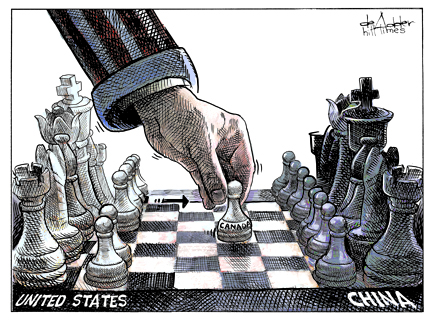
Copyright © 2022 by Michael de Adder
that is inimical to our core values. It is hostile to human rights, democracy, and the rule of law. It freely violates treaties, international law, and the shared precepts of the rules-based international order. It is expansionistic, seeking to impose its will on other countries and to usurp international waters. It is aggressive, openly threatening its nearby neighbor Taiwan and relentlessly expanding its military might with the stated objective of neutering the West. It is ruthless (and shameless) in its use of genocide, the hostage-taking of foreign nationals, heavy-handed police state tactics, cyber-crime, malign interference with other countries’ governance, the corrupting of foreign leaders, intellectual property theft, and obstructing a full investigation into the deadly COVID-19 coronavirus pandemic. It is a stranger to truth, with a regime that lies through its teeth without hesitation. It is gaining in economic and military power, with the stated ambition of achieving predominance in the world, wresting that position away from the Western democracies. It is recklessly engaged on a course which will dangerously destabilize international affairs and inevitably bring it into conflict with any nation or people who oppose it. The trouble with China is that it is a totalitarian dictatorship which is hostile to all we hold dear and intent on imposing its will upon the rest of the world by any and all means at its malevolent disposal.
On September 24, 2021, two Canadians, Michael Kovrig and Michael Spavor, were freed by China after a gruelling 1,020 days of captivity. The pair were taken
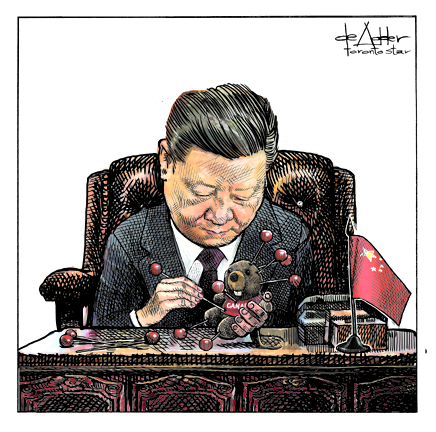
Copyright © 2022 by Michael de Adder
hostage by China in December 2018 in retaliation for the arrest of a Chinese national, Meng Wanzhou, pursuant to an U.S. extradition request. Meng, who is the chief financial officer of the Chinese telecom giant Huawei, had been charged with fraud in the United States. She was released on bail; and, although she was obliged to remain in Vancouver while her extradition was heard by the courts, she was comfortably ensconced in a multi-million dollar home and ably represented by a battery of lawyers. But, independent courts are alien to the Chinese regime’s way of doing things. Instead, they kidnapped two blameless Canadians, whom they proceeded to keep in harsh confinement and deprive of the regular consular access to which they are legally entitled under binding treaties. Lawlessness was heaped upon lawlessness, when the two Canadians were absurdly charged with espionage. In August 2021, Spavor was convicted after a so-called ‘trial’ in which the supposed ‘evidence’ against him was kept secret: he was sentenced to 11 years in prison. For his part, Kovrig was ‘tried,’ in March 2021, but no verdict has been announced. When Weng accepted a ‘deferred prosecution agreement’ with the U.S. Department of Justice, the so-called ‘Princess of Huawei’ was on her way home to a hero’s welcome; and ‘the two Michaels’ were simultaneously put on a flight back to Canada. State kidnapping is the first count in our indictment of China’s regime, but there are many others.
China lays spurious claim to the nearby island of Taiwan, which is a mere 130 to
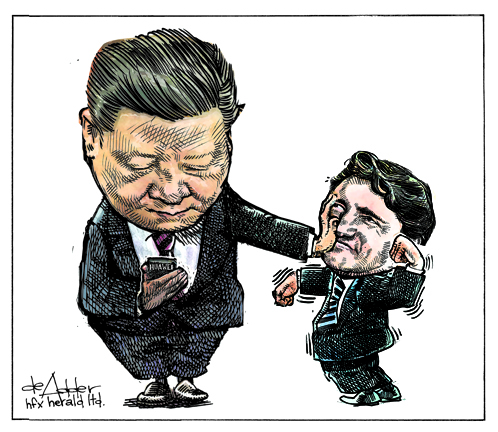
Copyright © 2022 by Michael de Adder
180 km offshore. The island was annexed by China in the 17th century; two hundred years later it was ceded to Japan. In 1949, in the wake of civil war, the losing Republic of China (ROC) side retreated to Taiwan, leaving the mainland in the iron grip of the Chinese Communist Party (CCP). But what started as a government-in-exile gradually morphed into what has been, for many years, a de facto independent country. Hardly any nation dares to officially recognize Taiwan as a sovereign state, for fearing of incensing China; but, that is what Taiwan actually is. And its 23.5 million people have made it into a peaceful, democratic, and extremely prosperous country. (Polls show that fewer than 10% of Taiwanese favor unification with China, and only a paltry 2.7% even identify themselves as ‘Chinese.’) Trouble is: China lays claim to Taiwan and has no qualms about saying they’ll be ‘reunited’ by force, if need be.
The ensuing sporadic war of words has occasionally heated up. In 1958, China bombarded Taiwan’s Kinmen and Matsu islands. In 1996, in an unsuccessful attempt to dissuade Taiwanese voters from electing a president whom China accused of harboring pro-independence sentiments, China carried out missile tests close to Taiwan. Most recently, over the course of several consecutive days in early October 2021, China sent a cumulative total of 150 military aircraft toward Taiwan, entering the island’s “air defense identification zone” (ADIZ), though not its exclusive territorial airspace. It was a provocation, it was a threat, it was a way of testing Taiwan’s defenses, and it was also a way to wear down those defenses by forcing them to repeatedly scramble to meet the incoming threat. The tactic can also erode a nation’s readiness by lulling it into complacency with a series of false alerts, until a real attack unexpectedly happens.
Meanwhile, China is substantially expanding its naval, air, and missile assets in or adjacent to the South China Sea. In part, that’s to bolster its lawless claim to that large expanse of international waters and to the strait that separates Taiwan from the mainland. Free passage by all nations through international straits is guaranteed by international law. The United States and its allies have made a point of exercising that right on an ongoing basis, with transits of naval ships through the Taiwan Strait. For instance, on October 14-15, 2021, a U.S. guided missile destroyer sailed through the strait accompanied by a Canadian frigate. A spokesman for China’s inaptly named People’s Liberation Army (PLA) had this comment, “The United States and Canada colluded to provoke and stir up trouble… seriously jeopardizing [the] peace and stability of the Taiwan Strait.” But, in fact, the real threats to peace and stability are China’s aggressive actions and bellicosity. Indeed, the second self-professed rationale for their military build-up in the area is to make it impossible for the United States to come to Taiwan’s aid in case of attack. That includes developing long-range missiles and new, heavily-armed ‘aircraft carrier killer’ warships that are intended to ratchet up the risk to hugely expensive aircraft carriers to the extent that the U.S. will be unwilling to risk them in theater. The U.S. Navy has eleven aircraft carriers, all of them nuclear-powered, each with a crew compliment of about 3,000 sailors. The newest addition to that fleet cost $13 billion to develop and build — just for the ship itself. The all-important air-wing of 74 aircraft for each carrier costs an additional $6.5 billion, and the cost of escort ships for each carrier group is $10 billion more. The Chinese aim to make the risk of deploying them in the Taiwan Strait, and, ultimately, anywhere in the South China Sea, so high as to be unacceptable, thereby neutralizing the chief military asset that might be employed to protect Taiwan. The Chinese approach to date has been one of “strategic patience,” waiting until the cross-strait military balance tilts further in its favor and using force “only when it can comprehensively overwhelm Taiwan and disincentivize or even deny American military intervention,” as one commentator puts it.
There is plenty to cause grave concern about China on other fronts. They have imprisoned up to a million ethnic Uighurs in Xinjiang (a region in northwest China with predominantly Turkic peoples) in what amount to concentration camps, in what many in the international community regard as genocide. The captive people are used as forced labor; and, there have also been reports of forced sterilization, systematic rape, torture, and forced indoctrinization, as well as the closure of Muslim mosques. Xinjiang has also been a testing ground for Orwellian electronic mass surveillance, including the widespread use of facial recognition software. To the south, China maintains its control over a once-restive, previously self-governing Tibet by indoctrination, usurpation of indigenous cultural and religious traditions, colonization by ethnic Han Chinese, and other measures right of out of the ethnic-cleansing handbook. Meanwhile, in Hong Kong, China swept away the fundamental rights of free speech, a free press, and freedom of assembly, along with the territory’s democratic institutions. Under the transparently fraudulent guise of so-called “national security,” China has (since 2019-20) outlawed dissent and crushed freedom. In the process, it reneged on a legally binding international treaty which guaranteed Hong Kong’s special status and its peoples’ rights. China’s inhumane and lawless oppression in Xinjiang, Tibet, and Hong Kong has irretrievably lost it the consent of the people living there. In the process, it has lost something else, namely, the legitimacy of its control over those places.
China is a very active player in the arms race. Since we in the West were so inexcusably irresponsible as to transfer most of our manufacturing sector there (in our self-destructive quest for cheap labor), China has gained the economic wherewithal to rival the West. For instance, it is (along with the U.S., Russia, North Korea, and others) developing hypersonic missiles, a new form of missile technology that threatens to be extremely destabilizing. Like traditional ballistic missiles, hypersonic missiles travel very fast (more than five times the speed of sound); but, unlike the former, hypersonic missiles fly on a low trajectory (instead of along a high arc into space). The upshot is that they may reach a target more quickly; they are likely to evade anti-missile defences; and, worst of all, their much great maneuverability makes them much harder to track and defend against. They can be armed with either conventional or nuclear weapons, a fact which makes their unpredictable flight path (and, consequently, their likewise unpredictable intended target) more likely to elicit a miscalculation or overreaction by an opposing nation.
On other fronts, China actively monitors its nationals when they are abroad (as students or otherwise) and threatens them and their kin back home over even the most innocuous criticism of the CCP-controlled state. China has an extensive program of influence-peddling, designed to curry favor with foreign business and political leaders, right down to the municipal government level. And, it has a premeditated program of corrupting foreign leaders, a fact which has prompted a bipartisan bill in the U.S. Congress called the “Countering Russian and Other Overseas Kleptocracy Act,” a.k.a. “the CROOK Act.” (That legislation would establish a fund to support anti-corruption efforts abroad, including efforts to counteract China’s deliberate use of corruption to increase its economic and political influence abroad.) State-sponsored corruption is considered to be an integral part of China’s so-called “Belt & Road” foreign development initiative. An advocacy director for the NGO Transparency International points out that, “the presidents of Chad and Uganda, for example, were offered bribes of $2 million and $500,000, respectively, by the chief executive of a Chinese energy conglomerate closely aligned with the Chinese government in exchange for opening the countries’ oil and gas markets to Chinese businesses. Through such wide-ranging corruption schemes that exploit developing nations, China is able to weaponize corruption to advance its national interests.”
The trouble with China is that it is a malign regime which is intent on crushing freedom and extending its sway on the world stage. Under its current totalitarian regime, China is a clear, present, and growing danger to the Free World. Its power may be on the rise; but we are not helpless in its path. When China released the two Canadians it lawlessly held hostage for nearly three years, its spokesman condescendingly pointed out that “Canada has to learn the lesson.” He was right: we do have to learn the lesson — just not the lesson (subservience to China) that he had in mind. Canada and its partners in the West need to take meaningful actions to punish bad behavior by China, to deter it from committing more of the same, and to counter and contain its bid for international (or even regional) dominance. Thus far, Canada’s response has been inexplicably milquetoast. That needs to change.
Canada and its allies should immediately urge its citizens not to travel to China for any reason – on the grounds that Westerners traveling there may be subject to arbitrary, unlawful detention and to the flagrant denial of their human rights. We should indefinitely suspend issuing visitor visas to all Chinese citizens, excepting dissidents who are demonstrably opposed to its one-party regime. And we should revoke existing visitor visas for Chinese citizens (again, excepting dissidents), including Meng Wanzhou. The nations of the Free World should strive to move the February 2022 Winter Olympics away from Beijing. If that fails, we should boycott those games. We should likewise oppose China being the venue for other prestige events, like G-20 meetings. We should impose tough sanctions against high-ranking leaders of the Chinese regime for crimes against humanity against the Uighurs and Tibetans, for violating international law in Hong Kong, and for the criminal offense of kidnapping two innocent Canadians. We should amend our law to allow civil suits against foreign regimes and their leaders for outrages like torture and crimes against humanity. We should outlaw investment by Chinese firms (state-owned or otherwise) in strategically critical sectors of our economy, like resources, telecommunications, agriculture, high technology, and what’s left of our manufacturing sector. Existing investments in such sectors by Chinese firms should be subject to immediate mandatory divestment. Canada should finally bar involvement by Huawei in the much-vaunted 5-G (‘Fifth Generation’) wireless technology infrastructure. We should block China’s bid to be included among the northern nations who discuss Arctic policies.
We should enact laws to criminalize (and sanction) the monitoring and intimidation of foreign-born nationals resident in Canada by their nations of origin. We should restrict ownership of real property in Canada to Canadian citizens (and perhaps permanent residents). Canada should reduce the size of its diplomatic and consular staff in China and require China to do the same. We should not resume past efforts to enter into a free trade arrangement with China until such time, if any, that China manages to throw off its tyrannical system of government. Canadians should demand accountability from our own government for its irresponsible decision in 2020 to partner our respected National Research Council with a body in China that is closely connected with the scientific research arm of the Chinese military, a force which is inherently inimical to our security, in a lamebrained quest to collaborate with a hostile state on a COVID vaccine which could be produced here in Canada. (As it happens, not a drop of the ‘CanSino vaccine’ has ever been delivered for use in Canada: planned deliveries abruptly stalled at the outset of the Meng affair.)
The West should strengthen its mutual defense ties with like-minded nations in the Asia-Pacific region — nations like Japan, South Korea, Australia, and New Zealand — and overtly guarantee our aid to them in the event they are attacked. The new Aukus Pact between the United States and Australia (signed in mid-September 2021), which clumsily offended their mutual ally France, will give Australia access to nuclear-powered submarines and U.S. designed long-range missiles. But, it should be broadened to include other facets of defence and to include more members — with a view to creating an Asia-Pacific sibling for NATO. The United States is already obliged to help provide Taiwan with the means to defend itself under the 1979 “Taiwan Relations Act.” That help mostly takes the form of military technology. But, in early October 2021, it was reported that a small force of U.S. Marines and “special operators” have been secretly training troops in Taiwan on a rotational basis for at least a year. We need to increase our support of Taiwan and make it clear that an attack on Taiwan by China will not be tolerated. The trick is to do that without provoking the very thing we want to forestall. That calls for measured policies, like including Taiwan in more international fora, without explicitly referring to it as a sovereign state in the process.
We are entering ever more dangerous times in world affairs. Conflicts between nations are as old as history itself. But, conflicts between Great Powers tend to increase in likelihood when one is in perceived relative decline and the other is on the rise. It’s a scenario that makes the one feel insecure, the other over-assertive. It magnifies rivalry, and it erodes international stability. We need to navigate a dangerous course between the Scylla and Charybdis of current geopolitics, namely, the need to counter and contain an aggressive, autocratic, and expansionistic China without precipitating a global conflagration in the process.
John Arkelian is an award-winning author, foreign affairs specialist, lawyer, and journalist. He represented Canada abroad as a diplomat.
Copyright © 2021 by John Arkelian.
The foregoing essay also appeared in the Winter 2021 edition of Grapevine Magazine.
Visit Michael de Adder at: https://www.deadder.net/ And see our portrait of the artist at: https://artsforum.ca/art-2
*************************************************
With “Friends” Like These…
© By John Arkelian
The Free World needs to be far more discriminating about whom we call allies, let alone friends. During the Cold War, we supported any number of repugnant regimes throughout the Third World. If they were hostile to communism and pliable to our economic interests, it mattered not one whit if they savagely oppressed and murdered their own people. That shameful legacy continues to run riot today. Principles, values, legal accountability, even mere common decency — they count for nothing against perceived material benefit or short-term geopolitical expediency. Consider the case of Saudi Arabia. Its vile regime is antithetical to all we hold dear. It has contempt for human rights; indeed, disagreeing with that regime can be a capital crime. It is an undemocratic tyranny; it oppresses women; it imprisons or kills non-violent critics; it wages a ruinous war in neighboring Yemen (with our tacit blessing) which has created a major humanitarian crisis. It is beholden and allied to ‘Wahhabism,’ a harsh, hateful, and extremist form of Islam that spawned the 9/11 terrorists (most of whom were Saudis). And, it encourages us in protracted hostility toward its sectarian and geopolitical rival Iran, when, in fact, there is little to qualitatively recommend one of those antagonists over the other. It brazenly murdered a resident of the United States who was a journalist with a leading American newspaper. And, it, and/or some of its agents, may have aided and abetted the murderous 9/11 attack upon the American homeland. And so we ask: With “friends” like these, who needs enemies?
In September 2021, a documentary called “9/11 — Unfinished Business,” hosted by Peter Mansbridge, aired on CBC-TV. It addressed allegations that some members of the Saudi government, and perhaps that government itself, actively aided and abetted the 9/11 terrorists, fifteen out of nineteen of whom were Saudis (not to mention bin Ladin himself). Three Saudi officials at their embassy in Washington appear to have given tangible assistance to the hijackers. The Saudis dismiss any such malfeasance as the acts of “rogue elements.” Y et, the Saudi ambassador himself, Prince Bandar bin Sultan al Saud, is allegedly linked to a suspect disbursal of $75,000. And those familiar with the internal workings of the Saudi regime point to a tightly controlled Mafia-state, where ‘rogue elements’ within the government are an oxymoron. In the immediate aftermath of 9/11, all flights in the United States were grounded — with the curious exception of seven planes carrying 30 to 40 high-ranking Saudis. They got special treatment: not only were they allowed to fly out of the U.S., but they were also excused from questioning by the FBI. It didn’t hurt that Bandar was on close first-name terms with the Bush family, regarded by them as a surrogate member of their family. Meanwhile, a private equity firm, the Carlyle Group, whose list of investors included the likes of George H.W. Bush, Secretary of State James Baker, and the bin Ladin family, abruptly “scrubbed” off the names of its prominent Saudi investors. But, more damning, by far, have been the implacable ongoing efforts by the U.S. government to block access to classified documents that might incriminate the Saudi government on the always handy, all-purpose ground of “national security.” Those documents are being sought by lawyers representing the family members of 9/11 victims in a class action civil ligitation suit against Saudi Arabia. One of those lawyers said that he believes they can prove that “a cabal” of Saudi government officials conspired with al-Qaeda operatives. In the meantime, the families who are party to the lawsuit told President Biden that he was not welcome at this year’s anniversary memorial. In response, Biden has directed the Justice Department to review and release still-secret FBI documents and evidence.
Neither the 9/11 Commission (which made its report in 2004), nor a later Congressional Report (whose final chapter was released in 2016) reported any evidence of Saudi government collusion with the terrorists, though the latter did note that the terrorists must have had help from someone with accommodations, opening bank accounts, and connecting with local mosques. As reported by AP, there was a conclusion that “some hijackers had connections to, and received support from, people who may be connected to the Saudi government. … [And] FBI sources suggested at least two people who assisted the hijackers may have been Saudi intelligence officers. But it didn’t reach a conclusion on complicity.” Senator Bob Graham said in 2015 that Americans would be “outraged” if they knew the truth about the Saudi role in 9/11.
AP also reported that a former FBI agent who worked on that agency’s separate investigation opined “that Saudi Arabian diplomatic and intelligence personnel had knowingly given support to two of the hijackers.” Although the Obama Adminstration bowed to public pressure by releasing 28 pages of the 9/11 Commission Report which had been kept under wraps for years, Obama vetoed a Congressional effort to authorize 9/11 families to sue Saudi Arabia in federal court. For its part, the Trump Administration opposed the release of the name of a Saudi embassy official. To be fair, the latter two instances of obstructionism may have been motivated by reason of national policy on diplomatic relations rather than some sinister effort to shield malefactors in the Saudi regime. But, the lingering suspicion of foreign state complicity (fueled by odd details, like the presence of Saudi officials’ telephone numbers on the mobile phone of a Guantanamo Bay prisoner) in the worst case of mass terrorism in modern history is too important to be sloughed-off on the basis of mere diplomatic niceties. Nor does it engender confidence to learn that the Saudi government spent $27 million in a single year lobbying the U.S. government. If the governments involved have nothing to hide, they should welcome the scrutiny. As Lawrence Wright, the author of “The Looming Tower: Al Qaeda and the Road to 9/11,” says, “We became a county that we shouldn’t be — all because of 9/11.” It was a traumatic, transformative event in American history, propelling the nation into protracted wars and undermining its own respect for human rights and the rule of law — through the warrantless use of mass surveillance, imprisonment without charge, let alone trial, suspension of habeas corpus, torture, rendition, and the assassination of real or perceived enemies abroad. The people deserve to know the complete truth about the events that precipitated that national trauma.
On October 2, 2018, Jamal Khashoggi entered the Saudi consulate in Istanbul, Turkey, by appointment, to collect some documents needed for his intended marriage to a Turkish woman. His fiancée, Hatice Cengiz, waited outside; but Khashoggi never emerged from the premises. He has not been seen since. Khashoggi was a journalist; he was a resident of the United States, where he wrote for The Washington Post. He had quit his native Saudi Arabia and was critical of its authoritarian regime. He was neither a radical, nor a revolutionary; but the tyrants in Riyadh don’t like to be criticized, not even a little bit.
A team of fifteen Saudis, twelve of whom were connected with that state’s security services (one of them reportedly in possession of a bone saw), were dispatched to Istanbul on the very day that Khashoggi had his appointment at the consulate. Despite the regime’s initial protestations of ignorance (followed by an absurd tale of a fistfight gone lethally wrong, and, later, by equally hard to credit suggestions of ‘rogue agents’ who went off-script), it appears that assassins were sent by the Saudi regime to murder Khashoggi in cold blood – and to do so at the inviolable premises of a mission devoted to diplomatic and consular relations between two states.
From the get-go, it was impossible to believe that this outrageous and grisly act of premeditated murder occurred without the foreknowledge and instigation of Mohammed bin Salman, the crown prince of Saudi Arabia, who calls all of the shots there. Indeed, the CIA quickly concluded (in November 2018) that bin Salman ordered the murder. Evidence that we know about includes a telephone conversation that bin Salman’s brother, Khalid bin Salman, who is the Saudi ambassador to the United States, had with Khashoggi. He advised Khashoggi to go to the Saudi Consulate in Istanbul to collect the aforementioned documents and assured him that it was safe for him to do so. Intelligence sources gleaned that the ambassador made that call at his brother’s behest. Clandestine audio survelliance recorded by Turkey inside the consulate makes it clear that Khashoggi was set upon and killed within moments of entering the premises, while the Saudi consul general is heard complaining to the killers about the ensuing mess. According to an intercepted communication, one of the killers, a security official who was close to bin Salman, called one of bin Salman’s top aides to report that the operation had been completed. Earlier intercepted communications indicated that the Saudi royal family had been seeking for some time to lure Khashoggi back to Saudi Arabia. Those early conclusions about who was behind the murder were recently confirmed: In February 2021, a report by the U.S. Director of National Intelligence lays the blame squarely upon bin Salman, noting that, “since 2017, [he] has had absolute control of the kingdom’s security and intelligence organizations.”
But the truth didn’t interest Donald Trump; on the contrary, it was decisively trumped by the value the United States places on its economic, military, and political ties to the Saudi regime. It is a perceived bulwark in our ongoing conflict with Iran — though, truth be told, the Saudis are every bit as unpalatable as their Shiite antagonists. It is a deep-pocketed customer for American military hardware and a leading oil producer (though its value to the U.S. economy in trade and investment was wildly overstated at the time by Trump).
Astoundingly, the then President of the United States callously shrugged off the murder: “America First! The world is a very dangerous place!” First, he fatuously opined that maybe the killing hadn’t occurred at all. (Where is the body? he wondered.) Then, he repeated baseless Saudi claims that Khashoggi was linked to the Muslim Brotherhood and, therefore, by implication, deserved to die. Trump’s assessment was shocking in its open contempt for holding a murderer accountable. Initially, when asked if he believed that bin Salman was responsible for the murder, Trump took a page from his shameful ‘excuse the tyrant’ playbook by vacuously saying about bin Salman that, “He says he didn’t do it.” (It was a deplorable replay of what Trump said, to his grotesque discredit, at the Helsinki Summit in July 2018, when he accepted Putin’s disingenuous denial of Russian interference with U.S. elections over the conclusions of his own intelligence agencies.) Later, Trump opined that: “It could very well be that the crown prince had knowledge of this tragic event — maybe he did and maybe he didn’t!… That being said, we may never know all of the facts surrounding the murder of Mr. Jamal Khashoggi. In any case, our relationship is with the Kingdom of Saudi Arabia.” Trump was shockingly blatant about it: the cold-blooded murder of an American resident was of no consequence when weighed against the value he attached to continued business as usual with a purported ally.
In his book, “Rage,” about the Trump presidency, journalist Bob Woodward describes the then president bragging about protecting bin Salman during a conversation in January 2020. When Woodward points out that Khashoggi’s murder and dismemberment “is one of the most gruesome things… You yourself have said [so],” Trump shrugs it off with a callous retort: “Yeah, but Iran is killing 36 people a day…” He went on to boast, “I saved his ass” — and, it’s true: he did. A bipartisan resolution in Congress declared bin Salman complicit in Khashoggi’s murder. The Senate unanimously voted to approve that measure in December 2018, and all but seven Republicans in the House of Representatives did so, too. A majority of lawmakers voted to end U.S. support for Saudi Arabia’s involvement in the catastrophic war in Yemen. In 2019, bipartisan majorities in the House and Senate passed legislation to block or limit U.S. weapons sales to Saudi Arabia, the United Arab Emirates, and Jordan. The votes came after the Trump Administration used an emergency executive order to approve the sale of $8.1 billion in arms to those three countries without Congressional approval. But the bills to limit arms sales never became law because Trump blocked them with a veto, and legislators were unable to muster the two-thirds vote in both houses of Congress needed to override that veto.
Trump’s indifference to the murder was shameful, and his ice-cold calculus that not even a heinous crime should interfere with our so-called alliance with the Saudi regime was shocking. But, as harsh as his words (and lack of action) were, it is too soon to say if his successor will actually hold the noxious regime accountable. The signs are not promising. Joe Biden said some of the right things during the 2020 presidential election campaign, calling Saudi Arabia a “pariah” and pledging that it would “pay a price” for what it did. But, so far, those words have not been matched with corresponding action. Maybe Trump was simply indecent enough to come right out and say what other political leaders were thinking, namely, that they have no intention of breaking with the Saudi regime, no matter how grave the provocation or despicable the crime. As Khashoggi’s fiancée, Hatice Cengiz, has said about overlooking such crimes: “If you do that, you’re no different than them.”
In late October 2021, CBS’ “60 Minutes” interviewed Saad Aljabri, a former senior Saudi intelligence officer who fled Saudi Arabia in May 2017 and is now living in exile in Canada. Aljabri describes bin Salman as a “psychopath with no empathy” who once boasted that he could kill the kingdom’s then ruler (King Abdullah), and replace him with his own father. That’s one man’s allegation, of course; but it certainly seems consistent with the evidence. (Aljabri further alleges that a Saudi hit-squad was dispached to Canada to murder him, noting that the suspects, a group of six Saudis, were intercepted, and deported, at the Ottawa airport in October 2018.)
There are signs elsewhere of public impatience with our own leaders’ misplaced tolerance for (and, too often, downright coziness with) international bad actors. For instance, the recent purchase of a popular British soocer team by Saudis created a backlash. Newcastle fan associations decried the league, saying that it had “chosen money over morals” in allowing the takeover, arguing that it had “done business with one of the world’s most bloody and repressive regimes … To give the thumbs-up to the deal at a time when the [league] is promoting the women’s game and inclusive initiatives such as rainbow armbands shows the total hypocrisy at play.”
When savagery collides with civilization, the civilized man must react with steely resolve. The noxious regime of Saudi Arabia has shocked the world with acts that can only be called savage. We in the West, with our allegiance to liberty, rule of law, inalienable human rights, and democratic, accountable governance, can only abhor acts of such barbarity. One of them, the murder of Jamal Khashoggi, is the act of savages, an act that is utterly reprehensible and repugnant to any civilized human being. Our response must be severe and implacable — however belated in coming. The United States, Canada, members of the European Union, and other Western democracies should take these decisive steps: We should demand that Saudi Arabia immediately surrender all fifteen suspects for trial in the United States or at the International Criminal Court. We should insist on the FBI investigating the murder. We should resolve to uncover whoever gave the orders that resulted in the murder, even if that person is, as seems all but certain, the country’s de facto leader. We should insist that all those responsible must be held accountable: since the evidence points to bin Salman’s culpability, we must demand that he be surrendered for trial in the West. We should indefinitely suspend all military and security cooperation with Saudi Arabia, including all sales of military equipment, no matter the financial cost to ourselves in doing so. We should immediately suspend all new investment in Saudi Arabia or by that country in the West. We should apply severe pressure (including sanctions) on the regime to immediately remove Mohammed bin Salman from any role in his country’s governance or succession, without waiting for the result of the criminal investigation. We already know enough to deem him unfit for rule. Western countries should immediately reduce their embassies and consulates in Saudi Arabia to a bare minimum, likewise severely reducing Saudi diplomatic and consulate presence in the West. Should the Saudi regime fail to cooperate with any of these measures, the West should formally break off diplomatic relations with that state. We should belatedly pressure the Saudi regime to get out of Yemen, where it is, with our tacit acquiescence, engaging in war crimes and crimes against humanity.
It was reported early in the outrage following Khashoggi’s 2018 murder that the Saudi regime threatened to retaliate if we took measures to penalize them for their act of grotesque savagery by hiking oil prices and throwing the world economy into chaos. It should be made clear to them that any such action will result in severe countermeasures. Finally, if we learn that the Saudi government aided and abetted the mass murderers of 9/11, our only recourse ought to be to depose that barbarous regime by force. There can be no compromise with savagery. Those who choose to behave as savages must be treated as such: Justice, and our own core values, demands no less.
John Arkelian is an award-winning author, foreign affairs specialist, lawyer, and journalist. He represented Canada abroad as a diplomat.
Copyright © 2021 by John Arkelian.
The foregoing essay also appeared in the Winter 2021 edition of Grapevine Magazine.
*************************************************
The Ignominious Debacle in Afghanistan
© By John Arkelian
Abject failure is a hard thing to face; yet that is precisely what has been unfolding before our eyes on a daily basis as the 20th anniversary of 9/11 draws near. The complete and ignominious collapse of our long mission in Afghanistan has manifested itself with a suddenness and a gravity that are nothing less than shocking. The chaos and panic occasioned by our hasty departure is tough to watch, awakening memories of the fall of Saigon on April 30, 1975. Throngs of frightened civilians crowd the airport runway desperate to escape, a few of them clinging to the outside of an aircraft as it accelerates for take-off. A cargo plane meant for 100 passengers is packed with over 600. Mothers with outstretched arms lift or fling their infants over razor-wire to Western troops. People wade through raw sewage, desperate to find a way into the temporary sanctuary offered by this last bit of territory held by Western forces. It didn’t have to be this way.
Our failure in Afghanistan is comprised in equal parts of defeat, disgrace, betrayal, and debacle. Defeat, because we are leaving a deplorable enemy – the cruel, murderous, and fanatical Taliban – in control of the country. Afghanistan is right back to where we found it, twenty years ago, when we liberated it from those same terrorist oppressors. Disgrace, because for several years we have not only been negotiating with said terrorists, we’ve foolishly done so from a position of self-inflicted weakness. Disgrace, because so many lives – Western and Afghan – have been lost for nothing. Disgrace, because yet another American president has embraced a narrowly short-sighted view of America’s “national interest.” Trump may be gone, but his parochial “America First” mantra lives on. Disgrace, too, because our leaders have indulged in sheer mendacity – drawing false and selfish distinctions between international terrorism and its local variant, and dressing-up defeat as a ‘mission accomplished.’ The Taliban are, indisputably, terrorists. They practice terror on a daily basis. It matters not one whit if they confine their crimes to their own country or actively strike out beyond its borders. And, make no mistake, the Taliban aided and abetted the most heinous act of international terror in modern history (the attacks on the United States on September 11, 2001) by harboring their fanatical kin, al-Qaeda.
Betrayal, because we are abandoning the Afghan people, including our many friends there. We are betraying our first principles – our professed commitment to human rights and democracy. We are betraying our own interest by failing to maintain solidarity among NATO allies on such matters as the extent and duration of our disorganized evacuation of civilians. We are betraying all the Afghan women and girls who got educated and became employed (as journalists, doctors, legislators, judges, police officers, performing artists, and more) when we offered them false hope of a lasting liberation from misogynistic oppression. Betrayal, too, of the Afghan government, which is our ally, by forging a cynical side deal with our mutual enemy, the Taliban.
Debacle, because the United States and its NATO allies are making a shabby, ignominious exit, with our tails between our legs, when we could have left a sufficient residual force in place indefinitely to forestall the Taliban from taking over the country. After all, there were only 2,500 American soldiers there (down from a peak of 100,000 during the Obama years) – out of 1.3 million active duty U.S. forces (not including reserves). There is ample precedent elsewhere. American and Canadian forces have remained on watch in Europe since 1945; and U.S. forces have remained on guard in South Korea for nearly as long. It is a travesty of another kind that we continue to tolerate disloyal acts by purported “allies” like Pakistan – the very nation which aids the Taliban and gave secret sanctuary to Osama bin Ladin. And we soft-peddle hostile acts by rivals like Russia, which reportedly offered a bounty on dead NATO soldiers (though, truth be told, it would come as no surprise to learn that the U.S. did the same thing during the Russian occupation of Afghanistan in 1979-89).
The West’s intervention in Afghanistan, led by the United States, has lasted 20 years. Four American presidents have presided over that conflict. Each of them has made grievous mistakes. After the 9/11 attacks on the U.S., it was soon determined that those acts of mass terror were carried out by al-Qaeda, from its base in Afghanistan. While we find little to commend about George W. Bush, he got two things right. The first was his conclusion that by hosting and harboring al-Qaeda, the Taliban has aided and abetted mass murder. The second was his response: he issued an ultimatum to the Taliban on September 21, 2001 – close the terrorist camps and surrender al-Qaeda, or share their fate. The Taliban elected to stand by their friends and fellow terrorists. So, the West acted to destroy them both. That was the original narrow remit of our mission in Afghanistan. B ut it morphed into something more ambitious, namely, rebuilding Afghanistan as a free, democratic country and liberating its oppressed people, chief among them, its women and girls. Were those bigger objectives a mere excuse by our leaders to extend our stay? Who knows? One thing is certain: our soldiers, our NGOs, and our ordinary citizens took those noble goals seriously. And it’s not as if the United States hasn’t led successful nation-building efforts before – witness the transformation of postwar Germany and Japan into peaceful, prosperous democracies.
The Bush Administration went badly astray – taking its eye off the ball in Afghanistan when it needlessly ignited a much bigger war in Iraq. Later presidents have made inexcusable missteps of their own. On December 1, 2009, when he announced a ‘surge’ of an additional 30,000 U.S. troops in Afghanistan, Barack Obama also announced a timetable for drawing down American forces there, showing his proverbial cards to the enemy in the process. But worse was yet to come.
Eager to indulge his isolationist base, Donald Trump was keen to quit Afghanistan. His administration opened direct negotiations with the Taliban, without involving the Afghan government we ostensibly support! There were nine rounds of talks over 18 months. At one point, Trump proposed hosting the Taliban representatives at Camp David – an unseemly invitation for bloodstained terrorists – until the death of another U.S. soldier at their hands scuttled that plan. The so-called ‘peace agreement’ announced on February 19, 2020, a lopsided deal if ever there was one, amounted to an abject capitulation to the enemy. The U.S. committed itself (and its NATO allies) to a firm timetable for withdrawing their troops. The Taliban agreed not to host international terrorists anymore, which is to say terrorists who would directly target the U.S. and its allies. It was a cynical move, which said, in effect: ‘As long as you don’t target us, we don’t care what you do in Afghanistan. We’ll look the other way when you commit acts of terror there. Just don’t aim it at us.’ Worse still, we had to take the Taliban at their worthless word, for the agreement had no enforcement mechanism. The Taliban has already aided and abetted mass murder directed at the West. They are terrorists. Those facts render them unfit (not to mention untrustworthy) as parties to a peace agreement. But the so-called peace agreement was, as noted, really just a U.S. capitulation. Its terms also included empty exhortations that the Taliban engage in peace talks with the Afghan government (a mere sham, as they instead accelerated their hostile takeover of the whole country) and “consider” a ceasefire (though none ever materialized). We released 5,000 captive Taliban (who promptly rejoined the fight), while they released 1,000 of their prisoners.
When Joe Biden came to office in January 2021, he chose to carry on with his predecessor’s scheduled withdrawal, though the original May 1st final departure date was extended by four months. s August 31st approached, the Afghan government and army melted away or simply fled, though the vice-president and some special forces have vowed to resist from a mountainous redoubt. The Taliban didn’t bother waiting for the last American to leave; they took over the country, including its capital Kabul, in a week-and-a-half, leaving Western forces holding only the airport. The daily spectacle of desperation there is made worse by the mendacity and appalling short-sightedness of our leaders.
Biden contends that we did what we set out to do – we chased al-Qaeda out of Afghanistan. That was the chief original objective (though it was paired with a now failed pledge to depose the Taliban); but it quickly evolved into something much more. We gave the Afghan people hope, and now we have abandoned them. Furthermore, al-Qaeda still has a presence in Afghanistan, as do other noxious groups, like ISIS, and, lest we forget, the whole country is now back under the iron grip of terrorists. Biden says chaos was inevitable – whether we left now, ten years ago, or ten years from now. If that is so, then we should have stayed indefinitely – with the bare minimum of firepower needed to forestall the present calamity. Biden says we can’t fight other peoples’ wars. The trouble is: we inserted ourselves into Afghan affairs. We freely took upon ourselves responsibility for their fate. Abandoning them now is shameful. Biden says that it is not in America’s “national interest” to stay in Afghanistan any longer. He seems to be an unofficial member of the “America First” club. It’s a recklessly short-sighted place to make a stand. America’s interest, the Free World’s interest, is to promote (by word and deed) the spread of democracy, to safeguard human rights everywhere in the world, to avoid looking weak in the eyes of actual and potential aggressors, to be implacable in our opposition to terrorists and to never forget the atrocities they have committed, to pursue international stability (which is inconsistent with one-sided deal-making with brutes like the Taliban), to never leave our own people or our supporters among the local population behind, and to be steadfast in our commitments to our allies. The United States and the rest of the Free World have failed, ignominiously, on all of those counts in Afghanistan.
John Arkelian is a lawyer, an international relations specialist, and a former diplomat.
Copyright © 2021 by John Arkelian.
The foregoing essay also appeared in the Fall 2021 edition of Grapevine Magazine.
*************************************************
Apocalypse in Slow Motion:
A Brief History of An Intractable Conflict
© By John Arkelian
It is deeply imbued in the human psyche to regard those we perceive as “the other” in negative terms: it gives us licence to treat them with indifference, suspicion, and active hostility. Our capacity (some would say, our need) for subdividing ourselves into “us” and “them” is relentless. It hardly matters what identifying marker or trait ‘justifies’ the distinction – race, religion, nationality, language, and culture are the usual suspects, but, in fact, any excuse will do. Indeed, if none of the usual grounds for discriminating avail, we are as apt to latch onto eye color or simply living on the ‘wrong side of the street’ as a basis for erecting the impassable border between “us” and “them.” Once we have identified the “the other,” it is all too easy for us to neglect them, marginalize them, dispossess them, ascribe sinister intent to them, fear them, hate them, oppress them, enslave them, or kill them. Maybe our innate ability to dehumanize (and/or demonize) select members of our own species is a relic of early Man’s tribal roots. But, truth-be-told, it’s all too common for us to embrace the urge to identify some of us as “other” rather than to resist that urge. As deplorable as it is to face, there is something deeply inhumane in our psyche which gives us permission to relish hostility toward others once the bolted door to our darkest impulses is flung open. The Holocaust and the genocide against Rwandan Tutsis are revolting milestones in the human capacity to enthusiastically embrace the opportunity to hate and harm the conveniently designated other. The intractable conflict in the Middle East, which pits Jews against Arabs, is a microcosm of the “us” versus “them” dynamic.
The connection of the Jewish people to the region we now call Palestine dates back 4,000 years. It is reckoned that Abraham journeyed there from the city-state of Ur in Mesopotamia on a divinely appointed mission to find a new home for his descendants. But, the Hebrews, as they became known, were repeatedly separated from their Promised Land over the ensuing centuries. Drought and famine prompted their migration to Egypt’s Nile Delta, where they abided for 400 years. But their domicile there devolved into forced servitude, which led to their exodus (under Moses) out of Egypt around 1200 B.C. After a 40-year sojourn in the Sinai, the twelve Hebrew tribes re-entered Palestine and found themselves at war with the various Canaanite peoples already living there – a scenario that would replay 3,100 years later. Following 200 years of conflict, the Hebrews prevailed, under King David, around 1010 B.C. After the death of his successor, Solomon, in 931 B.C., civil war erupted and the Hebrews were divided into two kingdoms – Israel in the north, Judah in the south. he more prosperous of the two, Israel, was taken by the Assyrian Empire (ca. 722 B.C.), and its people (the proverbial ‘ten lost tribes’) were scattered. Judah’s turn came later, when another imperial power, the Babylonians under Nebuchadnessar, conquered the kingdom and conducted four mass deportations of the Jews (605-582 B.C.). In 586 B.C., Jerusalem was sacked and the Temple of Solomon was destroyed. But empires rise and fall, and when the Persians came to ascendancy, they liberated the Jews from their captivity in the 500’s B.C., and Judah was reborn as a semi-autonomous nation. However, Jews were expelled again, half a millennium later, after an unsuccessful revolt against their new Roman overlords in 70 A.D.
During their long absence from Palestine, the Jews endured discrimination and worse in their adopted homes throughout Europe and beyond. During the 19th century, the Jewish population of Palestine numbered only 25,000. Those numbers increased to 60,000 by the start of the 20th century – starting with the first ‘aliyah’ (or large migration) prompted by the murderous pogroms against the Jews in Russia that began in 1881. Immigration was also given impetus by the birth in 1862 of the Zionist movement, which advocated for the creation of a Jewish state.
During the First World War, Great Britain secured the allegiance of Arabs in the Middle East by dangling the prospect of independence from their Ottoman Turk overlords. Instead, in the wake of the war, Britain and France assumed colonial suzerainty over the region. For its part, Palestine was made subject to a British Mandate by the League of Nations, thwarting Arab aspirations for nationhood there and throughout the Middle East.
In November 1917, the British Foreign Affairs Minister (and former Prime Minister) Arthur Balfour wrote a letter to a prominent British Jew for onward transmittal to the Zionist Federation. That letter, which became known as the Balfour Declaration, stated that the British government “views with favour the establishment in Palestine of a national home for the Jewish people… it being clearly understood that nothing shall be done which may prejudice the civil and religious rights of existing non-Jewish communities in Palestine.” There’s the rub, of course: two peoples, two competing aspirations for nationhood, and two clashing perspectives as to their respective self-interest. The declaration chose its words with care: it proposed “a” national homeland, careful to avoid characterizing it as ‘the one and only homeland,’ let alone a Jewish state. And it stressed that nothing must prejudice the rights of the non-Jews already in place. Alas, more than a century later, it is clear that advancing the national and cultural interests of one side has undeniably come at the expense of the other side. In 1917, Zionists chose a much more expansive interpretation of the Balfour Declaration than was intended by its guarded and restrained language.
In June 1922, the Colonial Secretary, Winston Churchill, ‘clarified’ the Balfour Declaration by explicitly reducing its scope and meaning. The goal, he said, was not to create a wholly Jewish Palestine, but only a Jewish national home. He said that Palestine should remain Palestinian, but the rights of the 80,000 Jews then living there should be protected. He added that additional Jewish immigration was acceptable, as long as it did not “exceed whatever may be the economic capacity of the country to absorb new arrivals.” As it happened, the industriousness of Jewish settlers in Palestine created new economic capacity, enough to absorb a host of new arrivals. The trouble is that the ever-growing numbers of new arrivals inexorably changed the social, sectarian, demographic, and political facts on the ground, threatening to displace the indigenous Arabs. That scenario has repeated itself since 1967 through Israel’s stubborn persistence in building Jewish settlements on the territories which it seized and occupied in the course of defending itself from attack by neighboring states.
The pressures born of persecution and discrimination in Europe intensified before the Second World War, which saw an advanced state openly embrace hatred, racism, and mass murder as state policy. As a consequence, 170,000 Jews emigrated to Palestine in 1933-37, increasing their overall numbers there to 500,000 (compared to over a million Arabs). In 1935, Arab representatives formally petitioned the British government to halt Jewish immigration. Jews, of course, were fleeing persecution, which was becoming a matter of life or death. But, from the Arab point of view, it seemed like a colonization by Europeans which threatened to dispossess them physically and culturally. In July 1937, Great Britain’s Peel Commission Report concluded that competing interests in Palestine could not be reconciled and it recommended partition, with about 20% of the land to form a Jewish state. Jerusalem and other small areas would continue under the British Mandate; the rest would be combined with Jordan under Arab control. A majority of Zionists accepted this proposal, but the Arabs did not. In November 1938, the British reversed themselves, rejecting the Peel Report’s recommendations and opting instead for a continuing Mandate. In May 1939, a new White Paper put an end to the expansive interpretation of the Balfour Declaration by stating that “it could not have been intended that Palestine be converted into a Jewish State against the wishes of the Arab people of that land.” Eager to dissuade the Arabs from siding with Nazi Germany, the British acceded to most of their demands, stipulating that Jewish immigration would be restricted to 15,000 newcomers per year for five more years and then halt entirely. Both the Jews, and more surprisingly, the Arabs, rejected the new White Paper.
Jews in Israel formed paramilitary defence groups – Haganah, its break-away Irgun, and Lehi (a.k.a. ‘the Stern Gang’). The last of that trio was extremist enough to consider an alliance of convenience with Nazi Germany against Britain! Lamentably, there are always those who justify terrorism in the name of this or that cause. Lehi was unabashed in its violent fanaticism – assassinating a British Minister of State (1944), bombing the British embassy in Rome (1946), bombing a British police station in Haifa (1947), attempting (failed) bombings in the U.K. itself, and, with Haganah, in the 1948 war, attacking the Arab village of Deir Yassin, where between 100 and 254 people were killed.
After the British relinquished their responsibility for Palestine in November 1947, a United Nations resolution (#181) partitioned Palestine, assigning 5,500 square miles for a Jewish state and 4,500 square milers for an Arab state. On May 14, 1948, David Ben-Gurion declared Israel’s independence. Fifteen minutes later, it was recognized by the United States (with Harry Truman overruling the objections of his Secretary of State, George Marshall).
The decades that followed have witnessed a succession of wars between Israel, neighboring states, and hostile paramilitary groups – as well as repression by one side and terrorism by the other. In 1948-49, Arab League states invaded Israel. Both sides committed atrocities against civilians. Israel prevailed, taking half of the land originally earmarked for Arabs in the process. The 1956, the Suez Crisis saw Israel working with Britain and France against an assertive Egypt. In May 1964, the Palestine Liberation Organization (PLO) was founded: it rejected the existence of Israel and advocated a ‘right of return’ by displaced Arabs in response to the right of return for all Jews everywhere which is entrenched in Israel’s constitution. In the Six Day War of 1967, Israel won a decisive and admirable victory over invading forces from Egypt, Syria, and Jordan. In the process, it occupied the entire Sinai Peninsula, the Gaza Strip, the West Bank, and the Golan Heights. In victory, though, lay the seeds of future discord, rancor, repression, and intractable conflict. Israel became an occupying power justifiably, in the process of defending itself. But it has elected to continue to occupy all of those territories (except the Sinai and, technically, at least, Gaza) for 54 years. Controlling territories without the consent of the people living there has been as detrimental to Israel itself as to the population under its imposed control. It has robbed Israel of the moral high ground; it has, depending upon your point of view, turned a David into a Goliath; and, it has stoked resentments, creating a handy excuse for acts of violence in response.
Soon, terrorism and hijackings were on the rise in the region. A PLO offshoot attacked a school bus with bazookas in May 1970, leaving 12 dead (including young children) and 25 wounded (most of them permanently). In September 1972, terrorist murdered 11 Israelis (and one German) at the Munich Olympics. In 1970-71, conflict between Jordanians and displaced Palestinians erupted into the violent civil war known as Black September. In 1974, terrorists attacked an elementary school in Ma’alot, killing 22 children and two adults; in March 1978, terrorists killed 38 civilians on Israel’s Coastal Highway.
Other wars followed. In 1973’s Yom Kippur War, an over-confident Israel was attacked by Egypt and Syria. After serious reverses, Israel rallied and turned the tide. That war had a useful after-effect, at least. It prompted the Camp David Accords in 1978, which saw a peace treaty between Israel and Egypt (a peace which still endures), and a broad framework for a more general (and yet to be achieved) peace. The restive people of the Occupied Territories have launched protracted uprisings – the First and Second Intifada – in 1987-93 and 2000-2005, respectively. The first one ended with the Oslo Accord of 1993, which reiterated a U.N. Security Council resolution which recognized the right of the Palestinian people to self-determination. It also created the Palestine Authority (with one-time terrorist Yasser Arafat as its first president), which had limited self-governance over a portion of the Occupied Territories. But full-fledged self-determination, let alone statehood, has continued to elude the Palestinian Arabs.
In more recent years, there have been recurring armed conflicts in Lebanon – first between Israel and displaced Palestinians living there and later with the Iran-backed Hezbollah paramilitary group. There have likewise been recurring conflicts with the militant group Hamas (most recently in May 2021) in the Gaza Strip. That 139 square mile bit of arid coastline has been under Hamas control since 2006, but it remains tightly embargoed by Israel.
But, what of the future? What are the possible ways forward? One path, the path the parties to the conflict (and their enablers abroad) have been on for decades leads to more of the same – intermittent, limited, but deadly conflicts between one foe or another and always with the risk of a wider conflict. In recent years, the fear has been direct conflict between Israel and Iran, in which a regional war could spark an ever-wider conflagration. Israel has proven its prowess on the battlefield. But is it wise to rely exclusively on force of arms for self-defence? Military capability is essential for security, obviously. But what if the day comes when Israel loses its one-sided military pre-eminence? It needs allies, and it needs the force of law to fully buttress its self-defence. Most of all, it needs to take practical steps to reduce the sense of grievance among Palestinian Arabs in order to defuse that perpetual incubator for conflict.
The West, led by the United States, should reiterate its unshakeable commitment to always defending Israel from external attack. But we can be Israel’s steadfast friend and defender without giving it free writ to pursue unjust policies itself. Perpetually occupying another people’s home against their will is as bad for Israel as it is for the occupied Arabs. On the one side, it fuels repressive policies, which undermine democratic norms and respect for human rights; on the other, it feeds an abiding sense of grievance and impels some to resort to violence. For years, the government of Israel has shown no real interest in pursuing a ‘two-state solution,’ which would see two sovereign states – Israel and an Arab Palestine – coexisting side-by-side. Israel’s friends need to vigorously encourage it to identify and implement the incremental steps needed to arrive at that goal. A legacy of mutual hostility means that such steps will, necessarily, be gradual and tentative at first. But forward momentum, however modest, is long overdue.
We can start by applying meaningful pressure on Israel to belatedly halt its unlawful colonization of the Occupied Territories. That means no more new settlements and no expansion of existing ones. If Israel balks, as it has done for decades under governments of different stripes, we need to impose sanctions and withhold enough aid to penalize unhelpful behavior. Likewise, no more Arab properties in Jerusalem should be seized by Israel. Fair accommodation needs to be made to share water resources. A loosening of the suffocating embargo of Gaza – to the extent that it does not endanger Israel – should allow the free passage of people, trade, and civilian supplies. A generous move would be to declare the entire city of Jerusalem (Arab east and Jewish west) to be the common capital of both Israel and an incipient Arab state – with a joint city administration. It may be ‘like water on the Moon’ at present, but a noble long-term goal would be an eventual common market between two interconnected sovereign states. And why not ask a respected NGO to assess the educational curricula on both sides with a view to breaking down entrenched preconceptions and increasing inter-sectarian understanding? Reconciling opposing points of view is an essential element of confidence-building and peacemaking.
From early in the 20th century, there has been a recognition that when one side ‘changes the facts on the ground,’ it can only result in fueling rancor with the other side. When the Hebrews returned to Palestine in the 12th century B.C., they found the land already occupied (by Canaanites and others); history repeated itself in the first years of the 20th century A.D. When “us” and “them” occupy the same territory, the choice is intractable conflict or peaceful coexistence. Too often, between Israel and Arab Palestinians, we’ve settled for conflict. We can do better.
John Arkelian is a lawyer, an international relations specialist, and a former diplomat.
Copyright © 2021 by John Arkelian.
The foregoing essay also appeared in the Fall 2021 edition of Grapevine Magazine.
*************************************************
“The Case for a New, Improved Pax Americana”
© By John Arkelian
During its first 200 years, the Roman Empire presided over a period of
“Rayburn Gargoyle” © 2022 by Terry Rowe
unprecedented (for its time) stability and prosperity throughout the Mediterranean world – a period known as the ‘Pax Romana’ (or ‘Roman Peace’). While that order was largely established by force of arms, what gave it durability, purpose, and value was the force of civilization that it embodied. In the wake of the Second World War, a modern-day equivalent arose in the form of a Pax Americana. America’s leadership of the Free World, and its standing as a global superpower, brought with it many good things, like an international rules-based order, the rebuilding of post-war Europe and Japan, increased prosperity and well-being for many, a network of alliances that kept aggressive powers contained, and remarkable advances in science and technology. True, that period of American ascendancy was marred by its support for noxious proxies in the Third World; by a failure to adhere consistently to its own core values; by ill-considered violence in Vietnam and elsewhere; and by a failure to adequately resolve internal problems like racial injustice. Notwithstanding those failings (however egregious), the world was better for American leadership. It can be again.
We need a new, improved Pax Americana. By that, we really mean a collegial effort, a ‘Western Peace,’ a new world order promulgated and advanced by the civilization embodied in the values, laws, and culture of what we call the Free
“Flags Over Arlington” © 2022 by Terry Rowe
World, or ‘the West.’ But every alliance needs a leader, and America is the indispensable nation for that role. Besides, Pax Americana flows more trippingly off the tongue than Pax Occidentalis.
A durable new world order needs to fueled by a grand purpose and a righteous cause, which is to spread the blessings of freedom, prosperity, rule of law, fundamental human rights, security, and equality to all mankind. Those essential prerequisites to a good life are our common inheritance, despite the fact that most of humanity is bereft of them. We must swear eternal hostility to all forms of tyranny, oppression, and injustice; and we must give tangible expression to our core values and aspirations in our domestic and foreign policy. A reinvigorated West, tirelessly pursuing a new, improved Pax Americana, should express its purpose through seven chief initiatives.
(I) Revitalized Diplomacy
Diplomacy has been somewhat neglected in recent years; but the role of professional diplomats – in building state-to-state relationships, unraveling the nuances of other points of view, building international cooperation, and fostering mutual understanding – is an invaluable asset. We need to reinvigorate successful alliances, like NATO, and build new ones to counter new threats like China. We need to reform and thereby strengthen existing multilateral institutions like the United Nations, including the composition of its Security Council, which gives a stultifying veto power to ‘great power’ nations. And we need to incrementally entrust reformed multilateral institutions with more responsibility to act on issues that know no borders. Should our efforts be irrevocably blocked by hostile states like Russia and China, we should create new multilateral organizations with likeminded allies to supplement the existing ones and do some of the things their counterparts will not do – such as imposing strong sanctions against state malefactors. The United States should finally join the International Criminal Court, with limited caveats to protect its unique interests, if need be.
(II) A Peace Corps Writ Large
Millions of our fellow human beings are without secure access to shelter, clean water, adequate food, education, employment, medical care, physical security, and recreation. Millions, too, are denied their fundamental rights to gather peacefully, to dissent, to have a free and fair trial, to choose who will govern them, to hear a free press, to practice their own cultural, religious, or linguistic rights. People flee from places where resources or opportunities are scarce, where lawlessness and/or state oppression is endemic, and where famine or internecine conflict rages. Refugees risk everything to come to the West. Instead, the West should come to them – in a sustained, world-changing way to transform nations that so desperately need transformation. Effective, sustained, hands-on development aid and education, on an unprecedented scale, needs to be a key component of our activity abroad. What better way to implement it than through a Peace Corps on steroids, one that sends volunteers from the West (perhaps as one form of a new mandatory national service obligation to be introduced in places like Canada and the United States) to the Third World to build housing, introduce water purification, teach the poor, treat the ill, and create sustainable micro-economies whose produce we would give guaranteed access to in our markets. We should actively support local NGOs that feed the poor, teach the unschooled, advocate for the dispossessed, strive for human rights, and pursue reform.
(III) The Imperative of Human Rights
We should condemn oppressive regimes, deprive their governments of state-to-state support, sanction (and prosecute) their leaders, and actively support dissenters (like reformers in Belarus, Myanmar, Saudi Arabia, and Hong Kong) who are intent on genuine reform. And, in extremis, we should intervene militarily to topple murderous regimes (like Syria’s) as part of our ‘responsibility to protect’ fellow human beings. Upholding human rights must be our North Star, our most essential core value, the sine qua non around which all of our policies and practice revolve. That necessitates doing more, much more, than merely voicing pious platitudes. It means holding malefactors to account by weaponizing our criminal law. To that end, Western nations should adopt the principle of ‘universal jurisdiction’ by actively prosecuting heinous offences like war crimes, torture, genocide, ethnic cleansing, the use of prohibited weapons, and crimes against humanity – no matter where they occur in the world. And, in egregious cases, we should withdraw the protection of sovereign immunity from the worst offenders among foreign leaders and declare our intent to arrest and prosecute them should they venture into areas under our control.
(IV) Strengthening Democratic Institutions and the Rule of Law
Supporting, strengthening, and spreading democratic institutions and the rule of law should share primacy with human rights in all of our international objectives and activities. Nothing is more fundamental to whom we are as a society; nothing is more essential to our free society’s continued existence and vitality. Ultimately, any regime which lacks certain core attributes is not wholly legitimate. That means fair and free elections; fair and free trials; independent courts; a free press; security of the person from arbitrary arrest and detention; no searches of persons or property without demonstrably ‘reasonable and probable grounds;’ protection from cruel and unusual punishment (which ought to include capital punishment); and separation of church and state – among other things. Actively promoting those core values, and punishing their infringement, should be the tip of the spear in all of our dealings abroad, no matter the cost to us in foregone trade deals or non-participation in prestige events held in transgressor states. (That, along with China’s lawless use of kidnapping as state practice, ought to rule out participation by Western nations at the upcoming 2022 Olympic Games in Beijing, for example.)
(V) Building Security from Weapons of Mass Destruction and Technological Threats
The threats we face from weapons of mass destruction are intolerable ones which endanger our continued existence as a species. New and proposed technological threats are nearly as worrisome. Those dangers undermine the security of each and every human being, no matter where we happen to live. We need to rid ourselves of complacency and take meaningful steps to ameliorate those threats. We need to redouble our efforts to eradicate chemical and biological weapons. Russia, for one, uses the former variety of supposedly unlawful weapon as its weapon of choice in murder attempts on high profile dissenters like Alexei Navalny. We must move heaven and earth to prevent the proliferation of nuclear weapons to even more states. We should maintain severe sanctions on the dangerous regime in North Korea and extend said sanctions to its chief facilitator, China. We should apply unremitting pressure on India and Pakistan, inamicable neighbors which have too often been at daggers drawn, to divest themselves of nuclear weapons, in exchange for multilateral security guarantees. And, the West needs to reduce its own stockpile of nuclear weapons through treaties with its chief foes – with a view, one hopes, to eventually eliminating such weapons altogether. In recent years, too many such arms limitations treaties have been allowed to lapse.
We need to lead a concerted effort to prevent the militarization of space, the Earth’s moon, other planets, and other celestial objects, like asteroids. We need to lead an effort to outlaw the development, let alone deployment, of autonomous weapons systems, facial recognition systems, and electro-magnetic pulse (EMP) weapons. The latter, for example, could put entire national communications and power transmission grids out of commission for months (or longer) to catastrophic effect. We should build upon existing efforts to restrict the use of landmines. And, as a matter of urgent national security, we should disconnect our critical infrastructure from the internet. The race to connect anything and everything online represents an unacceptable vulnerability.
(VI) Military Security (Peace through Strength)
Weakness invites aggression. The only way a state, or group of states, can be secure is through strength. Our social values, democratic institutions, and economy need to be strong, but so does our military. Tried and true Cold War stratagems – of collective security, of deterrence, of containment, and of demonstrably possessing the ability for massive retaliation – remain as necessary today in our troubled relations with hostile regimes in China and Russia as well as bad actors among smaller states and non-state entities like terrorist groups. China, for one, has aggressive, expansionistic designs on Taiwan and the entire South China Sea, even as it undermines the legitimacy of its existing occupation of Hong Kong, Tibet, and the Xinjiang region through its flagrant contravention of treaties and its attacks on core human rights in those places (and through the consequent squandering of the consent of the people living there to be governed by China’s current tyrannical regime). For its part, Russia continues to meddle, destructively, in places like Ukraine and Syria. Their coercive designs abroad need to be contained and deterred – through strong alliances, guarantees of mutual defense with like-minded allies, and a robust military.
The West needs to maintain the strongest military in the world. But, we should end our reliance on a solely professional army. Instead, we should reinstate a system of national service, which, in time of peace, would give each citizen the option of volunteer service either with armed service or with a civilian service that does aid and development work domestically or abroad. All of us need to be directly invested in our nation’s defense. We also need to curtail our disproportionate reliance on expensive high-tech military systems. A high-tech automatic rifle is not always reliable in a desert or tropical setting; a satellite-enabled command, control, and communications network can be knocked out of commission with the very types of anti-satellite weapons which China is putting great efforts into developing; an enormously expensive aircraft carrier can be neutralized by a single, inexpensive ground-to-air missile; and we have near daily reminders of how acutely vulnerable anything connected to the internet is to cyber-attack. We can’t put all of our military eggs in one fragile high-tech basket. At least some of our assets need to be cheaper and more robust: more of our hardware and systems need to easily replaced or repaired and less susceptible to being adversely affected by unfavorable conditions. And, we need to do a much better job of caring for and rehabilitating our soldiers when they have suffered physical and psychological injuries.
(VII) Environmental Security
There can be no security for any of us in a world beset by environmental havoc. Global warming, climate change, deforestation, preventable droughts, sea level rise, resource depletion, loss of fresh water sources, over-population, pandemics precipitated by ever more encroachments on wild areas, and pollution of the land, sea, and air are among the environmental threats to a more harmonious and more equitably prosperous world. Some of those threats may endanger humanity’s continued survival. But, even in their least harmful form, they are guaranteed to create suffering, mass migration, and conflict. It’s up to us to make a priority of reversing those environmental crises. We could start by embracing a promise, borrowed from medicine, to do no harm. Only when we truly refrain from harming our common home can we start to find ways to collectively improve it.
John Arkelian is a writer, lawyer, and former diplomat.
Copyright © 2021 by John Arkelian.
The foregoing essay also appeared in the Summer 2021 edition of Grapevine Magazine.
Visit the photography of Terry Rowe at: https://terry-rowe.pixels.com/ And see our portrait of the artist at: https://artsforum.ca/photography
*************************************************
“If An Idealist Ran the White House”
© By John Arkelian
“Some men see things as they are and ask, ‘Why?’ I dream of things that never were and ask, ‘Why not?’” (George Bernard Shaw)
The United States of America was founded on great ideals – of
Image courtesy of VectorStock © 2020
liberal democracy, individual liberty, equality before the law, inalienable human rights, and governance that is truly of, by, and for the people. In practice, however, those great founding principles have sometimes been neglected, tarnished, unduly compromised, and even actively undermined by aims and actions that are unworthy of the Great Republic. The narrow, selfish interests of the few too often trump the common welfare of the many; when money taints politics, profit outranks principle. Core human rights are sacrificed on the unholy altar of an illusory security from those who would harm us. Wretched tyrannies are embraced as ‘allies’ when we should regard them as repugnant foes of freedom. Such regimes buy our friendship by joining our crusade against our latest bête noir (it was once fascism, then came communism, and now it is terrorism); siding with us against our latest geopolitical rival; or simply accommodating our selfish economic interests even at the cost of impoverishing their own citizens.
An ideologue is driven by a passion for an idée fixe, a belief system that purports to explain everything and promises worldly salvation to its true believers. An idealist, by contrast, is one who cherishes all high, noble principles (rather than a narrow ideology), one who dares to dream of what has never been and to ask, “Why not?” 2020 is a presidential election year in the United States. If there ever was a time to ask, ‘Why not?’ and ‘What if?’ this is it. If an idealist were president, he (or she) would be guided in all things by the great ideals upon which the nation (and

“Generous Spirit” © 2022 by Terry Rowe
indeed, the Free World) was founded.
In the 2016 presidential election, one candidate liked to talk about the process being “fixed.” And maybe it is, in ways that didn’t seem to occur to him. Third parties are shoved aside, effectively blocked from participating in presidential debates that are run by the two main parties. Democrat and Republican. How different are they, really? Both seem to neglect the 99% in favor of the narrow interests of one-percenters. Maybe they are just a good-cop, bad-cop tag team, an unholy pairing that gives us the illusion of choice, when, beneath the rhetorical ‘differences,’ each of those parties is one-half of a single Janus-faced party of the status quo.
And the status quo is unacceptable. Critical issues face America. Few of them are even mentioned by the dominant two parties. Politics in America is corrupted by money. The U.S. Supreme Court perversely endorsed the notion that money should talk. Yet who is calling for a constitutional amendment to attack that systemic corruption at its root, by, for example, restricting political donations to individual citizens – rejecting the perverse notion that corporations (and other organizations) have, through their artificial legal ‘personhood,’ somehow acquired a right to ‘free speech’ and political participation? And there should be a cap on how much money even flesh-and-blood persons can contribute, lest the rich end up with more potent political free speech than everyone else. And speaking of impediments
“Statue Focus” © 2022 by Terry Rowe
to democracy, no one mentions the gerrymandering of electoral district boundaries by individual states, a political ‘fix’ that predetermines the result in many states before the election is ever held. The establishing of electoral boundaries should be the responsibility of a non-partisan agency.
Income inequality is a crisis that demands action, as the chasm between rich and poor grows ever larger, undermining the existence of the strong middle class which has long guaranteed the nation’s stability, prosperity, and democracy. According to a BBC report, at most corporate workplaces in America, a typical worker would have to labor for more than 300 years to earn as much as their CEO makes in one year. Not so long ago, the income ratio between the highest paid and the average earner in a typical corporate setting was in the vicinity of 20:1; now, it’s 265:1, and sometimes even 1,000:1. An American CEO needs only a day-and-a-half to out-earn the annual income of a worker making an average wage at the same workplace. Why not mandate a fairer ratio by law, one that caps executive salaries at, say, 12, 15, or 20 times what the lowest paid employee at that company earns? And why not get back to a truly progressive tax system, with much higher income tax rates for those making princely sums? When you get right down to it, does anyone ‘need’ or ‘deserve’ to earn multi-millions, let alone billions, in income? And, while we’re in the workplace, what about requiring worker representation on corporate boards of directors? Without hardworking men and women, there would be no corporate profits; so, why not mandate better ways to let them share in the success they’ve been so instrumental in creating?
Who has a plan to bring rationality to the debate over firearms and find ways (by constitutional amendment, if need be) to impose reasonable restrictions on gun ownership, including such obvious basics as thorough screening (for criminal records or mental instability) and sensible limits on the kind of guns deemed fit to be in civilian hands? The Second Amendment to the Constitution provides that, “A well regulated militia being necessary to the security of a free state, the right of the people to keep and bear arms shall not be infringed.” Its very words suggest that the right to bear arms is causally linked to membership in a ‘regulated’ militia, though the Supreme Court has perversely rejected the proposition that the one thing is contingent upon the other. Reasonable restrictions on guns is not a panacea for ending crime (or even the deplorable mass shootings that periodically plague the nation), but it is nevertheless a measure whose need and worth cannot be denied by any reasonable person.
We concentrate on the dangers posed by terrorism and extreme fundamentalism while we neglect the looming geopolitical rivalry with an expansionistic China. We have been sold a fraudulent bill of goods which asserts that “globalization” is both inevitable and good for us, when it is neither. In the interests of the few, we have de-industrialized the West, transferring industry and jobs to the Third World (especially to China). It is a profound betrayal of the West – and it poses a clear and present danger to our security. What about environmental protection? There are tough choices to be made there. Why aren’t we hearing coherent plans about protecting the environment from the two main parties?
What about the grave risk to our freedom posed by the security state? Why aren’t candidates pledging to dismantle the unconstitutional measures (such as mass surveillance, warrantless searches, detention without trial, and mistreatment of prisoners), enacted in the wake of 9/11, measures that are redolent of Big Brother? Why are we still unlawfully holding prisoners in Guantanamo Bay (and perhaps elsewhere) without charge or trial – in open breach of our most fundamental legal guarantees?
Why are we still propping-up noxious, dictatorial regimes? Worse still, why are we selling weapons to them? Why aren’t we more discerning about who we call allies? Tyrannies like Saudi Arabia and Egypt, to name only two, don’t belong on that list. All cooperation with the former tyranny should have come an immediate halt in the wake of the murder of the journalist Jamal Khashoggi on October 2, 2018 on the supposedly sacrosanct premises of a consulate by agents of the Saudi regime very probably dispatched by the man in charge of that regime – the crown prince Mohammed bin Salman. Severe sanctions should be imposed and kept in place until Salman is deposed from office and surrendered to the International Criminal Court for trial. Instead, it has been business as usual. Why aren’t we insisting that a genuine friend, Israel, stop ignoring its own long-term interests (along with everyone else’s) by continuing to build settlements on territory it does not have lawful claim to while endlessly postponing the compromises needed to try to heal the perpetual wound of conflict with the occupied Palestinians? We can rededicate ourselves to always protecting Israel from external attack without recklessly giving it carte blanche to pursue unjust policies of its own.
Why aren’t we insisting that China rein-in its reckless ally North Korea? If China refuses, it is a direct part of the problem and needs to be sanctioned itself. And strict sanctions (including a strong lobbying effort to deny China the privilege of hosting prestigious international events like the Olympics) are the only just response to that noxious regime’s outrageous imprisonment of up to a million ethnic Uighurs in so-called “reeducation camps” and its oppressive measures in Hong Kong aimed at squashing the legitimate desire there for human rights. The Free World needs a leader, and the United States is the essential nation to play that role – a role that entails close cooperation with like-minded allies and a steadfast dedication to the mutual defense of all those who embrace fundamental human rights, justice, and democracy.
Why is America unwilling or unable to control the movement of people across its southern border – and what should we do about it? Every sovereign nation must control its borders. Locking people in cages isn’t the answer. But intervening effectively – through massive aid and development programs (and, if needs be, regime change) – in the countries (in Latin America and elsewhere) that are producing large numbers of migrants is vital. If conditions at home weren’t miserable, people wouldn’t feel the need to risk everything on crossing North America’s southern desert or Europe’s Mediterranean Sea.
Why are we not taking urgent measures at home to dismantle oligarchy in favor of real democracy? Why are we not ensuring that wealthy individuals and corporations pay their fair share? Why are we not reversing the reckless trend to militarizing our domestic police forces? What are we doing about the ubiquitous presence of pornography, gambling, misinformation, and outright fraud on the internet? Why on earth are we not dismantling large corporate conglomerates in favor of real competition and meaningful choice for consumers? It is intolerable that so many internet companies (Facebook, Microsoft, Google, Amazon, Apple, and the like), television networks, newspapers, and radio stations are held in so few (corporate) hands, when democracy needs a multiplicity of competing voices. Neither Obama nor Trump chose to hold the financial racketeers among our bankers and investment companies accountable for the criminally irresponsible activities that nearly derailed our economy in 2008. None of them were charged with an offense. We need to lay charges against those whose greed, fraud, and recklessness did so much harm to so many people. We should reform the operations of Wall Street, and bring it under strict regulation in the public interest, by outlawing highly risky esoteric investment instruments and by restoring the longstanding ban on banks using monies on deposit in risky ways.
We need to reverse the egregious misuse of the Espionage Act against whistleblowers and to instead guarantee protection of those who draw back the curtain on governmental or corporate wrongdoing. Likewise, the use of assassination (usually by remote-controlled aerial drones) should cease being a routine tool in our security arsenal. Assassination of real or perceived enemies is not a fit practice for a nation founded on the rule of law.
Who is addressing the troublingly massive national debt and our large annual federal budget deficits? How are we to get back to balanced budgets? What about making health care universally accessible to all, regardless of their financial means? Other industrialized countries have done so: Why not the United States? What about improving education? What about reversing the inane practice of letting banks and polluters police themselves? What about undoing the perverse trend of privatizing prisons? Who is talking about sensible ways to reconcile two competing needs, namely (i) ensuring that the military might of America remains second to none and (ii) ensuring that we ‘get the most bang for our buck’ in a defense budget that eats up the lion’s share of national spending? And, why is no one talking about the acute national security threat that has been created by our foolhardy headlong rush to connecting everything online – a mad venture that even now continues its careening course to catastrophe with plans for a pointless “internet of everything?” Military command and control systems, critical infrastructure, sensitive government communications, electronic voting machines, and personal information about ordinary citizens – all of that, and more, needs to be unhooked from the internet. And let’s not forget the all-out assault on privacy by governments and big business alike. That trend must be reversed: our personal life (and our ‘data,’ such as shopping preferences) must once more be private – and protected. And, speaking of privacy, we must halt the incremental movement toward the widespread, random use of facial recognition software
A key duty of those aspiring to high public office is to set a good example, by, for example, actively countering the deplorable decline of civility in public discourse – a decline that has been incrementally underway for many years. That duty has been violated in every way imaginable in recent years. But, just as conspicuous by its absence, is a real commitment to honoring and daily practicing the high ideals upon which the country was founded. That needs to change. America needs to once more be the greatest nation on Earth, the best hope for mankind, the self-styled ‘land of the free and home of the brave,’ and that enviable ‘shining city on a hill.’
Copyright © 2020 by John Arkelian
John Arkelian is an award-winning journalist, lawyer, and author. A former diplomat, who represented Canada in London and Prague, he also served as a Federal Prosecutor and as a Professor of Media Law.
The foregoing essay also appeared in the Spring 2020 edition of Grapevine Magazine.
Editor’s Note: The illustration appears courtesy of VectorStock. Based in New Zealand, VectorStock has a wide-ranging inventory of art and graphics. Over 20 million strong, their attractive images are some of the classiest clip-art we’ve seen, with a strong visual impact. We were as impressed by the speed of their service as by the quality of their art. Visit VectorStock at: https://www.vectorstock.com/
Visit the photography of Terry Rowe at: https://terry-rowe.pixels.com/ And see our ‘portrait of the artist’ at: https://artsforum.ca/photography
*************************************************
America’s Social Fabric is Unraveling
© By Gail Helt
America is in decline. It is hard to pin down exactly when this decline began, but our social fabric is unraveling. The American
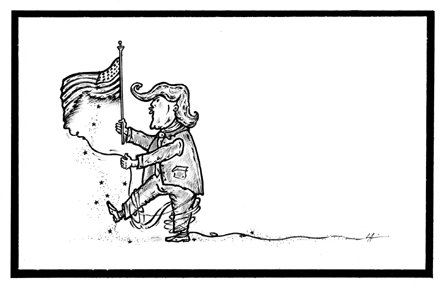
The Great Unraveler: Cause, symptom, or a bit of both? Illustration © 2020 by Linda Arkelian.
experiment has succeeded because it is rooted in a social contract between the governed and those who govern. But that contract has always been based on trust. We don’t trust each other anymore. How has the nation that won two world wars, sent men to the Moon, and created the liberal international order that has brought relative peace and prosperity to the world – all of which required Americans to work together and trust each other – gotten to this place?
The cause is debatable. Maybe it stems from the 1970s, when Watergate, the Pentagon Papers, and the Church Committee hearings in the U.S. Senate tested our trust in government. Maybe the distrust is rooted in the lies about ‘weapons of mass destruction’ (or ‘WMD’) that led Americans to war in Iraq, or the documented reports several years later revealing that our government had embraced torture as a tool of counterterrorism policy. It is hard to deny that, for some, the loss of a sense that we are in this together happened with the election of our first black president, Barack Obama, when it became apparent that we were not a post-racial society and that a sizable number of us could not accept, much less trust, a black man in the White House. Those same individuals are largely responsible for the election of Donald Trump, a man who has spent the last four years pulling at the threads of our already unraveling social fabric, until it may be impossible to weave it back together.
What does decline – this unraveling, if you will – look like? The primary element of our social contract is elections. Americans go to the polls every two or four years (and, in some states, more often) to cast ballots for candidates we trust to represent us. We do this, year after year, because we trust the process. Or, at least, we did. Never before has an American president (and his supporters in the media) engaged in a campaign meant to undermine our faith in our electoral process. For example, when considering how to protect the constitutional rights of American citizens to participate in the 2020 election during a pandemic, President Trump immediately dismissed the idea of mail-in ballots, claiming this could guarantee electoral fraud. He alleged that Democrats were pushing the idea to steal the election. He went so far as to claim that “mail boxes will be robbed” by people looking to forge signatures on ballots.(1) Pro-Trump media personality Tucker Carlson falsely claimed in April that expanding citizens’ ability to vote by mail would allow them to request and print ballots online, destroying our faith in the fairness of the election.(2)
What purpose does rhetoric like this serve? It raises questions in the minds of Americans about the legitimacy of their electoral process, and the abject refusal to explore mail-in voting options serves to suppress the vote in one of the most heated elections in our collective memory, which will, in turn, cause Americans to question its outcome. If we cannot trust our electoral process, we cannot trust our government. This distrust has divided us along party lines in ways America has rarely been divided before. When that happens, we stop talking to each other, we stop trusting each other, and eventually we cannot trust our government. Without that trust, our government cannot function, because elected officials become so worried about losing support over a single legislative vote that the president can cite to tag them as disloyal, that they cannot compromise on even the most urgent legislation.
This is currently playing out over the COVID-19 crisis, as states consider how to reopen safely, and governors are mocked for mandating the use of masks in public places. President Trump has referred to the COVID pandemic as a hoax invented by Democrats, and refuses to wear a mask; so his supporters have rushed to embrace that twisted logic, arguing against phased reopening and wearing masks and accusing those who prefer to be more cautious of wanting to damage Trump’s presidency. Read any comment section under newspaper articles about the pandemic and the need to continue to socially distance, and you will read dozens of people claiming that COVID will immediately disappear after November’s presidential election – i.e. that Democrats are using COVID as a political tool. We have become so cynical about each others’ intentions that we rush to assume the worst about people who simply want to protect themselves and their neighbors from a virus that in many cases has horrific outcomes.
Beyond this, the concerted effort from the White House to undermine our faith in our democratic institutions is yet another means to weaken the fabric of our society. Sadly, our country is now one where the president and his supporters denigrate the national security professionals whose depth of expertise have guided us through the Cold War, helping us avoid nuclear war with the Soviet Union and limiting Soviet expansion. These careerists across government developed and implemented the Bretton Woods agreement, which led to the longest period of peace (i.e. no great power war) and prosperity which the world has seen in hundreds of years. They have helped us avoid another 9/11, ended the reign of terror of Osama bin Laden, and disrupted terrorist organizations. They work long hours at significant personal cost so they can warn of missile launches, border incursions by hostile nations into allied territory, pandemics in Asia or Africa, political instability in Latin America, and countless other national security concerns.
Yet, the President routinely demeans these patriotic men and women, calling them the “deep state” and implying they are part of some shadowy cabal that works to thwart his every move. Trump’s remark in Finland in 2017, when he openly sided with Russian President Vladimir Putin over his own intelligence community (‘IC’) in regard to Russian interference in the 2016 election comes to mind. Standing next to a representative from a country that would love to weaken us, and siding with that enemy, sent a message to supporters that they should be suspicious of their own intelligence agencies. Further, Trump seems to instinctively understand that his national security apparatus has the ability to undermine his own personal agenda simply by conveying facts to the public; so, it must be kept from doing so. This is why he refused to allow intelligence officials to give a public global threat briefing to Congress earlier this year, despite the precedent of this annual event. In 2019, for example, CIA officials’ testimony on Iran and North Korea contradicted Trump’s claim that they were, and were not, respectively, a threat – hindering Trump’s ability to pursue his hard-line agenda on Iran, and his appeasement of North Korea. What happens when the IC warns, say, of Russian aggression against Poland or Latvia? Or that a reconstituted ISIS has emerged and is threatening U.S. interests in the Middle East? Or, of the next pandemic? Will Americans believe it? Will that president be able to persuade the American public that action is needed, or will we dismiss such warnings out of hand, as “deep state” efforts to carry out some globalist agenda?
Trump launched a rhetorical war against former CIA Director John Brennan, a staunch critic, threatening to revoke his security clearance, which Trump falsely implied was used to access classified information he would then leak to MSNBC, where Brennan works as a consultant. This move was so unprecedented that approximately 200 former national security personnel signed an open letter criticizing Trump’s action, citing free speech concerns and fears that his action would constrain current IC members who might be reluctant to fulfill their mandate of speaking truth to power out of fear their own clearance could be pulled, ending their careers. (Full disclosure: I was a signatory to that letter.) Trump’s attacks on the IC as a “deep state” that is out to get him undermines the public trust in the intelligence community that is charged with keeping America safe, prompting Americans to view the IC, and much of government, with distrust.
Another of these democratic institutions is a free press. A free press is the lynchpin of democracy – without it, government abuses will go unreported, elected officials will act with impunity, and corruption will abound. Yet many distrust the media, simply because the president has condemned much of it “fake news.” Many Americans discount even obviously accurate reporting, events we can see with our own eyes, because it comes from a source that has criticized Trump. For example, we were asked to dismiss live video footage of the National Guard using force to remove peaceful protesters from the street in front of St. John’s Episcopal Church in Washington, D.C., simply because Trump denied that force was used. We were then asked to believe those same peaceful protesters were in fact rioters, and that the government had no choice other than to remove them by force. And Trump supporters buy this, denying what they saw with their own eyes, and calling those who are unwilling to dismiss such images ‘unpatriotic,’ ‘haters,’ ‘leftists,’ or ‘anarchists.’ Trump makes clear his expectation that supporters will believe him – after all, he once said he could shoot a man on Fifth Avenue and not lose support – and they always do. Supporters eat these lies up, because they confirm what they themselves desperately want to believe: that the media is out to get Trump, and without Trump they have no voice, because they cannot bring themselves to trust the rest of us.
Where do we go from here? Do we have the will to chart another course? Can we mend what Trump has rendered? The truth is: we have no choice, if we want this American experiment to continue. The next president will have to find a way to unite this nation and be the leader Trump has proven he cannot be. Reversing our decline is necessary to resuming American leadership in the world, and repairing the social fabric of our nation is the first step toward that reversal. Much is at stake here. If Americans remain divided over the intentions of our own government, over the legitimacy of our elections, or over the integrity of our institutions, we will never lead again. Leadership requires national will, and coalescing behind a national agenda. Our weakening social fabric has allowed nations like China, whose malign intentions are evident, to seize this moment to exert hegemony, edging us out of Asia and relegating billions to the whims of authoritarian leaders who seek Beijing’s aid, which comes without strings attached. It is not just the American experiment that is at stake; the future of freedom is as well.
Gail Helt directs the Security and Intelligence Program at King University in Tennessee. She spent nearly a dozen years as an analyst at the CIA, where she developed expertise in Asian security issues, politics, leadership, and governance; while there, she authored briefings for senior policymakers, including the President of the United States. Her academic research interests include democratization, the decline of U.S. influence around the world, and Asian politics.
Copyright © 2020 by Gail Helt.
Illustration copyright © 2020 by Linda Arkelian.
Foonotes:
(1) @realdonaldtrump, “There is NO WAY (ZERO!) that Mail-In Ballots will be anything less than substantially fraudulent. Mail boxes will be robbed, ballots will be forged & even illegally printed out & fraudulently signed. The Governor of California is sending Ballots to millions of people, anyone…..” Twitter, 26 May 2020, 8:17a.m.: https://twitter.com/realDonaldTrump/status/1265255835124539392
(2) “Tucker Carlson Tonight,” Media Matters, 14 April 2020: https://www.mediamatters.org/tucker-carlson/tucker-carlson-says-michelle-obamas-vote-mail-campaign-would-destroy-faith-our
*************************************************
Making Room for Moral Responsibility in Foreign Policy
© By John Arkelian
“None of us – as an individual – can save the world as a whole, but… each of us must behave as though it were in his power to do so.” (Václav Havel)
How we see, understand, and interact with the world says a great deal about us – as individuals and as nations. In the realm of political affairs, principle has long taken a distant backseat to power politics. The term of art for that approach is
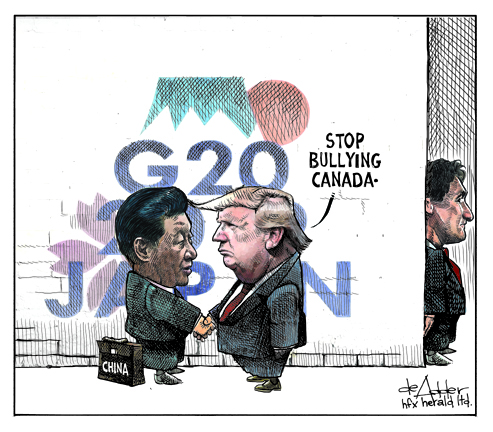
Copyright © 2022 by Michael de Adder
“realpolitik.” It predicates policy and action based on practical objectives rather than abstract principles. Its adherents scoff at treating ideals as the basis for national policy, in the domestic or foreign sphere, and instead claim a dubious pride in dealing with the world as it actually is, rather than as it ought to be. Encyclopedia Britannica says that “realpolitik thus suggests a pragmatic, no-nonsense view and a disregard for ethical considerations. In diplomacy, it is often associated with [the] relentless… pursuit of the national interest.” A writer in Foreign Affairs magazine notes that, historically, realpolitik is closely associated with such frankly ruthless figures as Machiavelli, Bismarck, and Henry Kissinger. But, its writ runs much broader and deeper than merely those not-so-illustrious practitioners. In truth, it is the dominant organizing principle for human political affairs. But, must it ever be so?
The answer is no. There is another way, a way based upon shared moral responsibility and the eminently practical consideration that no man is free unless and until all men are free. Václav Havel (1936-2011), Czechoslovakia’s playwright and dissident turned first post-communist president, said it best: “One can
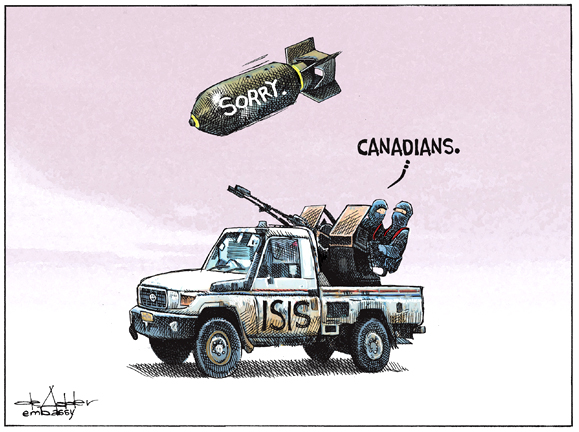
Copyright © 2022 by Michael de Adder
imagine a foreign policy… that demonstrably does not merely pursue the selfish interests of a country, but instead displays a feeling of common responsibility for the fate of all human society, its freedom, its plurality, and its life in peace.” Accepting a shared moral responsibility for the world means rejecting the notion that one nation (or group of nations) can be free, prosperous, and secure while others are deprived of those secular blessings. An exchange between two founders of the American Republic illustrates the principle that we are all our brothers’ keepers: “Where liberty is, there is my country,” declared Benjamin Franklin, to which Thomas Paine retorted, “Where liberty is not, there is my country.” As political affairs writer Chris Hedges explains, “For Paine, the role of the citizen extended beyond national borders. The fight of those living under any system of tyranny was his fight. ‘When it shall be said in any country in the world, My poor are happy; neither ignorance nor distress is to be found among them; my jails are empty of prisoners, my streets of beggars; the aged are not in want, the taxes are not oppressive; the rational world is my friend, because I am a friend of happiness – when these things can be said,’ wrote Paine, ‘then may that country boast of its constitution and its government.’”
What then must we do to put our core principles into practice on the world stage? Why, first and foremost, we must recognize that those guiding principles are the bedrock foundation and sine qua non of our civilization. Without them, we are bereft and adrift from the values for which our forefathers sacrificed so much. Our ideals are not disposable luxuries, to be glossed over at our passing convenience in favor of some perceived material benefit. No, they are the veritable beating heart of who we in the West are as a people. Our great founding principles – of liberal democracy, individual liberty, equality before the law, inalienable human rights, and representative government which is truly accountable to its citizens – aren’t a reward only for the fortunate few, but, rather, the rightful inheritance of all mankind. We can put that proposition into practice by giving primacy in our foreign policy to moral principles like universal human rights. And we can freely take on the heavy and oft-cumbersome mantle of moral responsibility for our fellow human beings, wherever they may be in the world. Let us consider, then, how those ideals might be expressed in responding to some of the world’s current injustices and its always plentiful roster of ‘bad actors.’
Popular protests in Syria during the ill-fated Arab Spring in 2011 turned into a bitter civil war that is still active nine years later. It’s a pity the West failed to intervene in a meaningful way in the beginning, before things turned intractably violent. The conflict created some abhorrent factions, including ISIS and the al-Qaeda affiliated al-Nusra Front – extremist groups which have too often dominated the armed opposition to the government. But, all along, the Syrian government itself has been an equally repugnant player. The ensuing conflict killed thousands and generated millions of refugees, whose flight from their country (and from the region generally) has created a humanitarian and political crisis in the West. In December 2019, the United States shamefully deserted its most effective allies in Syria (namely, the Kurdish ethnic minority) in the face of pressure from the authoritarian Erdoğan regime in Turkey – in the process, abandoning the West’s physical presence there, along with our moral authority.
There have been recurring credible reports that the Syrian regime’s forces have bombed civilian targets and used outlawed chemical weapons. Those actions are unlawful, grossly immoral, and intolerable. In response, the West should simultaneously pursue all of the following countermeasures: (1) We should attack Syrian military aircraft on the ground to degrade (and if possible destroy) their ability to continue to bomb civilian targets. (2) We should push for the indictment at the International Criminal Court (ICC) of Syria’s president (Bashar al-Assad), key members of his regime, as well as his enablers abroad in the governments of Russia and Iran and in Hezbollah (the militant group based in Lebanon). There is a glaring prima facie case against them all for war crimes and crimes against humanity. Charges should be laid by the ICC, and those responsible should be arrested and extradited to that court if they venture within the reach of the West or its allies. (3) We should pressure troublesome external players like Russia, Iran, and our own ally Turkey to get out of Syria and impose sanctions should they fail to comply. (4) We should tirelessly strive to convene peace talks and push to keep those talks in session until a solution we can live with is achieved. (5) And, if those measures fail, we should target the top leadership of the Assad regime for lethal ‘decapitation’ strikes, as much as we should ordinarily shrink from resorting to violence.
Our justification for taking those actions (including the unilateral use of force) should be the “responsibility to protect” doctrine recognized by members of the United Nations in 2005. The Syrian regime has made war upon its own people; it has targeted civilians and/or shown a criminally reckless disregard for their safety; it has purportedly used proscribed weapons of mass destruction; and it has wrongfully prevented humanitarian aid organizations from accessing civilian victims of the brutal conflict. For those reasons, the Syrian regime is lawless and illegitimate. For those reasons, the West has the right, and the moral obligation, to intervene.
Right across the border, in Israel, a festering asymmetrical conflict between Arabs and Jews has produced decade after decade of human misery and protracted insecurity for all concerned. Israel is our ally and our friend, and it is a democracy in a neighborhood where that is extremely rare. We should rededicate ourselves to always defending Israel from external attack but desist from giving it carte blanche to pursue unjust policies of its own. Israel occupied the West Bank, the Gaza Strip, and the Golan Heights in 1967 while defending itself from attack by neighboring countries. That occupation was therefore legitimate in its origins; but it has now gone on for 53 years. Occupying another people against their will is harming Israel itself (it takes harsh measures to control a restive population, undermining its own democratic and humanitarian credentials in the process), not to mention the Palestinians over whose lives it has taken absolute sway. And, Israel has made matters worse by systemically endeavoring to change the facts on the ground – by, for example, building large Jewish settlements in territories which it occupied by force and over which it does not hold sovereignty, and by purporting to permanently annex East Jerusalem.
The unalterable fact is that the land between the Mediterranean and the Jordan River is home to both Jews and Arabs, to both citizens of Israel and to those who currently have no state of their own. Despite years of mutual rancor, oppression, mistrust, and violence, those two people must learn to coexist. The best framework to achieve self-determination for both sides is still a ‘two-state solution.’ That requires creating a viable Palestinian state as well as guarantees for mutual security. It won’t be easy to devise compromises to thorny questions of borders, the return of Arab refugees, access to potable water, and defense guarantees. But the best hope of that process starting is for the West to tell its friend that the status quo is in no one’s interest and that we will henceforth exact severe penalties for actions detrimental to creating mutual trust and peace (including Israel’s unilateral practice of creating and sustaining settlements on any part of the occupied West Bank).
Meanwhile, on the Arabian Peninsula, the hapless nation of Yemen continues to be the scene of ugly conflict between multiple internal competitors and external interveners like Saudi Arabia. The political crisis that began in 2011 has grown incrementally worse: the result is a human rights disaster, with 17 million people endangered by famine and cholera and more than 50,000 killed outright by warfare. The West must take resolute measures to end the war. We can start by demanding that Saudi Arabia and other external forces, all of whom purport to be our allies, vacate the territory of Yemen immediately or face an indefinite suspension of our military aid and political support.
The armed intervention in Afghanistan by the United States and allies like Canada was prompted by the 9/11 attacks by al-Qaeda terrorists. Acting (at first) mostly through local warlord surrogates, we attacked the terrorist camps, chased the survivors out of the country, and overthrew their Taliban hosts. Nineteen years later, the Western allies have tired of the interminable struggle. Large swaths of the country are back under Taliban control, and even the (mostly urban) areas where we exercise control remain sporadically insecure. Many lives on both sides have been lost. However, where we maintain tenuous control, girls can go to school, women are free of the Taliban’s misogyny, and there is a semblance of political freedom. Those small gains are apt to disappear the moment Western forces quit the scene. And yet, the United States has been negotiating its departure with the same ruthless ideologues with whom we have been at war for so many years. We seem to be less concerned about the fate of those who sided with us against the Taliban than with extracting a token promise that the Taliban won’t again give sanctuary to terrorists from abroad. Talking to an enemy is rarely a bad thing, but the same cannot be said for a unilateral withdrawal in what amounts to abject capitulation. As if to remind us of their deplorable ways, our would-be partners, the Taliban, attacked a maternity hospital in Kabul in May 2020 killing 24 people, including newborn infants. It would be irresponsible and grotesquely immoral for us to leave the Afghan people to the not-so-tender mercies of such brutes. While we do not relish the prospect of endless war, we have only two moral options in Afghanistan: (1) to maintain a sufficient residual force there indefinitely to forestall a Taliban takeover, or (2) to offer permanent sanctuary in the West to every Afghan man, woman, and child who does not want to be ruled by the Taliban.
Multilateral institutions like the European Union and NATO need to take a principled stand when any of their members stray from our shared values of democracy, an independent judiciary, and protection of human rights. Countries like Hungary (under Viktor Orbán) and Turkey (under Recep Tayyip Erdoğan) have strayed badly from those shared values – by, for example, jeopardizing freedom of the press and undermining the independence of the courts. We need to devise effective ways to ostracize them and to penalize them. And, we need to find ways to suspend them, respectively, from the EU and NATO. Elsewhere, ostensible allies have a rogues’ gallery of bad actors at their helms: The Philippines has a thug in charge, in the deplorable person of Rodrigo Duterte. Saudi Arabia is being run by its crown prince, Mohammed bin Salman, who is very probably responsible for the brutal murder of the journalist Jamal Khashoggi in October 2018. In Egypt, a democratically elected government was overthrown by the military dictatorship of Abdel-Fattah el-Sissi in July 2013. The West wasn’t fond of that nation’s first democratically elected government (which was Islamist in orientation), so, in egregious dereliction of our supposed fealty to democracy, we sat on our hands when it was toppled by tyrants. Pakistan has democratic elections, but its military (and its military intelligence agency, the ISI) plays an oversized role in policy decisions – sheltering terrorists like Osama bin Ladin and Taliban forces, sponsoring terrorism in Afghanistan and Kashmir, and engaging in a nuclear arms race with its equally culpable neighbor and rival India. Those countries, under their current regimes, are not morally fit to be treated by us as allies.
And that doesn’t even scratch the surface of international bad actors. North Korea savagely oppresses its own citizens and endangers us all with its bellicose nuclear proliferation. Russia murders its own journalists, imprisons opposition figures, and sends assassins to the West to murder dissidents. It committed naked aggression by invading and seizing Crimea in March 2014, and it continues to foment civil war in eastern Ukraine. It twists its own constitution inside-out every few years to unlawfully extend the one-man rule of its autocrat-in-chief Vladimir Putin. Meanwhile, the one-party dictatorship in China, presided over by its “president for life” Xi Jinping, has open contempt for human rights and for international law. It is in the process of breaking the legally binding treaty which guarantees Hong Kong’s political autonomy and its legacy of free speech, free assembly, and independent courts. It has unlawfully imprisoned a million or more Uighurs in its northwest and is subjecting them to forced ideological indoctrination because it regards them as a restive ethnic and religious minority. It has likewise broken guarantees afforded to the people of Tibet, rendering its control over both of those territories to be a matter of raw force rather than legitimate consent. It props up a dangerous regime in North Korea. It is an ongoing threat to the independence of the island nation of Taiwan. And it is unlawfully creating artificial islets in an illegitimate attempt to impose new areas of national control over international waters.
There are geopolitical and security aspects to some of those acts of malfeasance, and they require countermeasures to safeguard our own security. But, be it ostensible friend or outright foe, any regime that attacks fundamental human rights, oppresses its own (or other) people, undermines a free society, or concentrates all power in the hands of a few is an implacable enemy of all we hold dear. If our values mean anything, we have to safeguard them at home and relentlessly advance their spread abroad. That means giving more than feeble lip service to our core values. It means making the protection and advancement of our core principles the driving force in our foreign policy – a foreign policy that will consistently give as much importance to our shared moral responsibility for the world as it does to our material self-interests (in trade and otherwise) of the moment: “There will never be a heaven on earth. But… the world can become a better place if we sometimes have the courage to look up at the stars.” (Václav Havel)
John Arkelian is an award-winning author and journalist. He represented Canada abroad as a diplomat.
Copyright © 2020 by John Arkelian.
The foregoing essay also appeared in the Summer 2020 issue of Grapevine Magazine.
Visit Michael de Adder at: https://www.deadder.net/ And see our portrait of the artist at: https://artsforum.ca/art-2
*************************************************
An Unchecked President
© By Allan J. Lichtman
After the Senate failed to remove President Donald Trump for abuse of power and contempt of Congress, Republican Senator Susan Collins of Maine, who voted for acquittal, issued one of the worst predictions in American political history. “I believe that the president has learned from this case,” she said. “The president has been impeached. That’s a pretty big lesson.” In fact, the only “lesson” that the president learned from the Senate trial was the validation of his claim that “I can do whatever I want as President.”
Upon his February 5, 2020 acquittal, Trump doubled-down on assaulting federal law enforcement and intelligence professionals, the free press, the judiciary, and the oversight authority of Congress. He fired federal officials who had dared to testify and tell the truth during the House’s impeachment inquiry. He sacked the Director of National Intelligence Joseph McGuire after a congressional intelligence briefing that warned of Russia’s intervening in the 2020 American presidential election on Trump’s behalf. Trump replaced him, as acting director, with political operative Richard Grenell, who has no intelligence experience. He then nominated another inexperienced political hatchet-man, Republican Representative John Ratcliffe of Texas, as permanent director.
Trump said that he, not the Attorney General, is the nation’s chief law enforcement officer and repeatedly attacked the judge and the jurors in the trial of convicted felon Roger Stone. He continued to accuse falsely his political opponents of crimes and to ignore congressional requests for executive branch documents. He blamed the press and the Democrats for concern about a potential coronavirus epidemic in the United States. He redirected additional funds from the military to fund his border wall.
The evolving defense of their client by Trump’s lawyers, affirmed by the vote of Collins and other Republican Senators (except for Mitt Romney of Utah), gave Trump justification for his autocratic presidency. First, his lawyers said that Trump had done nothing wrong. Second, they argued that abuse of power is not impeachable. The defense ended by asserting that the president could do anything he wants (short of an indictable crime) to assure his election. “Every public official that I know believes that his election is in the public interest,” said the president’s handpicked constitutional expert, Alan Dershowitz, on the Senate floor. “If a president does something which he believes will help him get elected in the public interest, that cannot be the kind of quid pro quo that results in impeachment.”
This doctrine of unchecked power, which Dershowitz failed to corroborate with any judicial or scholarly authority, exposed what the founders feared most about a rogue president and why they advisedly put impeachment into the Constitution. Influential framer Gouverneur Morris said, “The Executive ought therefore to be impeachable for treachery and corrupting his electors.” James Madison warned that a president “might pervert his administration into a scheme of peculation or oppression” or even “betray his trust to foreign powers.”
In a little noticed but important speech before the Federalist Society, Attorney General William Barr lent his prestige to upending the American tradition of balanced power and endorsing President Trump’s view of an all-powerful executive. Barr lamented a “steady encroachment on Presidential authority by the other branches of government,” when the opposite is true. He further distorted history to claim that for patriots in the Revolutionary War the prime antagonist was an overweening Parliament, not a tyrannical king. He denounced the courts for usurping executive authority, saying that, “the Framers did not envision that the courts would play the role of arbiter of… disputes between the political branches.” Thus, according to Barr, there is no judicial remedy for Trump’s claim of “absolute immunity” from congressional oversight.
Contrary to this mythology about original intent, Alexander Hamilton made clear the critical role of the courts in the system of checks and balances that the framer’s enshrined in the Constitution. He wrote that a “limited Constitution … can be preserved in practice no other way than through the medium of courts of justice, whose duty it must be to declare all acts contrary to the manifest tenor of the Constitution void. Without this, all the reservations of particular rights or privileges would amount to nothing.” Yet, in a stunning rebuke of the Framers’ ideal of balanced power, a three-judge panel of the U.S. Court of Appeals recently ruled that the courts have no role in enforcing congressional subpoenas. If this decision becomes precedent, it strengthens Trump and Barr’s vision of an imperial presidency and destroys congressional oversight. Any president could tear up subpoenas for witnesses and documents without consequences, short of the blunt instrument of impeachment. Some authorities have even suggested that Congress may have to dust off its long-neglected authority to hold recalcitrant witnesses and officials in criminal contempt, with fines and even imprisonment as penalties.
Barr did issue a rare criticism of the president, but only after the Attorney General had intervened to weaken his department’s sentencing memo for Trump ally Roger Stone, prompting the four assigned prosecutors to withdraw from the case, including one who resigned from the Justice Department. Barr said, “Public statements and tweets made about the department, about people in the department, our men and women here, about cases pending in the department and about judges before whom we have cases, make it impossible for me to do my job and to assure the courts and the department that we’re doing our work with integrity.”
However, this faux outrage was patently a ploy to create the appearance of distance between the Attorney General and the president. Since Barr’s pronouncement, Trump has issued dozens of tweets and public statements about these Justice Department matters. Barr has not resigned but has instead continued doing what he knows is the president’s bidding. He maintains a back channel for the president’s personal lawyer, Rudy Giuliani, to funnel information about alleged corruption by Joe Biden and his son Hunter in Ukraine. Yet Giuliani has not presented a single shred of credible evidence about any wrongdoing by the Bidens. Although, with Barr’s complicity, Trump has stonewalled every subpoena regarding investigations of his administration, you can bet that he will comply in an instant to a congressional subpoena requesting information about Joe Biden and his son Hunter.
Barr also ordered a rare independent review of the prosecution of Trump’s former National Security Adviser Michael Flynn, who pleaded guilty to lying to the FBI and then sought to withdraw this plea. Despite the finding of the Justice Department’s independent Inspector General that the national security investigation of the Trump campaign was properly predicated without political bias, Barr has aggressively pursued his own inquiry into the matter. He also followed the president’s lead by attempting to b.ock U.S. prosecution of a Turkish bank last year after Turkish President Recep Tayyip Erdogan asked for help on the matter from President Trump.
Earlier, Barr put a misleading spin on the report of Independent Counsel Robert Mueller to indicate that it had exonerated the president of collusion with the Russians and obstruction of justice. Yet, the report never addressed the broad issue of collusion but only investigated the crime of conspiracy. Although Mueller did not charge the president with obstruction of justice, the report said explicitly that he could not exonerate the president of this crime. Barr’s misleading construction of his report, led the usually reticent Mueller to rebuke him in writing, saying that Barr’s “summary” of his report had created “public confusion” and “did not fully capture” the report’s “context, nature, and substance.”
On March 5, 2020, federal district court judge Reggie Walton, a George W. Bush appointee, issued a scathing rebuke of Barr’s handling of the Mueller Report. The disconnect between Barr’s “summary” and the actual redacted report, Judge Walton said, caused “the court to seriously question whether Attorney General Barr made a calculated attempt to influence public discourse about the Mueller Report in favor of President Trump despite certain findings in the redacted version of the Mueller Report to the contrary.”
A bipartisan group of more than 2,000 former prosecutors have signed a letter calling on Barr to resign. The letter “strongly condemns President Trump’s and Attorney General Barr’s interference in the fair administration of justice.” It says that “Mr. Barr’s actions in doing the President’s personal bidding unfortunately speak louder than his words. Those actions, and the damage they have done to the Department of Justice’s reputation for integrity and the rule of law, require Mr. Barr to resign. But because we have little expectation he will do so, it falls to the Department’s career officials to take appropriate action to uphold their oaths of office and defend nonpartisan, apolitical justice.”
Just like Barr, Republicans in the U.S. House and Senate have become unblinking enablers of President Trump. The reason is simple. The president has trashed virtually every principle that Republicans professed to stand for, leaving the GOP as a cult of personality behind the president. Personal moral and personal responsibility: gone. Fiscal restraint, limited government, states’ rights: gone. Fidelity to the Constitution and respect for traditional institutions of government and the free press: gone. Republicans have nothing left in their zeal to maintain political power other than Trump himself.
Through bluff, bluster, and falsehoods, Trump succeeded in gaining acquittal from all but one Republican Senator. Although alternative facts may work with his Republican enablers, they will not stop a disease. Trump’s response to the coronavirus challenge has been marked by delays, incompetence, and misinformation. If the outbreak pushes America into a recession it will likely doom his reelection. Whether he serves one or two terms, Americans should not despair that Donald Trump will have damaged the presidency beyond repair or precluded the emergence of another great president. The great presidencies of Abraham Lincoln and Franklin Roosevelt both came in the wake of the failed administrations of their predecessors. Before Lincoln, Democratic President James Buchanan accepted, and even embraced, the institution of slavery. He hastened the nation’s descent into secession and war. Franklin Roosevelt’s predecessor, Herbert Hoover, proved unequal to challenges posed by the Great Depression that began on his watch in 1929 and continued to spiral downward throughout his years in office. Great challenges have called forth great leadership in the history of the United States, and these tests are not relics of the past. It can and must happen again in our troubled times. “That some can achieve great success,” Lincoln said, “is proof to all that others can achieve it as well.”
Allan J. Lichtman is Distinguished Professor of History at American University in Washington, D.C.; he is the author of “The Case for Impeachment” and “Repeal the Second Amendment: The Case for a Safer America.”
Copyright © 2020 by Allan J. Lichtman.
Editor’s Note: A fundamental tenet of the rule of law is that prosecutions and politics do not mix. Donald Trump recently dubbed himself the “chief law enforcement officer” of the United States: This self-styled prosecutor-in-chief has repeatedly exceeded the constitutional limits of his office by denigrating the criminal prosecutions of his cronies, by publicly dangling the possibility of pardons while cases are still before the court, and by overturning the decisions of military justice tribunals (as in the case of Navy SEAL Edward R. Gallagher, who had been accused of war crimes by his fellow service members) and thereby dangerously undermining the military’s foundational concern for “good order and discipline.” While there are constraints on prosecuting an American president while he is in office, it is not clear that such limitations need impede a judge presiding over a criminal trial from finding the president (like any other person) in contempt of court for utterances that are openly intended to influence that trial’s outcome and/or to bring the very administration of justice into disrepute. Trump’s egregiously improper attempts at interfering with the prosecutions of such felons as Paul Manafort and Roger Stone are blatant examples of open contempt of court. It’s a shame the presiding judges in such cases haven’t said so. The current president may be shameless, but we daren’t shrink from invoking shame whenever he speaks (or acts) in contempt of the nation’s civic mores, let alone its constitutional strictures. And, as the author has suggested above, it is sorry state of affairs when a purported constitutional ‘expert’ asserts with a straight face that nothing a president does (including promoting his own reelection by fair means or foul) is unlawful if it is done in his own belief that it is in the public interest.
**************************************************
‘Winning’ at all Costs:
The Bizarre Position of the Trump Administration on the Northwest Passage
© By Robert Huebert
At the conclusion of the Arctic Council meeting in May 2019, U.S. Secretary of State Michael Pompeo stated that Canada’s position on the Northwest Passage is “illegitimate.” This should be the final proof that the Trump administration cares only about “winning,” with no regard to its own interests, let alone those of its closest ally and economic partner – Canada.
Pompeo’s statement is only the latest in a series of comments by Trump administration officials who have made it clear that it is now time to “win” their argument with Canada regarding the status of the Northwest Passage. The Americans have always maintained that it is an international strait, while Canada argues that it is internal waters. The difference in these two positions concerns international shipping through the passage. If Canada is correct, then we have the right to either allow or refuse the entry of foreign vessels in the passage. If the American position prevails, then all international shipping – including submarines – can use the passage regardless of Canada’s position.
In 1988, through the direct involvement of President Ronald Reagan (a Republican) and Prime Minister Brian Mulroney, the two countries reached a practical solution to the dispute. Agreeing that this solution would not prejudice each other’s position on the passage, the United States would ask Canada for consent for its icebreakers – the only American surface ships capable – to traverse the passage. In return, Canada would automatically grant the consent. With this solution, neither state could be viewed as giving ground, and it was a means to avoid politically costly disputes over the issue.
Now, however, due to Trump’s pathological need to “win,” the Americans are set to disregard this solution and “win” the dispute. The U.S. Secretary of Navy, Richard Spencer, has publicly stated three times this year that the United States is preparing for what they call a ‘freedom of navigation’ operation through the Northwest Passage. This means sending their one operationally functioning icebreaker or a naval ship through the passage without asking Canada for consent or permission. The idea is not only a direct slap at Canada (and stupid), but it is also directly against U.S. interests!
First, while lambasting the Canadian position, Pompeo also attacked Russia and China for their moves to militarize the Arctic. Given that Russia is actively militarizing and China may soon be taking similar action, then the United States’ move to attack Canada, its most important ally, while meeting this threat makes no sense. If the Americans are really concerned about the rise of Russian military strength in the Arctic, it needs Canada to help meet the threat. Specifically, NORAD needs to be modernized to counter the growing Russian threat in the Arctic, and that cannot occur without Canada’s participation, given our Arctic geography and long-standing cooperation on this issue. Given this backdrop, it is astounding that the Americans think that provoking Canada on one of the most politically sensitive issues in Canadian-American relations is rational. What Canadian prime minister will want to work with the Americans to modernize our shared northern defences if they destroy the 1988 agreement that had politically resolved the problem of the Northwest Passage?
Secondly, a freedom of navigation challenge will create a ‘lose-lose’ situation for the Americans. If the Americans conduct a successful voyage and use that operation at an international court to win their positon that the NWP is an international strait, they will open the passage to unimpeded transit of Russian and Chinese submarines and aircraft. Under international law, submarines enjoy the right of transit passage through international straits submerged. All aircraft have the right to overfly an international strait. If the Americans are really concerned about a rising Russian and Chinese threat in the Arctic, how can they possibly believe this is a good thing? On the other hand, if the ship that they send fails to make the transit, whether due to ice conditions or the lack of proper charting in these waters, then all they will have done is prove the Canadian position that these waters are unique and are not a functioning international strait.
More to the point, the United States will have damaged its relations with Canada. If the Americans succeed, they fail; and, if they fail, they fail. Either way, they have seriously hurt their relationship with Canada right at the moment they need to be working more closely with Canada. While Trump may get to claim that once again he has “won” where others have not, what he will actually have done is seriously hurt American interests and cause further damage to the special relationship that existed between Canada and the United States.
Robert Huebert is an associate professor in the Department of Political Science at the University of Calgary. He also served as the associate director of the Center for Military and Strategic Studies; and, in 2010, he was appointed to the Canadian Polar Commission. His research interests include international relations, strategic studies, the law of the sea, maritime affairs, Canadian foreign and defense policy, and circumpolar relations. He co-authored (with Whitney Lackenbauer & Franklyn Griffiths) “Canada and the Changing Arctic: Sovereignty, Security, and Stewardship” (Wilfrid Laurier U. Press, 2011). His essay “The Arctic and the Strategic Defense of North America: Resumption of the ‘Long Polar Watch,’” appears in the book “North American Strategic Defense in the 21st Century: Security and Sovereignty in an Uncertain World” (Springer, 2018).
Copyright © 2019 by Robert Huebert.
The foregoing originally appeared in The Globe & Mail. It appears in Artsforum Magazine with the permission of its author.
Editor’s Note: The prevailing modus operandi described by Robert Huebert – an arrangement which is now threatened by the woefully short-sighted preoccupation of the current U.S. president with hollow ‘victories’ – was an eminently practical compromise between the United States and Canada over competing views of the legal status of the Northwest Passage. It effectively ‘circled the square’ of their opposing, ostensibly irreconcilable, views of the Passage, as ‘international strait’ versus ‘internal waters,’ without forcing the issue. A head-on legal and political confrontation between those competing views would, as Huebert points out, be to the practical disadvantage of both allies. Of course, leaving aside the case of Northwest Passage, there is a compelling argument to be made in favor of treating key straits elsewhere in the world as international waters, freely navigable by all countries. Consider the Strait of Hormuz, which gives access to the Persian Gulf, source of much of the world’s oil, or Southeast Asia’s Strait of Malacca (situated between the Malay peninsula and the Indonesian island of Sumatra), which is a vital conduit for international trade. A superpower cannot tolerate the prospect of such critical ‘squeeze-points’ being controlled by any single country, which might block free passage and impede a global power’s projection of force abroad. But the geopolitical imperatives of great powers aren’t the whole story: all trading nations, big or small, depend on the unimpeded navigation of the seas (and of the airspace above those waters). As global warming continues the great Arctic thaw, the once mostly moot status of the Northwest Passage will grow increasingly practical, as will challenges to Canadian sovereignty (and security) by hostile powers like Russia and China. It is essential that Canada and the United States find a way to ‘agree to disagree’ and maintain a practical compromise that is in both of their interests.
**************************************************
An Impeachment Investigation is an Urgent Priority
© By Allan J. Lichtman
The Democrats who equivocate about an impeachment investigation of President Donald Trump need to understand that impeachment is right constitutionally, historically, and politically. It is the proper remedy for a rogue president who, if left unaccountable, will likely win reelection next year.
Impeachment is not a catastrophic event
America’s founders established impeachment as a legal and peaceful means for removing a dangerous leader without resort to revolution or assassination. As Benjamin Franklin said, “It would be the best way, therefore, to provide in the Constitution for the regular punishment of the Executive when his misconduct should deserve it, and for his honorable acquittal when he should be unjustly accused.”
After his impeachment and acquittal, a chastened Andrew Johnson ceased obstructing the integration of free slaves into national life. Despite warnings to the contrary, the presidency emerged stronger than ever following Clinton’s impeachment and acquittal. The resignation of Richard Nixon to avoid impeachment and conviction, removed a dire threat to America’s constitutional order.
The U.S. House has sole authority for impeachment
A House of Representatives empowered with the sole constitutional authority for impeachment, must decide whether a president’s conduct merits an impeachment investigation. It should not consult a crystal ball to divine whether or not the Senate might vote to convict him. Articles of impeachment would automatically trigger a public trial in the Senate. Chief Justice John Roberts, who has a fidelity to the law, would preside, not Senate Majority Leader Mitch McConnell. House prosecutors would point an accusing finger at the president, present their case, and compel his lawyers to defend him with credible arguments and evidence, not just spin. Who knows what the Senate might do after a trial?
There are grounds for impeachment beyond obstruction of justice
The redacted report of Special Counsel Robert Mueller established a case against Trump for obstruction of justice that is stronger than the case that led nearly every Republican in the House to impeach President Bill Clinton. In an open letter, hundreds of former prosecutors agreed that Mueller’s evidence would have led to felony charges against President Trump if he were not protected as a sitting president. “We emphasize that these are not matters of close professional judgment,” the letter said.
Other potential grounds for impeachment that the Mueller report does not consider include charges by the Southern District of New York that implicated Trump in two felonies for violating campaign finance laws, which are in place to avoid the corruption of our elections. By failing to divest himself of his business interests, Trump has likely violated the Constitution’s emoluments clause that prohibits a president, without congressional authorization, from taking anything of value from foreign governments or their entities. There is at least circumstantial evidence that despite the lack of coordination during the campaign, the president is compromised by the Russians.
In addition, allegations of financial misdeeds include potential money laundering, tax evasion, insurance fraud, the illegal use of his charitable foundation to advance his presidential campaign, and the corruption of his inaugural committee. Like Richard Nixon, President Trump may have also abused his presidential powers, through his assault on the Department of Justice, the Congress, the judiciary, and the free press. Following the precedent of an article of impeachment that the House Judiciary Committee voted against Nixon, the current House could impeach Trump for defiance of lawful congressional subpoenas.
Democrats misread the impeachment of President Bill Clinton
The Democrat leadership presumes that a backlash following Clinton’s impeachment politically damaged his Republican accusers. Yet, the opposite is true. Clinton’s impending impeachment cost the Republicans a few House seats in the midterm elections of 1998, but not control of the House.
The impeachment, however, netted the Republicans the greater prize of the presidency in the election of 2000. Republican candidate George W. Bush achieved a one-vote Electoral College majority with his 537 vote victory in Florida. Yet, the cloud of scandal blunted the vote for Al Gore and kept on the shelf the Democrats’ best campaigner, President Clinton. If Clinton had campaigned in Florida, he surely would have turned more than 537 votes in favor of Democratic candidate Al Gore.
Democrats misread their chances to defeat Trump in 2020
Per the ‘Keys to the White House,’ my prediction system that correctly forecasted Trump’s win in 2016, Trump wins again in 2020 – unless six of 13 key factors turn against him. Currently, the president is down only three keys: Republican losses in the midterm elections, the lack of a foreign policy success, and the president’s limited appeal to voters.
An impeachment and trial would cost the president a fourth key – the scandal key – and expose him to dropping another key by encouraging a serious challenge to his re-nomination. Other potential negative keys include the emergence of a charismatic Democratic challenger, a foreign policy disaster, or an election-year recession.
Democrats in the U.S. House should realize that history would not have celebrated ‘Richard the Faint-Hearted’ or ‘Catherine the Cautious.’ History recognizes leaders with courage and boldness. It is past time for Democrats to meet the preeminent challenge of their times and do what is right for their country and their party.
Allan J. Lichtman is Distinguished Professor of History at American University in Washington, D.C. and author of “The Case for Impeachment.”
Copyright © 2019 by Allan J. Lichtman.
**************************************************
Collusion and Obstruction by Trump remain Open Questions after Attorney General’s “Summary” of the Mueller Report
© By Allan J. Lichtman
As a historian who deals with primary source documents, I know that a summary of a primary document like the full Mueller report is often incomplete and misleading, especially when prepared by an interested party like Attorney General William Barr. Barr did not even provide a real summary of Mueller’s key findings. He includes only some 84 words of direct quotations from the comprehensive Mueller report, most of which are not even complete sentences. Barr devotes nearly all his three-and-a-half page summary to boilerplate about the Mueller investigation and his own characterization of Mueller’s findings.
Even this inadequate summary fails to demonstrate a lack of collusion between the Trump campaign and the Russians. The two relevant Mueller quotations in the summary are as follows:
(1) “[T]he investigation did not establish that members of the Trump Campaign conspired or coordinated with the Russian government in its election interference activities.”
(2) “the evidence does not establish that the President was involved in an underlying crime related to Russian election interference”
The use of the bracket to begin the first quotation suggests that there may have been a prior clause that Barr omits. The lack of a capital letter to begin the second quotation and the absence of a closing period suggest that there may have been an omitted prior and subsequent clause.
Mueller does not use the word ‘collusion’ in either quotation. He concluded that Trump and his associates did not conspire or coordinate with the Russians in a way that arises to an indictable federal crime. That conclusion does not rule out collusion with the Russians that falls short of such crime. It does not rule out that Trump or campaign officials were under Russian influence.
There remains much that we need to know. For example, how did Mueller account for the Trump Tower meeting between Donald Trump, Jr., Campaign Chair Paul Manafort, and Jared Kushner with Kremlin-connected Russians? The emails setting up the meeting had openly promised dirt on Hillary Clinton as “part of Russia and its government’s support for Mr. Trump.” Why did the Special Counsel fail to interview Don Jr. and Kushner about this meeting and other Russian connections?
How did Mueller account for Campaign Chair Paul Manafort’s offer to provide Russian oligarch Oleg Deripaska privileged access to the Trump campaign? How did he evaluate Manafort’s meeting with Konstantin Kilimnik, a Ukrainian with ties to Russian intelligence, to whom he provided internal Trump campaign polling information? We need to know why there were many dozens of contacts between the Trump campaign and Russians and why none of the contacts were reported to the FBI, even after the Bureau warned the campaign about overtures from Russians. Were all these contacts all merely coincidence? If so, why did everyone concerned cover-up and lie? We still don’t know.
Contrary to claims by President Trump and his lawyers, the Special Counsel did not exonerate the president of obstruction of justice. Rather, Mueller stated “The special counsel states that ‘while this report does not conclude that the President committed a crime, it also does not exonerate him.’” (emphasis added). It was Attorney General Barr, not Mueller, who exonerated Trump.
Barr’s exoneration should carry no weight. Since the administration of Ulysses S. Grant in the 1870s, the point of establishing Special Prosecutors or Special Counsels in matters involving presidents is to conduct investigations and reach conclusions independent of the president or his political appointees. This independence sometimes led to clashes with presidents, most famously the ‘Saturday Night Massacre’ when President Richard Nixon fired Special Prosecutor Archibald Cox. Yet, without independent investigations, Congress and the public can have no confidence in their results.
Attorney General William Barr is not only a political appointee, but he was also on record before his appointment in saying that essentially a president cannot be charged with obstruction of justice. To allow Barr to have the final word on obstruction is to shatter nearly 150 years of precedent on independent investigations. It is now up to Congress to consider whether a charge of obstruction is justified.
Obstruction of justice by itself is a crime and a basis for impeachment. In 1974, the House Judiciary Committee, including a third of Republicans, voted an article of impeachment against President Nixon for obstructing investigations of the Watergate break-in even though he was not charged with the crime itself. In 1998, the full House voted an article of impeachment against President Bill Clinton for obstructing the investigation of his private consensual affair with Monica Lewinsky. Nearly every House Republican voted for this article and most Senate Republicans voted to convict Clinton for obstruction. If the charge of obstruction turns on a president’s state of mind, why did Mueller fail to submit written questions on obstruction to the president and decline to press for an in-person interview?
Ultimately, these questions can be resolved only if Congress and the public have an opportunity to view the full Mueller report and draw their own conclusions. The American people agree. A ‘Morning Consult’ poll taken in late February found that 68 percent of registered voters said that the report should be made public. Only 10 percent said that it should not, with 22 percent undecided. Without access to the full report, we’ll get only spin from Republicans and Democrats, further undermining the people’s fragile confidence in the institutions of their government.
Allan J. Lichtman is Distinguished Professor of History at American University in Washington, D.C. and author of “The Case for Impeachment.”
Copyright © 2019 by Allan J. Lichtman.
Editor’s Note: Robert Mueller was appointed as Special Counsel on May 17, 2017 by the U.S. Deputy Attorney General to investigate Russian interference with the 2016 U.S. presidential election; possible links between the Trump campaign and the illicit Russian activities; and possible obstruction of justice. The Mueller investigation led to 199 criminal charges, 37 indictments or guilty pleas, and five prison sentences (among them, several persons closely associated with Donald Trump for criminal offenses like bank fraud and making false statements). On March 22, 2019, Mueller concluded his investigation and delivered his report to the U.S. Attorney General, who subsequently summarized the report’s findings in a four-page letter to Congress. In its aftermath, Trump, who has bombastically denounced the investigation as a “witch-hunt” from the get-go, with near daily proclamations of “No collusion,” has loudly declared himself to be fully exonerated of any and all wrongdoing, a hyperbolic claim that ignores both the many other active investigations into his business dealings and the ambivalent language about possible obstruction of justice cited in the mere fragments of the Mueller Report that have thus far been made public.
**************************************************
Torture and the CIA:
A whistleblower goes to prison while a perpetrator gets promoted
© By John Kiriakou
I was inside the CIA’s Langley, Virginia headquarters on September 11, 2001. Like all Americans, I was traumatized, and I volunteered to go overseas to help bring al-Qaeda’s leaders to justice. I headed counterterrorism operations in Pakistan from January to May 2002. My team captured dozens of al-Qaeda fighters, including senior training-camp commanders. One of the fighters whom I played an integral role in capturing was Abu Zubaida, mistakenly thought at the time to be the third-ranking person in the militant group. By that May, the CIA had decided to torture him. When I returned to CIA headquarters that month, a senior officer in the counterterrorism center asked me if I wanted to be “trained in the use of enhanced interrogation techniques.” I had never heard the term, so I asked what it meant. After a brief explanation, I declined. I said that I had a moral and ethical problem with torture and that – the judgment of the Justice Department notwithstanding – I thought it was illegal.
Unfortunately, there were plenty of people in the U.S. government who were all too willing to allow the practice to go on. One of them was Gina Haspel, whom President Trump has nominated as the CIA’s next director. You remember “Bloody Gina” Haspel. She’s already the CIA’s acting director and has had just about every high-level job in the building. She’s the godmother of the CIA’s immoral, unethical and illegal George W. Bush-era torture program. She was the chief of a secret prison, where she oversaw the implementation of the torture program and was personally responsible for directing the torture of Abd al-Rahim al-Nashiri, the alleged mastermind of the USS Cole bombing. Nashiri’s attorneys say the torture of their client was so severe that he has lost his mind and can no longer participate in his own defense.
Putting Haspel in charge of the CIA would undo attempts by the agency – and the nation – to repudiate torture. The message this sends to the CIA workforce is simple: Engage in war crimes, in crimes against humanity, and you’ll get promoted. Don’t worry about the law. Don’t worry about ethics. Don’t worry about morality or the fact that torture doesn’t even work. Go ahead and do it anyway. We’ll cover for you. And you can destroy the evidence, too.
Described in the media as a “seasoned intelligence veteran,” Haspel has been at the CIA for 33 years, both at headquarters and in senior positions overseas. Now the deputy director, she has tried hard to stay out of the public eye. Mike Pompeo, the outgoing CIA director and secretary of state designee, has lauded her “uncanny ability to get things done and inspire those around her.” I’m sure that’s true for some. But many of the rest of us who knew and worked with Haspel at the CIA called her “Bloody Gina.”
The CIA will not let me repeat her résumé or the widely reported specifics of how her work fit into the agency’s torture program, calling such details “currently and properly classified.” But I can say that Haspel was a protégé of (and chief of staff for) Jose Rodriguez, the CIA’s notorious former deputy director for operations and former director of the counterterrorism center. Rodriguez eventually assigned Haspel to order the destruction of videotaped evidence of the torture of Abu Zubaida. The Justice Department investigated, but no one was ever charged in connection with the incident.
CIA officers and psychologists under contract to the agency began torturing Abu Zubaida on August 1, 2002. The techniques were supposed to be incremental, starting with an open-palmed slap to the belly or the face. But the operatives where he was held decided to start with the toughest method: They waterboarded Abu Zubaida 83 times. They later subjected him to sleep deprivation; they kept him locked in a large dog cage for weeks at a time; they locked him in a coffin-size box (and, knowing that he had an irrational fear of insects, put some in it with him). Rodriguez would later tell reporters that the torture worked and that Abu Zubaida provided actionable intelligence that disrupted attacks and saved American lives. We know, thanks to the Senate Intelligence Committee’s report on CIA torture and the personal testimony of FBI interrogator Ali Soufan, that this was false.
I knew what was happening to Abu Zubaida because of my position in CIA operations at the time. I kept my mouth shut about it, even after I left the CIA in 2004. But by 2007, I had had enough. President George W. Bush had steadfastly denied to the American people that there was a torture program. I knew that was a lie. I knew torture didn’t work. And I knew it was illegal. So, in December 2007, I granted an interview to ABC News in which I said that the CIA was torturing its prisoners, that torture was official U.S. government policy, and that the policy had been personally approved by the president. The FBI began investigating me immediately.
A year later, the Justice Department concluded that I had not committed a crime. But CIA leaders were still furious that I had aired the agency’s dirty laundry. The CIA asked the new Obama Justice Department to reopen the case against me. It did, and three years later, I was charged with five felonies, including three counts of espionage, resulting from that ABC News interview and a subsequent interview with the New York Times. Of course, I hadn’t committed espionage, and the charges were eventually dropped, but only after I agreed to plea to a lesser charge. I served 23 months in prison. It was worth every day. Largely because the CIA’s conduct became public, Congress has specifically prohibited waterboarding and other techniques that the agency used at the secret sites. A ban on torture is now the law of the land.
But while I went to prison for disclosing the torture program, Haspel is about to get a promotion despite her connection to it. Trump’s move hurts morale among CIA officers who recognize that torture is wrong. It comforts people at the agency who still believe “enhanced interrogation” is somehow acceptable. I spoke with a senior officer this past week who said, “The more things change, the more they stay the same.” There’s an attitude of defeatism among opponents of torture. And the message it sends to our friends and allies (as well as the countries we criticize in the State Department’s annual human rights reports) is this: We say we’re a shining city on a hill, a beacon of respect for human rights, civil rights, civil liberties, and the rule of law. But, actually, that’s nonsense. We say those things when it’s expedient. We say them to make ourselves feel good. But when push comes to shove, we do what we want, international law be damned.
The meaning of Haspel’s nomination won’t be lost on our enemies, either. The torture program and similar abuses at military-run prisons in Iraq were among the greatest recruitment tools that al-Qaeda, ISIS, and other bad actors ever had, according to legal experts, U.S. lawmakers, and even the militants themselves. It energized them and gave them something to rally against. It sowed an even deeper hatred of the United States among militant groups. It swelled their ranks. It was no coincidence that ISIS paraded its prisoners in front of cameras wearing orange jumpsuits (like those worn by Guantanamo Bay detainees) before beheading them. Haspel and the others at the CIA who engineered and oversaw the torture program are at least partially responsible for that, because they showed the world how the United States sometimes treats captives.
Do we Americans want to remain a nation that tortures people, like North Korea, China and Iran? Are we proud of the era when we snatched people from one country and sent them to another to be interrogated in secret prisons? Do we want to be the country that cynically preaches human rights and then violates those same rights when we think nobody is looking? Our country cannot afford that. We cannot look the other way. We cannot reward the torturers. Gina Haspel has no business running the CIA.
John Kiriakou is a former CIA officer, a former senior investigator for the Senate Foreign Relations Committee, and a former counterterrorism consultant for ABC News. In 2007, he blew the whistle on the CIA’s torture program, revealing that the CIA tortured prisoners, that torture was official U.S. government policy, and that the policy had been approved by then-President George W. Bush. He became the sixth whistleblower indicted by the Obama administration under the Espionage Act – a law designed to punish spies. He served 23 months in prison. He is currently an activist for the whistleblower community and a radio host. In 2012, Kiriakou was honored with the Joe A. Callaway Award for Civic Courage, an award given to individuals who “advance truth and justice despite the personal risk it creates.” He won the PEN Center USA’s prestigious First Amendment Award in 2015. He is the author of “The Reluctant Spy: My Secret Life in the CIA’s War on Terror.” And, he co-authored, with Joseph Hickman, “The Convenient Terrorist: Two Whistleblowers’ Stories of Torture, Terror, Secret Wars and CIA Lies.”
The foregoing article first appeared (in slightly briefer form) in The Washington Post on May 11, 2018. It appears in Artsforum Magazine with the permission of its author.
Copyright © 2018 by John Kiriakou.
Visit the author at: http://www.johnkiriakou.com/ or on Twitter @JohnKiriakou
*************************
Editor’s Note:
Torture is absolutely prohibited by the highest law in the land: The Eighth Amendment to the U.S. Constitution provides that, “Excessive bail shall not be required, nor excessive fines imposed, nor cruel and unusual punishments inflicted.” Cruel and unusual punishment includes (but is not limited to) torture. Torture is unconstitutional. There are no exceptions; there are no opt-out clauses. That is a simple, incontestable fact. Torture is unambiguously illegal under U.S. law and under binding international law. It is also grotesquely immoral, for those of us who actually care about such things.
The term ‘waterboarding’ is used in the foregoing article. The Merriam-Webster dictionary defines it as “an interrogation technique in which water is forced into a detainee’s mouth and nose so as to induce the sensation of drowning.” At law, waterboarding is a form of torture, notwithstanding the cynical use of euphemisms like “enhanced interrogation techniques” by some to improperly mask that fact and to insidiously cloak their illegality with a semblance of counterfeit legitimacy.
In 2002, Gina Haspel was in charge of a secret CIA “black site” located in Thailand, far from the scrutiny of the U.S. justice system. Her tenure there overlapped the torture of Abd al-Rahim al-Nashiri, a Saudi national suspected of involvement in the terrorist attack on the American destroyer USS Cole in 2000. In 2005, Haspel destroyed videotape evidence of interrogation sessions – including, not coincidentally, the torture that took place at those interrogations.
Senator John McCain (Republican – Arizona) called upon the Senate to reject Gina Haspel’s nomination to be the director of the CIA: “Ms. Haspel’s role in overseeing the use of torture by Americans is disturbing. Her refusal to acknowledge torture’s immorality is disqualifying. I believe the Senate should… reject this nomination.” Sen. McCain, who is chairman of the Senate Armed Services Committee, is seriously ill and may not be present for the vote on Haspel’s nomination. But his principled opposition to the nomination seems to have provoked the ire of the White House. Kelly Sadler, a communications aide to the president, dismissed McCain’s views at an internal staff meeting, saying, “It doesn’t matter, he’s dying anyway.” (That vile remark, since downplayed as a ‘joke,’ is just the latest manifestation of the indecency which seems so appallingly characteristic of the current president and his administration.) In our view, Sen. McCain was too mild in rejecting Haspel as a suitable candidate, describing her as “a patriot who loves our country and has devoted her professional life to its service and defense.” There is nothing ‘patriotic’ (or honorable) about torturing another human being, covering it up, and violating the constitution in the process. Haspel is unfit for the job of directing the CIA; she belongs in a jail cell, not in a position of trust.
JA – May 16, 2018
Postscript: On May 17, 2018, the U.S. Senate perversely confirmed the appointment of this most unsuitable candidate.
**************************************************
A Korean Comedy of Errors
© By Sung-Yoon Lee
Were the inter-Korean summit meeting in late April 2018 between the South’s Moon Jae-In and the North’s Kim Jong Un a fictional play, it would be a commendable aesthetic fulfillment of ‘the Aristotelian unities,’ that is: the unity of ‘action’ (a single action – the meeting itself), ‘time’ (occurring over no more than 24 hours – on April 27), and ‘place’ (unfolding in a single existing place – the border village Peace House).
But, because the compressed day-long date, capped by an elaborate Korean-themed dinner, carries very much real-life nuclear (and gulag) consequences, the rendezvous that proved long on bonhomie and woefully short on dismantlement discussions on weapons-and-camps of mass destruction, merely reaffirms a cliché, namely, Karl Marx’s dictum that history repeats itself in tragi-farcical cycles.
Worse still, the event may come to be remembered not just as another farcical sequel to the first inter-Korean summit in 2000 – which entailed a bribe transfer of $500 million from Seoul to Pyongyang – but also as a prequel to a yet-to-be born, ill-fated meeting to be forgotten. President Donald Trump must realize that he is walking right into an elaborate trap set by the wily North Korean leader. By lining up world leaders for meetings while making no concessions beyond verbal palliative, Kim has willed himself into Global Everyman who thinks no ill.
For decades, few outside the military establishment took North Korea seriously. Few recognized that the Kim dynasty is deft at both wielding the stick and dangling the carrot. Hard as it may be to acknowledge the ultra-weird and irresistibly mockable regime as a sophisticated adversary, the scorecard on nuclear diplomacy over the past quarter-century tells it all: Tens of billions of dollars of aid won by ‘Team Weird,’ some of which must have funded the “military-first” state’s nuclear and ballistic missile programs. Team America and its allies? In approximate terms, less than nothing.
Kim is poised to preach to the world that his policy of socialist pugnacity and anti-social patience really pays. In other words, Kim’s nukes and gulags, made possible in part by the generous gifts of Kim’s engagers, are for keeps. To presume otherwise, for example, that the Korean dictator-in-perpetuity, who, after a banner ballistic year in 2017, had a sudden change of heart in 2018 and decided to be a nice guy going forward, would be a rarefied form of ahistorical self-hypnosis.
Further, to believe that Kim called for talks because of Trump’s threats of “fire and fury” and “total destruction” would be to engage in an even more esoteric form of mental exercise. Trump made that threat on August 8, 2017. Just three weeks later, on August 29 (known in the North and South as “National Humiliation Day” in memory of the date in 1910 on which the Korean peninsula was colonized by Imperial Japan), Kim proved that Trump’s sound and fury signified just about all of nothing by firing an intermediate-range ballastic missisle over Japan. Five days later, Kim ordered his nation’s most powerful nuclear test to date, a thermonuclear test blast that fractured the mountain above the test site. Neither the earlier threat, nor Trump’s derisive references to “Rocket Man” at the U.N. General Assembly on September 19, 2017, did a thing to deter Kim, who fired off his nation’s most powerful intercontinental ballistic missile in late-November 2017.
The Moon-Kim meeting reaffirms the truism that a summit meeting is neither a family reunion nor a blind date. Rather, a summit meeting is the acme of often protracted, contested negotiations, even between allies. It is a symbolic reaffirmation of major agreements already reached between the parties. Yet both Moon and Trump have approached their meetings with Kim as a possible political windfall, armed with little else than blind faith in their ability to tame the ruthless dictator.
For Moon to rush into a summit with Kim in spite of no perceivable change in Pyongyang’s policy was the first mistake. Just as his predecessors had done, Moon chose to ignore his Northern counterpart’s ploy of dangling the possibility of denuclearization and peaceful coexistence. Going all out at the actual meeting on the flimsy atmospherics of inter-Korean rapprochement, while failing to press Kim on substantive issues such as denuclearization and the suffering of the North Korean people, was Moon’s second mistake. Moon dutifully played his self-cast supporting role to Kim-the-lead-actor’s empty theatrics. They planted a “peace tree” together, toasted each other, and Moon played host to the dystopian state’s royal family.
Moon’s third unforced error was reveling in pan-Korean ethnic identity and nationalism, with its implicit anti-U.S. bent. Such indulgences certainly boost one’s fragile ego and approval ratings. But it plays right into Kim’s hand of untying the blood-forged bond between the United States and the South while painting the United States as the intransigent aggressor that willfully impedes inter-Korean reconciliation and reunification. Accentuating ad nauseam the “blood bond” between the North and South, all the while peddling the practical virtues of making concessions to the North Korean tyrant, begs the question: On whose side stands Moon?
As the elected leader of the Republic of Korea, representing the entire Korean people, President Moon should have remembered his job description. Seizing the moment, he should have told the unelected, hereditary Northern leader to tear down the walls of his inhumane gulags. At the very least, as a former human rights lawyer, Moon should have called on Kim to release all political prisoners as well as South Korean and foreign detainees, and to allow the North Korean people some basic freedoms.
Instead, in a gesture eerily reminiscent of the final lines of Shakespeare’s “The Comedy of Errors,” when one of the Dromio twin clowns, upon finding his long-lost brother, says, “We came into the world like brother and brother / And now let’s go hand in hand, not one before another.” President Moon, holding Kim Jong Un’s hand, walked to and fro across the militarized border affectionately side-by-side, not one before the other. Trump must remember: Marx was wrong on many things, but he was spot on when it came to the cyclical tragi-farcical unities of history.
Sung-Yoon Lee is Kim Koo-Korea Foundation Professor in Korean Studies at the Fletcher School of Law and Diplomacy at Tufts University. A former research associate of Harvard University’s Korea Institute, he has testified as an expert witness at the House Foreign Affairs Committee and advised the chairman of the Senate Foreign Relations Committee on Korea policy.
The foregoing article was originally published in The Hill on April 27, 2018. It is reprinted in Artsforum Magazine with the permission of its author. (Mr. Lee discussed these issues on CBC Radio’s “The Current” on April 30, 2018.)
Copyright © 2018 by Sung-Yoon Lee.
Editor’s Note: The meeting between South Korea’s Moon Jae-In and North Korea’s Kim Jong Un took place on Friday, April 27, 2018. The proposed summit between Trump and Kim has been announced for June 12, 2018 in Singapore.
**************************************************
Signs of Hope at the Women’s March
© By Denise Roig
These are the signs of our times: ‘Make America Kind Again.’ ‘My Dignity Is Not Up for Grabs.’ ‘If You Are Not Angry, You Are Not Paying Attention.’ Or my favourite, held by a man in his thirties outside Washington’s National Mall: ‘Usually Not a Sign Guy, But Holy Shit!’ More even than the galvanizing rally speeches of Michael Moore, Gloria Steinem, and America Ferrera on January 21st, the homemade signs raised above heads, propped on strollers, strung around necks at the Women’s March on Washington felt like our voices.
On the long, chartered-bus ride from Toronto to Washington the night before, there’d been hours of talk with my fellow Democrats Abroad about our need to be heard. Many, especially those of us who came of age in 60s and 70s America, had protested over the war in Vietnam, the proliferation of nuclear arms, the invasion of Iraq. Last April, the night before the New York primary, my family and I drove to Buffalo with ‘Dump Trump’ signs. We faced a line of policemen as supporters filled the convention centre to hear a billionaire’s promises and lies. But the descent on Washington felt different. It felt imperative. Enough fuming over headlines, enough breast-beating (why didn’t I call people on my Democrats Abroad phone list before the election?), enough signing of online petitions since the election: Time to get a move on.
“Feel like a march on Washington?” emailed a childhood friend just days after the election. Our mothers – political hell-raisers in their day – had been dear friends, despite living on opposite sides of the U.S. for 50 years. That morning Trump had announced his first appointee: Steve Bannon, former executive chair of race-baiting Breitbart News, for chief strategist and senior counselor. “I’m in,” I wrote back. For the past two months the prospect of this march buoyed and comforted me. I would be marching for my mother, who, two days before she died, insisted on being propped up in bed so she could watch the PBS News Hour and argue with any and all Republicans. I would be marching for my sisters around the globe, and for my daughters and granddaughter. Yes, they live in kinder, gentler Canada, but we have bullies on the rise here, too. I would be marching for my Jewish family, my Puerto Rican family, my African-American family, my Mexican sister-in-law, my Turkish brother-in-law, my gay, disabled, mentally ill brother, and my Indian cousins.
We are the united people of America. Or we were. A man with a hole in his soul now threatens the hard-fought rights of women, Muslims, same-sex couples, people of colour and people with disabilities. He’s out to get immigrants, journalists and Hollywood. Next up: the Affordable Care Act, Planned Parenthood, NPR, PBS, and the National Endowment for the Arts. And since no human should have the right to destroy what is just and good and actually working, I donned a hastily knit pussyhat this last Saturday and joined 500,000 fellow citizens on a vast swath of muddy grass between Capital Hill and the Washington Memorial. We’d been advised by Democrats Abroad to focus our signs on human rights and not make the slogans pointedly about Trump. But marchers’ fury, creativity and senses of humour could not be quashed. What I will remember most about this remarkable day are the signs and the people who carried them.
There was the family of four – mom, dad, two little kids – in matching dark pink pussyhats with a sign that said simply, ‘We Never, Never Give Up!’ There was the twenty-something Asian man carrying a placard that read, ‘This Is What an American Looks Like.’ There was the trio of women in pink blankets, black letters warning: ‘Tomorrow, There Will Be More of Us.’ On a speeding Metro car packed with pink hats, I caught sight of: ‘OMG GOP WTF?’ A carousel set up incongruously near one end of the Mall drew tired families, but one girl kept her sign held high. ‘Do Not Concede! Demand We Keep Moving Forward!’ went around so many times I began to believe it.
The day’s crowning moment came after we turned our backs on the Capitol Building. With 300,000 more participants than expected, the march took on a free-form, anywhere-goes spirit, with crushes of people going in one direction and others swarming in the opposite. Eventually we spilled onto downtown streets, landing providentially on the steps of the Trump International Hotel. And this is where we laid our signs, the fruits of our fury and our imaginations, in a rising mountain of protest. That day we had our say. We will keep having our say.
Denise Roig is a U.S.-born author of three short-story collections (“A Quiet Night and a Perfect End,” “Any Day Now,” and “Brilliant”) as well as a memoir titled “Butter Cream: A Year in a Montreal Pastry Shop.” She lives in Hamilton, Ontario.
The foregoing article was originally published in The Toronto Star on January 24, 2017. It is reprinted in Artsforum Magazine with the permission of its author.
Copyright © 2017 by Denise Roig.
Editor’s note: The Women’s March described above took place in Washington, D.C. on Saturday, January 21, 2017. Marches also took place that day in many other places, large and small, in the United States, Canada, and other countries around the world.
**************************************************
Why Brexit isn’t a done deal
© By Steve Paikin
So, recapping… The majority of Britons have voted to quit the European Union. Two trillion dollars of wealth evaporated in a day. David Cameron will soon resign as prime minister. Scotland, whose citizens voted overwhelmingly to stay in the EU, is none too happy about being forced against its will to throw its lot in with England and thus will no doubt want another independence referendum, allowing it to stay with the European project. Divorce negotiations are likely to be problematic, as the EU tries to make an example of Britain and prevent other member states from quitting. The mother of all generation gaps has exploded among older Brits, who want things the way they were, and millennials, who feel that their future options have been kneecapped by a bunch of selfish older folks, who’ll only have to live with the consequences of this vote for a few years, while the kids face a lifetime of hurt.
This surely seems like one of those pivotal moments in history where the toothpaste simply can’t be put back in the tube. Or can it? Already, there are significant moves afoot to allow Great Britain to reconsider its Brexit. Paul Summerville, a former chief economist with Royal Bank of Canada (RBC) Capital, is adamant that reports of the death of Britain’s relationship with the EU are wildly premature. Summerville has watched this relationship from a variety of perches during his impressive career as an investment banker, a business professor at British Columbia’s University of Victoria, and now an entrepreneur. Born in England, he has also run twice for the Canadian Parliament. He lives part of the year in London and urges everyone to take a deep breath, saying:
• The referendum, legally speaking, isn’t binding.
• The vast majority of MPs elected in the 2015 election favor staying in the EU.
• As we’ve learned in Canada with two Quebec referendums, a vote of 50 per cent plus one is no longer considered a high enough bar to clear to break up the country. Less than 52 per cent of Brits voted to leave, well short of the 60 per cent “supermajority” many would argue should be required on the biggest existential issues of the day.
• In addition, voter turnout in the U.K. was 72 per cent. That’s a high turnout compared to most elections, but to many it’s much too low to truly determine big questions. For example, the 1995 referendum on Quebec sovereignty had a turnout of 94 per cent.
“I think that over the next few months, a powerful consensus will emerge that not enough has been done to give anyone the authority to take the U.K. out of the EU without an election that sends members to Parliament with that mandate,” Summerville emailed me from London. “That’s the very democracy that the Leave campaign was fighting for.”
So, how might the future unfold differently? Summerville asks us to imagine a political future in Britain where these shortcomings start to become a tsunami of political concern. Already, 3.8 million people* have signed a petition urging Parliament to reconsider the Brexit and to call a second referendum. He also imagines the new head of the governing Conservatives, having won the party’s leadership, but having no mandate from the people to serve as prime minister, calling an early election to confirm his or her right to take Britain out of the EU. And what if that leader, possibly pro-Leave leader and former London mayor Boris Johnson, loses that election? Or captures only a minority government? “There will be an election next spring to determine the issue,” Summerville says, insisting Britons are already suffering from buyers’ remorse, “and most likely, the party that supports staying in the EU will win, and this storm will have passed.”
I know the first draft of history has been written on the Brexit, and so far, it’s looking like a categorical volte-face in European history. But what if it isn’t? Voices such as Paul Summerville’s – and there were a lot of them in the British press over the weekend ̶ require us to keep an eye on the second draft of history, which may not be as inalterable a narrative as the first draft suggests: As Summerville said in the final line of his email to me “Britain will not leave.”
Journalist Steve Paikin is host of “The Agenda” weeknights on TVO.
Copyright © 2016 by Steve Paikin.
*As of on or about June 27, 2016
Editor’s note: The so-called Brexit vote occurred on Thursday, June 23, 2016 as an advisory referendum called by the Conservative government of David Cameron on the future of the United Kingdom in the (still) 28 nation European Union.
*****************************************************
The ‘Globalization of Indifference:’
The Pope Gives an Ecology Lesson to the World
© By Stephen Bede Scharper
Twenty years ago, I taught a course on religion and the environment at the University of Notre Dame. When people heard this, they would often scrunch up their faces and ask, “What does faith have to do with ecology?” In the past few years, teaching a similar course at the University of Toronto, this question is posed far less often, and the faces are far less scrunched. And now, thanks to Pope Francis, I may not have to answer this question again for some time.
On June 18, 2015, Francis planted what Greenpeace founder Robert Hunter might have called a “mind bomb.” Promulgating the first papal encyclical on the environment, Francis sent shock waves across the speaking notes of climate change deniers worldwide and Republican presidential hopefuls in the U.S. “The pope ought to stay with his job, and we’ll stay with ours,” declared James Inhofe, the dean of climate change deniers in the U.S. Congress and chairman of the Senate environment and public works committee. Roman Catholic Republican presidential aspirant Rick Santorum, perhaps forgetting Pope Francis’s background in chemistry, declared that the church would be better off “leaving science to the scientists” and focusing on what the church is “good at, which is theology and morality.” And fellow Catholic Jeb Bush, also seeking to take up residence in the White House, told news reporters that he doesn’t take economic policy from “my cardinals or my pope.” He didn’t say where he does get it from.
These, sadly, are representative, rather than rogue, voices. According to The Guardian, most Republicans in Congress deny the existence of climate change and actively resist legislation limiting greenhouse gas emissions. Among the uber-conservative Tea Party members, climate change skepticism runs near the 80% level, according to the Pew Research Centre. And of the nearly twenty Republicans in the presidential primary chorus, there is only one voice, South Carolina Senator Lindsey Graham, who dares to sing of the perils of climate change. When Pope Francis addresses the U.S. Congress this fall, the first pope in history to do so, he might well confirm that the emperors of climate change denial have no clothes. (Half of the legislators in attendance may indeed experience wardrobe malfunctions during the pope’s address.)
But, beyond the maelstrom of U.S. political discourse, Francis’s encyclical, as an authoritative teaching document to be used in Catholic schools and parishes throughout the world, will likely have a powerful impact for generations to come. Affirming that climate change is both real and human-engendered, Francis takes aim at a “throwaway culture” of unbridled consumerism, challenging not only Catholics, but the entire human family, to fashion a new, integrated and sustaining relationship with the planet. Beyond the fact that the detailed encyclical, entitled Laudato Si (“Praise Be”), echoing a canticle of the pope’s namesake, St. Francis of Assisi (c.1181–1226), is an authoritative teaching document that will be shared among the 1.2 billion Catholic faithful, it will, for several additional reasons, have special resonance beyond the Catholic world.
First, addressing not just Catholics, but “every living person on this planet,” the pope declares “nothing in the world is indifferent to us.” Echoing his sermon on the plight of thousands of desperate North African refugees when he spoke of the “globalization of indifference,” Francis here declares that not only human suffering, but the suffering of the earth, with rapid species extinction, coral reef destruction, and alarming climate change, must be embraced by Christian compassion. Second, Francis directly links Catholic social teaching on poverty with an emerging concern for creation. The Pope invokes a book title by Leonardo Boff, the twice-Vatican-silenced Brazilian liberation theologian, who spoke of the Christian duty to respond to both “the cry of the earth and the cry of the poor.” This brings together the two most important moral crises we now face. Third, Francis advocates not just for a pastoral reorientation toward the planet, but a seismic shift away from “rapidification”* and “irrational confidence in progress and human abilities” toward a culture of social and ecological inclusion, to protect, in the words of St. Francis, “Mother Earth.”
What does faith have to do with the fate of the earth? Ask the pope. He knows.
Stephen Bede Scharper, a Senior Fellow of Massey College, is associate professor of environment and religious studies at the University of Toronto. His column in “The Toronto Star” appears monthly.
The foregoing article was originally published in The Toronto Star on June 22, 2015; it is reprinted in Artsforum Magazine with the permission of its author.
Copyright © 2015 by Stephen Bede Scharper.
*Author’s Note: I think the pope uses the term “rapidification” to talk about two phenomena: (1) how technology and computers make the pace of life move so much faster and people are stretched in their daily lives to do everything more quickly; and (2) how, in a “throwaway” culture, things (including water) are commoditized, used, and discarded rapidly. Many things are disposable, not built to last, but rather intended for one-time use only, leading to incredible waste and a diminished appreciation for the things – like relationships, faith, and spirituality – that need to be ‘slow-cooked’ rather than ‘microwaved.’ (The cooking terms are mine, not Francis’s!)
Editor’s Note: As the late Vaclav Havel once said, the economic system we employ should serve the general welfare of human beings, not the other way around. Pope Francis makes a similar point in his recent encyclical: “We need to reject a magical conception of the market, which would suggest that the problems can be solved simply by an increase in the profits of companies or individuals.”
*****************************************************
ISIS: Parvenus in the Long and Wretched History of Man’s Inhumanity to Man
© By Scott Gilmore
It takes more to shock us than it once did. At least, this is what Islamic militants think. They continually look for new ways to grab our attention, to terrify us with their fanatical determination. The gothic horror of burning a caged hostage alive was an example. So too was their less graphic but equally nihilist destruction of the ancient city of Nimrud. Each of these acts was intended, at least partly, to cut through the noise, to startle and dismay us. In this regard, the terrorists must solve the same problem facing the manager of the local movie theatre: When everyone is constantly inundated with distractions, how do you get anyone to pay attention?
While traditional media outlets like newspapers may decline, the amount of information being transmitted has never been greater. We are drowning in stock quotes, cat videos, junk emails, and breaking news; all pumped directly into the computers on our desks, the phones in our pockets, and now the watches on our wrists. The only way for ISIS to stand out is to commit increasingly horrifying atrocities. The terrorists are actively helped by our politicians, who shamelessly amplify the acts of these desperate men. Instead of dismissing them as the shabby criminals they are – on the run and forced to hide in distant desert wastes – our political class cynically and preposterously elevate them into “existential threats.”
ISIS’ talent for the grotesque, abetted by our political class, creates the impression that mankind is plumbing new depths; that these are surely the darkest of times. Sadly, this is not true. The only thing new about these crimes is how relatively rare they have become. Human history is unfortunately filled with groups who ‘surpassed’ even ISIS. The genocide in Rwanda was only 20 years ago. Twenty years before that the Khmer Rouge murdered over 1.5 million Cambodians, many by torture. The Pakistani army killed over 300,000 Bangladeshis a few years before that, and displaced another 8 million. The Rape of Nanking, and the Jewish Holocaust remain in living memory, and just beyond that lies the Turkish genocide of the Armenians. In the 19th century, the Belgians killed over 10 million Congolese.
Century after century, the horrors continue. During the Thirty Years War, European Protestants and Catholics massacred over 8 million people. The Mongols and the Persians eliminated entire races. When the Romans conquered a tribe they were not content to kill and enslave every man, woman and child; they plowed the ruins to erase all memory of the culture. Remember Nimrud, the archeological ruin that ISIS just bulldozed? It was built by the Assyrians. They went even further than the Romans, sowing their conquered rival’s land with salt to poison it for generations. ISIS looks almost quaint in comparison.
It is important we remember this. Regardless of what our politicians claim, these ragged militants are not some new, world-ending form of evil. They are merely pale reminders of the horrors mankind used to commit with regularity. Don’t let them or anyone else shock you. The only thing unique about them is that they are now outliers, a reminder that for the overwhelming majority of the planet, life is far more peaceful and far safer than it has ever been before. And soon, like the Assyrians in Byron’s poem “The Destruction of Sennacherib,” ISIS, too, will falter and disappear, ‘their lances unlifted, their trumpets unblown.’
Scott Gilmore is a former Canadian diplomat, who covered the conflict in East Timor early in his career. In 2004, he launched the charity “Building Markets,” which aims to marshal entrepreneurship as a way to combat poverty abroad.
Copyright © 2015 by Scott Gilmore.
A version of the foregoing originally appeared in the March 30, 2015 issue of Maclean’s Magazine. It is reprinted in Artsforum with the permission of its author.
******************************************************
Learning from experience?
The case against Canadian military engagement in Iraq and Syria
© By Daryl Copeland
The government of Canada has announced that it will table a motion in Parliament to extend and expand the bombing, training, and special operations mission in Iraq. Syria may now also be included. Joining this mission was unnecessary; continuing and expanding it will compound the costs. Canada need not participate in this campaign. Following are five reasons why the application of armed force is ill-advised:
I. It doesn’t work.
Look no further than the disastrous results of recent Western military interventions: Afghanistan, where support for the Mujahidin gave way to the creation of al-Qaeda, is fractured and failing. Libya, where conditions of life once topped the African continent on the UNDP’s Human Development Index, is imploding. In Iraq, the current problem with ISIL is a direct result of the security, governance, and justice vacuum engendered by the ruinous U.S.-led invasion and occupation in 2003-11. Blowback, big time.
II. It plays into the hands of ISIL strategists
Recourse to high-tech violence is counter-productive and bolsters impressions of Western imperial bullying. Equally important, in a communications environment dominated by social and digital media, the recorded carnage (from barbaric executions to dead children, urban devastation, and ruined schools and hospitals) provides the raw material which facilitates domestic Jihadi recruitment and the virtual formation of extremist communities world-wide. Anti-Western attitudes, especially in Arab and Islamic countries, are reinforced and hardened.
III. It spoils the Canadian brand.
Within international organizations and among members of the NGO set, Canada is already seen as a retrograde player. Participating in U.S.-led wars undercuts what remains of Canada’s international reputation as a force for peace and progress, while exacerbating the threat to domestic security and the safety of Canadians abroad. How many red maple leaves have you noticed on backpacks lately?
IV. It reinforces the gross imbalance in the distribution of international policy resources.
With the military enjoying the limelight and adulated as the instrument of choice, diplomacy and development are suffering. DFATD, the combined department now responsible for bringing coherence and direction to these portfolios, is rudderless and marginalized. Diplomatic initiatives – once a hallmark of Canadian foreign policy – are non-existent, and our ineffective aid expenditures test OECD lows.
V. It is militarily insignificant and wasteful.
At a time of shrinking revenues and cutbacks, Canada’s expensive and purely symbolic contribution is making no measurable difference to the conflict’s outcome. If demonstrating alliance solidarity – rather than playing warrior nation wannabe – is the underlying objective, then there are preferable options.
What might constitute a better way forward? A national debate on all elements of international policy – defense, diplomacy, trade, aid, and immigration – is desperately needed. One of the government’s most disturbing tendencies is its insistence upon on muzzling, message control, and the centralization of all communications. It is time to open the floor.
Secondly, our Middle East policy needs drastic re-orientation, moving away from unconditional support for Israel – something even the U.S. is now reconsidering – to a balanced and comprehensive regional strategy. Civil society support, reconstruction, and humanitarian assistance to Iraq, coupled with working towards a negotiated end to the civil war in Syria, would be cornerstones.
Finally, at a time when terrorism is again being trumpeted as the greatest threat to Canadian security, Canada should publicly withdraw from the ill-starred ‘Global War on Terror’ and redeploy our resources to address more profound global challenges. Our increasingly hetero-polar world is riven by a host of wicked, complex, transnational issues, including climate change, environmental collapse, diminishing biodiversity, and resource scarcity. Each is immune to military solution and each imperils the entire planet. The inordinate emphasis on countering terrorism is a distraction which feeds the politics of fear.
To conclude: Staying-on in Iraq and expanding the mandate to include Syria will deepen the damage already inflicted by Canada’s disastrous nine-year folly in Afghanistan. Much explaining remains to be done regarding the failures of leadership, analysis, and judgement which led to so many bad decisions and such high casualties. Rampant boosterism, martial cheer-leading, wasting of billions, ignorance of history… Afghanistan was all of that. But worse. Beyond garden variety naiveté and inexperience, there was serious negligence and incompetence at the most senior levels. Criticism and dissent were stifled. The misadventure became a cancer on governance, a ticket-punching promotional opportunity for ambitious careerists and a cash cow for frequent flyers.
From the treatment of Richard Colvin, to stonewalling the MPCC enquiry into Afghan detainees, to refusing to investigate possible violations of international humanitarian law, to proroguing Parliament… these have been dark days for democracy and justice. Fast forward to the government’s chilling determination to grant more power to the security services under bill C-51. All part of the same agenda, and another big hit on legal rights and civil liberties.
Iraq is the latest blunt instrument being used to inflict trauma on the quality and integrity of Canadian politics and public administration – not to mention our international security, reputation, and influence. The institutional corrosion resulting from the policy of militarization has generated grave and enduring costs. It remains to be seen whether or not the transformation is reversible; the forthcoming federal election may provide an opening. Evidence of lessons learned? Certainly. Canada now knows to put out fires – with gasoline.
Daryl Copeland is an educator, analyst, and consultant. He is the author of “Guerrilla Diplomacy: Rethinking International Relations” (2009). A research fellow at the Canadian Defense and Foreign Affairs Institute, Mr. Copeland served as a diplomat from 1981 to 2011 in Thailand, Ethiopia, New Zealand, and Malaysia.
Copyright © 2015 by Daryl Copeland.
The foregoing article appeared in The Toronto Star on March 24, 2015. It is reprinted in Artsforum with the permission of its author. Visit him at: http://www.guerrilladiplomacy.com/
Guide to acronyms:
UNDP: United Nations Development Program
ISIL (a.k.a. ISIS): Islamic State of Iraq and the Levant
DFATD: Canada’s Department of Foreign Affairs, Trade, and Development
OECD: Organization for Economic Co-operation and Development
MPCC: Canada’s Military Police Complaints Commission
Editor’s notes: (1) Richard Colvin, who is referenced above, is a Canadian diplomat who was censured (and, many would say, scandalously scapegoated and defamed) by the government of Canada in 2009 for revealing that Afghan detainees who were being turned over to Afghan custody by Canadian forces were being tortured by Afghan forces. (2) After this article’s original publication, the Canadian government did indeed announce its intention to renew Canada’s current mission in Iraq, a mission that has Canadian military personnel training indigenous opponents of ISIS on the ground in Iraq, and Canadian fighter aircraft bombing ISIS targets in Iraq. The government proposes extending that mission by one year and extending the geographic reach of the airborne component of the mission to parts of Syria occupied by ISIS – without the consent of the loathsome government of Syria or the authorization of the U.N.. And what the government has described simply as ‘training’ has already seen Canadian special forces at the front lines in Iraq (one was recently killed there by so-called “friendly fire”), where, among other things, they are apparently active in providing laser guidance for targets of allied airstrikes.
*****************************************************
The Bully and the Weaklings:
How the Shirtless Czar Became a Naked Aggressor and Cowed the West
© By John Arkelian
Vladimir Putin doubtless indulges delusions of imperial grandeur, but the Shirtless Czar is nothing but a KGB thug. And his autocratic regime certainly knows how to act the part. Putin’s interference in neighboring Ukraine crossed the line into naked aggression and lawlessness with his recent seizure of Crimea. We say seizure, since seizure it was, notwithstanding the scant fig-leaf of a worthless so-called “referendum” that was conducted under illegal armed occupation and without a “no” option even appearing on its counterfeit ballot. Russia’s purported annexation of Crimea is a gross contravention of its own explicit guarantee, enshrined with force of law in a binding treaty, to respect the existing borders of Ukraine as they existed at that country’s independence from the defunct Soviet Union in 1990. It was on the strength of that very promise (made by both Russia and representatives of the West) that Ukraine agreed to cede its large stockpile of Soviet-era nuclear weapons. Some Ukrainians must be regretting that decision now. On the hard calculus of realpolitik, it is unlikely that Russia would be committing military aggression against a neighbor that had the power to defend itself with The Bomb.
Putin’s capture of Crimea is an act of international lawlessness that flagrantly violates the founding rationale and prime directive of the United Nations – which was to outlaw aggression by any state against any other and to absolutely forbid the alteration of existing international borders by force – be that force direct or indirect. To make matters worse, Putin has appealed to the favorite excuse of modern aggressors everywhere – the irredentist’s claim to be protecting (or reuniting with) ethnic kin who are suffering under the rule of a neighboring state: That noxious so-called rationale was used by Hitler to ‘justify’ his initial incursions into other sovereign states, and, initially, the West let him get away with it. We must not repeat the same mistake with Putin, or with future aggressors who will inevitably appeal to the same cynical, insidious justification of extending fraternal protection to ethnic kin in another country by attacking that country.
Putin’s act of criminality makes him and his regime international outlaws. The rest of the world must take strong and lasting measures to punish the autocrat and his regime – in an effort to hold them accountable, to dissuade them from taking similar action in other parts of Ukraine (where their machinations seem to be continuing at this very moment) or elsewhere, to exact a tangible penalty that will hurt the wrongdoers, and, it is hoped, to induce them to withdraw from the territories they have illegally seized (both in Ukraine and elsewhere). Alas, however, the West has thus far confined itself to stern words and vigorous finger wagging – empty gestures which can only embolden Putin to stay his aggressive course. Once more, the West has failed to act decisively and in accordance with its professed first principles. The litany of past such failures is a long one – witness the genocides in Cambodia and Rwanda, the bloody civil conflict in Syria, the crimes against humanity that went on in Bosnia for years before the West belatedly intervened, and the current internecine conflict in the Central African Republic, to name only a few examples from the past half century or so.
How then ought the West to respond to Great Power aggression? Today, it is Russia; in the near future, it is just as apt to be an expansionistic China. And, sad to say, the West itself has on occasion played the villain; though, whatever our recent misdeeds in places like Iraq, at least we have not made a habit of annexing other states’ territory outright – not for a great many years, anyway. So, do we respond to Putin’s aggression with open military force? Not while a host of less drastic measures remain unused in our quiver. To risk a nuclear conflagration would be unthinkable, save in the most dire of circumstances; but there are many other measures available to us, short of war. It’s too late for a few of these measures, but most sit idly on the table, awaiting only our resolve to put them into place:
Putin’s interference in Crimea was readily apparent prior to the beginning of the Winter Paralympic Games in March 2014. The West should have led a boycott of those games, demanding that they be moved from Sochi, Russia (a short distance down the Black Sea coast from the scene of Putin’s crime) to other available venues, like Vancouver. The West was far too slow to expel Russia from the G-8 group of leading developed nations. Its tardy ‘suspension’ should be re-characterized as a formal expulsion. Instead of the laughably mild “targeted” sanctions against a small handful of individuals close to Putin, the West should impose strong economic and travel sanctions against everyone in the Putin regime (or allied to it) – including the oligarchs and Russian banks. Among other things, they should be denied access to Western banks and capital; and selected assets of the Putin regime and its allies ought to be frozen. The West belatedly reduced its intergovernmental contacts with Russia; but it should completely exclude Russia from observer status in Western alliances like NATO and the EU. The West should forthwith oppose Russian chairmanship of U.N. committees and agencies. NATO should bolster its military defense posture in member states bordering on (or physically close to) Russia – nations like Estonia, Latvia, Lithuania, Poland, Hungary, and Romania – by stationing NATO forces in those member states. The West should expel Russia from participation in the interminable multilateral negotiations to resolve the Israeli-Palestinian conflict, the ongoing civil war in Syria, and conflict with Iran over its movement toward the capability of producing nuclear weapons. Russia has been part of the problem in most of those conflicts, supporting noxious regimes while simultaneously purporting to be a peacemaker. Europe needs to attend to the difficult and likely painful business of reducing its current reliance on oil and gas from Russia. The West needs to develop a serious long-term plan to wean itself from dependence on an energy-exporter that chosen to be hostile and threatening. Europe needs to signal its serious intent by implementing tangible incremental measures to reduce its energy imports from Russia, perhaps offsetting them for a time with special access to the U.S. ‘Strategic Energy Reserve.’ The United States should adopt as an urgent priority the development of a next-generation space shuttle, having perversely retired the existing shuttles before such a replacement system existed, to alleviate the current unfortunate dependence of the West on Russian rockets to get its personnel to the International Space Station.
And the West must make it clear the Putin’s seizure of Crimea will be as illegal and unacceptable tomorrow (and the day after that, and the year after that) as it is today. We must make it clear that our absolute abhorrence and rejection of Putin’s military aggression will not fade with time or give way to complacency or acquiescence. We should aid Ukraine with financial and material support. But we should require certain things of the government in Ukraine, namely: that they expel extremist elements (if any) from their ranks; that they articulate and abide by strong, unambiguous guarantees to ethnic Russians and other minorities within Ukraine’s borders to protect their linguistic and cultural distinctiveness, in part by enshrining such minority protections into their constitution; that they take tangible measures to ensure minority representation in the government of Ukraine; and that they reinforce their own legitimacy by holding free and fair national elections as soon as practically possible.
It is inexcusable that the West seems to be so ‘surprised’ by Putin’s lawless ways, let alone pretend to be caught unaware by them. We should not feign ignorance about the nature of the autocrat or his regime: Such studied naiveté is unbecoming. Putin presides over an undemocratic tyranny, where there is no free press. Independent voices in the media have been crushed, and independent journalists who criticize the regime are apt to be murdered. One of them, the highly respected war correspondent, Anna Politkovskaya, was gunned down outside her Moscow apartment building in a contract-style killing. Rivals and dissidents are likely to be imprisoned on trumped-up charges: That was the fate of the oligarch Mikhail Khodorkovsky, the oil tycoon who was imprisoned for a decade in a gulag for daring to oppose Putin. Two members of the political protest group Pussy Riot – Nadezhda Tolokonnikova and Maria Alyokhina – were sentenced to two years’ hard labor in March 2012 for doing a satirical song and dance in a Moscow cathedral. It was a harmless act of political dissidence that the regime dressed up as “hooliganism” in order to impose a draconian punishment. But, then, imposing savagely harsh punishments on anyone who dares to oppose, let alone assert their inalienable right to freedom, is the tyrant’s favorite way of crushing dissent. Putin’s political rivals, including reformers like Alexei Navalny, Yevgeny Roizman, and journalist Aksana Panova, have all faced trumped-up charges. In Panova’s case, it was for alleged “extortion,” which earned her a two year ban from practicing journalism. And critics abroad aren’t safe from the regime’s vindictive reach, either: The Putin regime dispatched assassins to lethally poison one critic, the former KGB officer, Alexander Litvinenko, who was living in London. The Kremlin’s agents slipped the rare radioactive element plutonium-210 into their prey’s food or drink and condemned him to an agonizing death. Putin presided over the brutal repression (which is very likely to have included crimes against humanity) against ethnic Chechens intent on secession (a foe, which, admittedly, was likewise capable of extreme savagery at times); and he unlawfully occupied sections of the independent nations of Georgia and Moldova using the same ‘irredentist’ pretext he is now employing in Ukraine, namely, that ‘we have to protect our fellow ethnic Russians living in those neighboring countries.’ And, lest we forget, Putin contrived a lawless game of musical chairs, by swapping roles between the presidency and prime ministership to wrongfully subvert the law and evade constitutional term limits that would (and should) have removed him from power years ago.
To condemn Putin’s aggression is not to justify or excuse our own misdeeds. The West launched an unprovoked, disproportionate war against a noxious regime in Iraq. We have made obscene use of criminal behaviors like torture, imprisonment without trial, and so-called ‘rendition.’ We have embraced the assassination of real or perceived enemies, together with untold numbers of collateral-damage victims, as a matter of routine state practice. We have acquiesced in a military coup against a democratically elected government in Egypt, betraying, in the process, all those who sought a democratic, secular future for that poor country – a future in which it would be governed by its people, with respect for minorities, and in accord with the rule of law. We have failed, for decades, to induce our close ally, the state of Israel, to come to terms with the Arabs within and outside its borders, and to quit the lands it has occupied by force – to its own detriment and that of the occupied peoples – for nearly 50 years. And we have succumbed so easily to fear of the danger of terrorism that we have acquiesced to the most egregious violations of our most fundamental and vitally important human rights – through massive, all-pervasive surveillance of law-abiding citizens. Those are our own failings – or, some of them. But our own pressing imperfections do not excuse us – or disqualify us – from acting with strength and conviction to oppose aggression by one state against another. Our collective security depends on us finding the will to act against any and all of those who would use force to their advantage.
John Arkelian is a lawyer, author, journalist, and specialist in international relations; he represented Canada as a diplomat in London and Prague.
Copyright © April 2014 by John Arkelian.
******************************************************
How to Respond to Putin
© By Sir Malcolm Rifkind, M.P.
The outcome of the European Council meeting of EU leaders on March 6, 2014 to decide upon a response to Russia’s aggression in Crimea may have exceeded Prime Minister David Cameron’s low expectations, but it was still woefully inadequate. The European Council adopted a position similar to proposals outlined in a Foreign Office official’s dossier photographed in Downing Street last week, namely to adopt a soft approach, ‘for now.’ If Russia failed to change course, or moved into eastern Ukraine, the Council solemnly declared, it would face ‘severe and far reaching consequences.’ This pusillanimity is predicated on the misconception that if only we do not provoke Russia into behaving a little bit worse, we might all return to the day before Russian troops took control of Crimea. But as the Council was issuing its statement, the Crimean parliament, under Russian patronage, was escalating the crisis by declaring its intention to transfer Crimea to the Russian Federation.
A few years ago, many of the same countries resisting a robust approach also objected to NATO drawing up contingency plans for the defence of the Baltic states from Russian aggression. It was regarded as too ‘provocative’ for a defence alliance to be seen to be prepared to defend itself. Those plans do not seem such a bad idea now.
We have already reached a point where – regardless of escalation or de-escalation from our present circumstances – Russia’s actions will have had serious implications not only for Ukraine, but also for Europe and potentially, for the globe’s precarious stability. From this point, all escalation or de-escalation will determine is just how serious those consequences will be. Putin can quite easily lose control of the process he has initiated. He may provoke a non-Russian insurrection in Crimea, poisoning relations between Russian and Ukrainian speakers in the rest of Ukraine. What would he do if the ‘ethnic tensions’ he has so mendaciously tried to use as a pretext for invasion become a reality?
The truth is that when the West takes a firm line with Putin, he cries foul and responds in an aggressive manner. When a more conciliatory line is decided upon, he senses weakness and responds in an aggressive manner to that too. The only way we can effectively stand up to autocrats like Putin is to speak to him using a language he understands – the exertion of robust pressure, where it damages the Russian economy.
I share wholeheartedly the majority consensus that Russia’s actions should not illicit a military response – this would be to take the same reckless risks with Europe’s security that Putin has taken. However, we should not underestimate the potential impact on the Kremlin of robust financial sanctions, nor overestimate the damage such a response would cause to our own economies. Hard power does not just come at the end of the barrel of a gun, as the Iranian regime has come to understand in recent years. To hit Putin where it really hurts, sanctions should be targeted not just at disreputable individuals, but also at Russian financial institutions, primarily Russian state-owned banks that are so reliant on access to our capital markets.
The edifice of Putin’s power is built on a series of parasitical economic relationships, in which members of an elite, with formal and informal ties to the Kremlin, loot money from the state and from each other. That elite has enriched itself at the expense of an increasingly rickety, corruption-infested, and resource-dependent economy. Putin is therefore extremely vulnerable both to shocks to the Russian economy and to the displeasure of the oligarchs he has co-opted into his spider’s web.
In addition, we should not concentrate our efforts solely on Russia. Ukraine deserves generous Western support, not only because of the courage and restraint demonstrated by the people and their new leaders, but also because the destabilisation of Ukraine and an attempt to assert Russia’s entirely bogus ‘right’ to interfere in Ukraine’s internal affairs is one of Putin’s primary objectives. The European Council’s bringing forward of Ukraine’s stalled Association Agreement with the EU was a welcome step.
It would be deplorable if short-term economic interests should prevent European countries from taking the steps necessary to put real pressure on Putin to change course. Putin has calculated that the West will prove too divided and self-interested to stand up to him. He enjoys proclaiming to his domestic audience and people around the world that we are decadent, complacent, and weak. The difficult question we must all ask ourselves is, is he right?
Sir Malcolm Rifkind is the Member of Parliament for Kensington. Born in Edinburgh, he taught in Southern Rhodesia before returning to the U.K. to practice law as a barrister. A member of the Conservative Party, he served in cabinets of Margaret Thatcher and John Major. He currently serves as Chairman of the Intelligence and Security Committee in the British Parliament.
Copyright © March 11, 2014 by Malcolm Rifkind.
The foregoing comment was first published by the European Leadership Network. It is reprinted in Artsforum Magazine with the permission of its author.
******************************************************
Egyptian coup is nothing to celebrate
© By Bessma Momani
The grassroots Egyptian movement that marshalled millions into Tahrir Square on June 30 [2013] will call this great amassment of people power a ‘revolution.’ The formidable bottom-up collection of petition signatures on the streets of Egypt was nothing short of an incredible show of popular will. But when the dust settles and the euphoria of another night at Tahrir dissipates, I’m afraid people will wake up to the realization that they are effectively under a military regime. A coup d’état is not to be celebrated, regardless of the populist means Egyptians used to get to Tahrir. Military regimes are rarely beacons of liberal values. They come from a cultural mindset to protect against — and to destroy — enemies of the state. Historically in Egypt, the military identified the Muslim Brotherhood, and a number of its more radical offshoots, as enemies of Egypt. This does not bode well for any transition.
Understandably many Egyptian supporters of the Brotherhood now feel robbed of participating in a free and democratic election. The impulse of many Islamists may be to lose complete faith in a democratic process. This occurred in Algeria in 1992, when Islamists, who won free elections in a first round, were denied participation in government after the Algerian military, backed by the West, annulled the elections. Algeria saw a devastating civil war that ensued for a decade with tens of thousands killed. Throughout Latin America, we witnessed similar coups d’état with Marxist parties identified as the enemy of state du jour. Today, Latin America is still healing the awful wounds of military dictatorship, missing persons of Marxist persuasion, and overturned democratic elections.
One doesn’t need to go into history to know how the military fared as government in Egypt. For a little over a year, the military ruled Egypt after it overthrew Hosni Mubarak in the January 2011 revolution. Under its watch, the military was vilified for its role in a number of crackdowns on protesters and its use of “virginity tests” on female protesters. There remain dozens of young people imprisoned by the Egyptian military, which conducts its trials outside the civilian court system under the guise of great secrecy. These are no liberal democrats; and I’m afraid the military’s so-called roadmap announced Wednesday will usher in a decade of instability.
The return of the military to power will not resolve the underlying economic problems facing the Egyptian people today. The frustration of people will continue after the dust settles and the streets and Tahrir Square are cleared. What will happen when the military cannot meet the needs of the people? Militaries often resort to emergency laws to suppress liberties and get a state’s “house in order.” This is the risk that Egyptians have taken with this coup d’état. It’s not a moment to celebrate, but one to take with great caution.
Bessma Momani is an associate professor at the University of Waterloo and the Balsillie School of International Affairs; she is a senior fellow at both the Centre for International Governance Innovation (CIGI) in Waterloo, Canada, and the Brookings Institution in Washington, D.C.
Copyright © 2013 by Bessma Momani.
The foregoing article was originally published by The Ottawa Citizen on July 3, 2013. It is reprinted in Artsforum with the permission of its author.
**********************************************************
Guantanamo Bay: A Medical Ethics-Free Zone?
© By George J. Annas, J.D., M.P.H., Sondra S. Crosby, M.D., and Leonard H. Glantz, J.D.
American physicians have not widely criticized medical policies at the Guantanamo Bay detainment camp that violate medical ethics. We believe they should. Actions violating medical ethics, taken on behalf of the government, devalue medical ethics for all physicians. The ongoing hunger strike at Guantanamo by as many as 100 of the 166 remaining prisoners presents a stark challenge to the U.S. Department of Defense (DOD) to resist the temptation to use military physicians to “break” the strike through force-feeding.
President Barack Obama has publicly commented on the hunger strike twice. On April 26, he said, “I don’t want these individuals [on hunger strike] to die.” In a May 23 speech on terrorism, the President said, “Look at our current situation, where we are force-feeding detainees who are . . . on a hunger strike. . . . Is this who we are? . . . Is that the America we want to leave our children? Our sense of justice is stronger than that.” How should physicians respond? That force-feeding of mentally competent hunger strikers violates basic medical ethics principles is not in serious dispute. Similarly, the Constitution Project’s bipartisan Task Force on Detainee Treatment concluded in April that “forced feeding of detainees [at Guantanamo] is a form of abuse that must end” and urged the government to “adopt standards of care, policies, and procedures regarding detainees engaged in hunger strikes that are in keeping with established medical professional ethical and care standards.” 1 Nevertheless, the DOD has sent about 40 additional medical personnel to help force-feed the hunger strikers.
The ethics standard regarding physician involvement in hunger strikes was probably best articulated by the World Medical Association (WMA) in its Declaration of Malta on Hunger Strikers. Created after World War II, the WMA comprises medical societies from almost 100 countries. Despite its checkered history, its process, transparency, and composition give it credibility regarding international medical ethics, and its statement on hunger strikers is widely considered authoritative. The WMA’s most familiar document is the Declaration of Helsinki — ethical guidelines for human-subjects research. The Declaration of Malta states that “Forcible feeding [of mentally competent hunger strikers] is never ethically acceptable. Even if intended to benefit, feeding accompanied by threats, coercion, force or use of physical restraints is a form of inhuman and degrading treatment.” The Declaration of Malta aims to set the same type of ethical norm as the Helsinki document. Physicians can no more ethically force-feed mentally competent hunger strikers than they can ethically conduct research on competent humans without informed consent. 2
It’s hardly revolutionary to state that physicians should act only in the best interests of their patients, with their patients’ consent. At Guantanamo, this principle is seriously threatened because constant physician turnover makes continuity of care impossible; physicians’ historical involvement in “enhanced interrogation” that has irrevocably damaged detainees’ trust in military physicians; and the use of restraint chairs to break a 2006 mass hunger strike. 3 Physicians may not ethically force-feed any competent person, but they must continue to provide beneficial medical care to consenting hunger strikers. That care could include not only treating specific medical conditions but also determining the mental competence of the strikers, determining whether there has been any coercion involved, and even determining whether the strikers want to accept voluntary feedings to continue their protest without becoming malnourished or risking death. 4
Hunger striking is a peaceful political activity to protest terms of detention or prison conditions; it is not a medical condition, and the fact that hunger strikers have medical problems that need attention and can worsen does not make hunger striking itself a medical problem. Nonetheless, Guantanamo officials have consistently sought to medicalize hunger strikes by asserting that protestors are “suicidal” and must be force-fed to prevent self-harm and “save lives.” 2 The DOD’s 2006 medical “Instruction” on this subject states: “In the case of a hunger strike, attempted suicide, or other attempted serious self-harm, medical treatment or intervention may be directed without the consent of the detainee to prevent death or serious harm.” This policy mistakenly conflates hunger striking with suicide.
Hunger strikers are not attempting to commit suicide. Rather, they are willing to risk death if their demands are not met. Their goal is not to die but to have perceived injustices addressed. The motivation resembles that of a person who finds kidney dialysis intolerable and discontinues it, knowing that he will die. Refusal of treatment with the awareness that death will soon follow is not suicide, according to both the U.S. Supreme Court and international medical ethics. 2 The March 2013 guard-force–centered Guantanamo policy on “Medical Management of Detainees on Hunger Strike” seems to concede this point, since it makes no references to suicide. (Available at www.globallawyersandphysicians.org/storage/AgendaHungerStrikeMeeting.pdf is the text and a summary of a meeting on physician participation in hunger strikes.)
A more troubling argument is that military physicians adhere to different medical ethical standards than civilian physicians — that as military officers, they must obey military orders, even if those orders violate medical ethics. Unlike individual medical and psychiatric assessments made in the context of a doctor–patient relationship, the decision to force-feed prisoners is made by the base commander. It is a penological decision about how best to run the prison. Physicians who participate in this non-medical process become weapons for maintaining prison order.
Physicians at Guantanamo cannot permit the military to use them and their medical skills for political purposes and still comply with their ethical obligations. Force-feeding a competent person is not the practice of medicine; it is aggravated assault. Using a physician to assault prisoners no more changes the nature of the act than using physicians to “monitor” torture makes torture a medical procedure. Military physicians are no more entitled to betray medical ethics than military lawyers are to betray the Constitution or military chaplains are to betray their religion. 5
Guantanamo is not just going to fade away, and neither is the stain on medical ethics it represents. U.S. military physicians require help from their civilian counterparts to meet their ethical obligations and maintain professional ethics. In April the American Medical Association appropriately wrote the secretary of defense that “forced feeding of [competent] detainees violates core ethical values of the medical profession.” But more should be done. We believe that individual physicians and professional groups should use their political power to stop the force-feeding, primarily for the prisoners’ sake but also for that of their colleagues. They should approach congressional leaders, petition the DOD to rescind its 2006 instruction permitting force-feeding, and state clearly that no military physician should ever be required to violate medical ethics. We further believe that military physicians should refuse to participate in any act that unambiguously violates medical ethics.
Military physicians who refuse to follow orders that violate medical ethics should be actively and strongly supported. Professional organizations and medical licensing boards should make it clear that the military should not take disciplinary action against physicians for refusing to perform acts that violate medical ethics. If the military nonetheless disciplines physicians who refuse to violate ethical norms when ordered to do so, civilian physician organizations, future employers, and licensing boards should make it clear that military discipline action in this context will in no way prejudice the civilian standing of the affected physician.
Guantanamo has been described as a “legal black hole.” 3 As it increasingly also becomes a medical ethics–free zone, we believe it’s time for the medical profession to take constructive political action to try to heal the damage and ensure that civilian and military physicians follow the same medical ethics principles.
Footnotes
1. “Report of the Constitution Project’s task force on detainee treatment.” Washington DC: The Constitution Project, 2013.
2. Annas GJ. “Worst case bioethics: death, disaster, and public health.” New York: Oxford University Press, 2010.
3. Annas GJ. “Hunger strikes at Guantanamo — medical ethics and human rights in a ‘legal black hole.’” N Engl J Med 2006; 355:1377-1382
4. Crosby SS, Apovian CM, Grodin MA. “Hunger strikes, force-feeding, and physicians’ responsibilities.” JAMA 2007; 298:563-566
5. Beam TE, Sparacino LR, eds. “Military medical ethics.” Vol. 2. Washington, DC: Office of the Surgeon General, 2003.
Source Information
From the Department of Health Law, Bioethics, and Human Rights, Boston University School of Public Health, and the Department of Medicine, Boston University School of Medicine, Boston.
Copyright © 2013 Massachusetts Medical Society.
This article was originally published on June 12, 2013 in the online edition of The New England Journal of Medicine. It is reprinted here with the permission of the Massachusetts Medical Society.
Visit The New England Journal of Medicine at http://www.nejm.org/
********************************************************
Edward Snowden: A Whistleblower’s Profile in Courage
© By Christopher H. Pyle
Edward Snowden may go down in history as one of this nation’s most important whistleblowers. He is certainly one of the bravest. The 29-year-old former technical assistant to the CIA and employee of a defense intelligence contractor has admitted to disclosing top secret documents about the National Security Agency’s [NSA] massive violation of the privacy of law-abiding citizens. Like Daniel Ellsberg, who disclosed the Pentagon Papers, Snowden is a man of principle. “The government has granted itself power it is not entitled to,” he told interviewers. “There is no public oversight. The result is that [NSA employees] have the latitude to go further than they are allowed to.” For example, he said, he could have accessed anyone’s e-mail, including the president’s.
This is not the first time that the American people have learned that their intelligence agencies are out of control. I revealed the military’s surveillance of the civil rights and anti-war movements in 1970. Bob Woodward and Carl Bernstein of the Washington Post disclosed the Watergate burglary by White House operatives, which led Congress to created two select committees to investigate the entire intelligence community. Among other things, the committees discovered that the National Security Agency had a huge watch-list of civil right and anti-war protesters whose phone calls it was intercepting. The FBI had bugged the hotel rooms of Martin Luther King and tried to blackmail him into committing suicide rather than accepting the Nobel Peace Prize. The CIA had tried to hire the Mafia to kill Fidel Castro. President Richard M. Nixon used the Internal Revenue Service to audit the taxes of his political enemies. His aides tried to destroy Daniel Ellsberg for leaking a history of the war in Vietnam, both by prosecuting him and by burglarizing his psychiatrist’s office for embarrassing information. The FBI opened enormous amounts of first-class mail of law-abiding citizens in direct violation of the criminal law.
Since then the technology has changed. The old Hoover vacuum cleaner has been redesigned for the digital age. It is now attached to the internet, where it secretly collects the contents of everyone’s “audio, video, photographs, e-mails, documents, and connection logs” from Microsoft, Yahoo, Google, Facebook, PalTalk, AOL, Skype, YouTube, and Apple. It also siphons billions of telephone communications and internet messages off the fiber optic cables that enter and pass through the United States. None of us has a reasonable expectation of privacy any more.
The Fourth Amendment* used to require specific judicial authorization before the government could undertake a seizure. No longer, according to the secret FISA [or Foreign Intelligence Surveillance Act of 1978] court. Secret seizures of “metadata” now precede individualized searches. Starting this fall, this information will be stored in a huge warehouse at Camp William, Utah, where it can be searched by computers whenever the military decides to re-label one of us a “person of interest,” like a reporter, a suspected leaker, or a Congressman it doesn’t like. Senator Lindsey Graham (Republican – South Carolina), claims not to be worried, but he should be. Before Watergate, FBI Director J. Edgar Hoover had 24 file cabinet drawers full of dirt on politicians just like Graham. Hoover let each politician know that the Bureau had found the compromising information while on some other search but promised not to reveal it. Not surprising, Hoover’s abuses of power were not challenged until he died. New York Governor Eliot Spitzer, who used to prosecute Wall Street swindlers, was driven from office when data-miners at the U.S. Treasury Department leaked news that he had laundering money to pay call-girls. If General David Petraeus, the CIA director, could not trust the privacy of his own e-mails, what hope is there for the rest of us?
Instead of combating “Communism,” the government now claims to be protecting us from “terrorism.” Maybe. But what it is also protecting is its ability to invade anyone’s privacy and to use that power, if it wishes, for good or ill and without supervision. From his position at NSA, Snowden says, he and his colleagues could wiretap just about anyone. Now that the story is out, President Barack Obama “welcomes” a “conversation” about the issues. Baloney! The function of secrecy is to prevent conversation, not welcome it. The Obama administration is a great supporter of privacy, but only for itself. That’s why it prosecuted former NSA executive Thomas Drake for trying, first through channels, and later through the Baltimore Sun, to stop an earlier data-mining project. ‘Operation Trailblazer’ was not just a gross invasion of privacy; it squandered a billion dollars, mainly on private contractors, and never worked. But rather than give Drake a medal, the government shut the program down, classified reports confirming his claims, and prosecuted him under the Espionage Act. The trumped up charges failed; he had been careful not to disclose classified information. But the prosecution saddled him with $100,000 in legal unpaid bills. Snowden can expect similar treatment but, like Bradley Manning, he might actually get more popular support.
The president insists that no one is listening to our phone calls, but Snowden said he could. Of course, we now know that President George W. Bush lied us into the war in Iraq, and that he falsely denied authorizing a massive program of warrantless wiretapping, which was then a felony under the Foreign Intelligence Surveillance Act. The NSA and FBI both denied their illegal wiretapping and mail opening programs in the 1950s and 1960s. In 2004, the Justice Department assured the Supreme Court that our government did not torture people, just a few hours before the torture photos from Abu Ghraib were broadcast on national television. Why should we believe such people now?
Secret government was curbed in the 1970s. President Nixon was driven from office. The NSA’s watch-list was shut down; the FBI was returned to law enforcement. Wiretapping was brought under the supervision of a Foreign Intelligence Surveillance Court. Assassinations were forbidden by executive order, and the campaign to punish leakers ended when White House aides were caught trying to suborn Ellsberg’s judge. Both Houses of Congress created intelligence committees to oversee our secret agencies. Unfortunately, these efforts at oversight have largely failed. Judge Vinson’s order to Verizon proves beyond cavil that the secret FISA court is a rubber stamp for the indiscriminate seizure of all sorts of personal records. President Obama would have us believe that all members of Congress have been properly briefed, but even Dianne Feinstein (Democrat – California), chair of the Senate Intelligence Committee, admits that she does not know how the data being siphoned off fiber optic cables and out the side doors of internet servers is actually being used. Classified briefings, of course, are the perfect way to silence critics. Once briefed, however vaguely, committee members are bound to secrecy. They can’t talk about what they learned, even with members of their own staff.
Seventy percent of the federal government’s intelligence budget now goes to private contractors. Far from overseeing the agencies, members of Congress court them, hoping to obtain business for companies that contribute generously to their campaigns. House Intelligence Committee member Randy “Duke” Cunningham and CIA Executive Director Kyle Foggo both went to prison for illegally steering government contracts to the same defense contractor. Senator Feinstein was embarrassed in 2009 when one of her fundraisers invited fellow lobbyists to lunch with her and boasted — in writing, on the invitation — that the intelligence committee’s work would be “served up as the first course.”
Americans can no longer trust the president, Congress, or the courts to protect them, or to protect the reporters, whistleblowers, and politicians upon whom our democracy relies. Our government has been massively compromised by campaign contributions and executive secrecy. At this stage, the only remedy is for more employees of the NSA, CIA, and FBI to undertake Thomas Drake’s kind of whistleblowing. This is what Edward Snowden has done: “I carefully evaluated every single document I disclosed to ensure that each was legitimately in the public interest. There are all sorts of documents that would have made a big impact that I didn’t turn over, because harming people isn’t my goal. Transparency is.”
No doubt the Obama administration will come after Snowden, as it did Drake. If it is going to defend our corrupt system of secrecy, it has to. But if it does, it will further discredit itself, again proving Justice Louis Brandeis’s dictum that, in politics, “sunlight is the best disinfectant.”
Christopher H. Pyle teaches constitutional law and civil liberties at Mount Holyoke College in Massachusetts. He is the author of “Military Surveillance of Civilian Politics” and “Getting Away with Torture.” In 1970, he disclosed the U.S. military’s surveillance of civilian politics and worked as a consultant to three Congressional committees, including the Church Committee.
Copyright © June 2013 by Christopher H. Pyle.
The foregoing article was originally published on Monday, June 10, 2013 in “Common Dreams,” a non-profit independent news center established in 1997. It is reprinted in Artsforum with the permission of its author. Visit Common Dreams at: http://www.commondreams.org/
*Editor’s Note: The Fourth Amendment to the Constitution of the United States provides that: “The right of the people to be secure in their persons, houses, papers, and effects, against unreasonable searches and seizures, shall not be violated, and no warrants shall issue, but upon probable cause, supported by oath or affirmation, and particularly describing the place to be searched, and the persons or things to be seized.”
***********************************************************
Tar-sands, Pipelines, and Other Preoccupations of a Petro-State
© By Thomas Homer-Dixon
If President Obama blocks the Keystone XL pipeline once and for all, he’ll do Canada a favor. Canada’s tar sands formations, landlocked in northern Alberta, are a giant reserve of carbon-saturated energy — a mixture of sand, clay, and a viscous low-grade petroleum called bitumen. Pipelines are the best way to get this resource to market, but existing pipelines to the United States are almost full. So tar sands companies, and the Alberta and Canadian governments, are desperately searching for export routes via new pipelines.
Canadians don’t universally support construction of the pipeline. A poll by Nanos Research in February 2012 found that nearly 42 percent of Canadians were opposed. Many of us, in fact, want to see the tar sands industry wound down and eventually stopped, even though it pumps tens of billions of dollars annually into our economy. The most obvious reason is that tar sands production is one of the world’s most environmentally damaging activities. It wrecks vast areas of boreal forest through surface mining and subsurface production. It sucks up huge quantities of water from local rivers, turns it into toxic waste and dumps the contaminated water into tailing ponds that now cover nearly 70 square miles. Also, bitumen is junk energy. A “joule,” or unit of energy, invested in extracting and processing bitumen returns only four to six joules in the form of crude oil. In contrast, conventional oil production in North America returns about 15 joules. Because almost all of the input energy in tar sands production comes from fossil fuels, the process generates significantly more carbon dioxide than conventional oil production.
There is a less obvious but no less important reason many Canadians want the industry stopped: it is relentlessly twisting our society into something we don’t like. Canada is beginning to exhibit the economic and political characteristics of a petro-state. Countries with huge reserves of valuable natural resources often suffer from economic imbalances and boom-bust cycles. They also tend to have low-innovation economies, because lucrative resource extraction makes them fat and happy, at least when resource prices are high. Canada is true to type. When demand for tar sands energy was strong in recent years, investment in Alberta surged. But that demand also lifted the Canadian dollar, which hurt export-oriented manufacturing in Ontario, Canada’s industrial heartland. Then, as the export price of Canadian heavy crude softened in late 2012 and early 2013, the country’s economy stalled. Canada’s record on technical innovation, except in resource extraction, is notoriously poor. Capital and talent flow to the tar sands, while investments in manufacturing productivity and high technology elsewhere languish.
But more alarming is the way the tar sands industry is undermining Canadian democracy. By suggesting that anyone who questions the industry is unpatriotic, tar sands interest groups have made the industry the third rail of Canadian politics. The current Conservative government holds a large majority of seats in Parliament but was elected in 2011 with only 40 percent of the vote, because three other parties split the center and left vote. The Conservative base is Alberta, the province from which Prime Minister Stephen Harper and many of his allies hail. As a result, Alberta has extraordinary clout in federal politics, and tar sands influence reaches deep into the federal cabinet. Both the cabinet and the Conservative parliamentary caucus are heavily populated by politicians who deny mainstream climate science. The Conservatives have slashed financing for climate science, closed facilities that do research on climate change, told federal government climate scientists not to speak publicly about their work without approval, and tried, unsuccessfully, to portray the tar sands industry as environmentally benign.
The federal minister of natural resources, Joe Oliver, has attacked “environmental and other radical groups” working to stop tar sands exports. He has focused particular ire on groups getting money from outside Canada, implying that they’re acting as a fifth column for left-wing foreign interests. At a time of widespread federal budget cuts, the Conservatives have given Canada’s tax agency extra resources to audit registered charities. It’s widely assumed that environmental groups opposing the tar sands are a main target. This coercive climate prevents Canadians from having an open conversation about the tar sands. Instead, our nation behaves like a gambler deep in the hole, repeatedly doubling down on our commitment to the industry.
President Obama rejected the pipeline last year but now must decide whether to approve a new proposal from TransCanada, the pipeline company. Saying no won’t stop tar sands development by itself, because producers are busy looking for other export routes — west across the Rockies to the Pacific Coast, east to Quebec, or south by rail to the United States. Each alternative faces political, technical, or economic challenges as opponents fight to make the industry unviable. Mr. Obama must do what’s best for America. But stopping Keystone XL would be a major step toward stopping large-scale environmental destruction, the distortion of Canada’s economy, and the erosion of its democracy.
Thomas Homer-Dixon teaches global governance at the Balsillie School of International Affairs in Guelph, Ontario. He is the author of “The Upside of Down: Catastrophe, Creativity, and the Renewal of Civilization” (Knopf Canada, 2007).
The foregoing article first appeared in The New York Times on April 1, 2013. It is reprinted in Artsforum with the permission of its author.
Copyright © 2013 by Thomas Homer-Dixon.
***********************************************************
In Torture We Trust?
© By Stephen Bede Scharper
In 1944, with the Second World War raging across Europe and the Pacific, Twentieth Century Fox released “The Purple Heart.” Starring Dana Andrews and a young Farley Granger, the film dramatizes the fate of eight captured airmen from Lieutenant Colonel James Doolittle’s April 1942 bombing raid on Tokyo. The soldiers are treated not as prisoners of war, but as murderers; they are tortured (off camera), and sentenced to death. Despite appeals to international law and the Geneva Convention, the Japanese military and judiciary, depicted in vintage World War II racialized and sadistic tones, show neither mercy nor concern for legal niceties. They torture the U.S. airmen to find out how their homeland was attacked.
One of the real-life survivors of this ordeal, Lt. Chase J. Nielsen, testified during the Tokyo War Crimes Trials held after the war that he was subjected to several types of torture, including waterboarding, or what was then termed “the water cure.” When asked what he felt when the Japanese soldiers pinned him down and poured water into his nose and mouth, he replied, “I felt more or less like I was drowning, just gasping between life and death.” As Judge Evan Wallach of the U.S. Court of International Trade noted in a 2007 Washington Post article, many of the war crimes convictions of Japan’s military and government elite were based chiefly on waterboarding.
Such water torture is graphically featured in the recently released Sony Pictures film, “Zero Dark Thirty,” but this time, it is the Americans, the erstwhile “good guys,” doing the torturing. And it does not happen off camera. Directed by Kathryn Bigelow, of “The Hurt Locker” fame, and starring Jessica Chastain as Maya, a coming-of-age CIA agent obsessed with killing Bin Laden, the film depicts CIA operatives torturing Al Qaeda suspects in their pursuit of the Al Qaeda kingpin. The film has met with wide commercial and critical success, grossing over $55 million (U.S.), and garnering five Academy Award nominations, including one for Best Picture. Jessica Chastain has already received a Golden Globe Award for Best Actress for her performance.
But the film has also sparked widespread condemnation as well as a U.S. Congressional investigation. Senators Dianne Feinstein (California) and Carl Levin (Michigan) of the Senate Intelligence Committee have written to Sony Pictures objecting to the film’s suggestion that torture-induced intelligence led to the finding of Bin Laden. And last week a U.S. Senate panel began investigating what information might have been shared between CIA officials and the filmmakers. Republican Senator John McCain, himself a torture victim during the Vietnam War, said the film made him “sick.”
“Zero Dark Thirty” depicts torture as a crucial tool in fighting the “war on terror.” Embracing the “dark side,” as advocated by former U.S. Vice-President Dick Cheney, the characters in the film have no apparent moral qualms about beating, torturing, and sexually humiliating Muslim prisoners. As Jane Mayer observes in her recent New Yorker review, “Zero Conscience in ‘Zero Dark Thirty,’” the film is virtually silent on the divisive internal debates within the military, political, and security establishments about the use of torture in the war on terror.
What is wrong with this picture? Why can torture not be viewed as an “extra tool” in the war against the “bad guys”? First, torture is not only ineffectual for intelligence gathering, it also is anathema to democratic rule of law. It violates every legal protection of the human person. This is why it has long been condemned by democratic governments, and banned under international protocols such as the 1984 UN Convention on Torture. It is widely known within the intelligence community that people will say anything under torture. Tellingly, “Zero Dark Thirty” fails to include all the wasted CIA time and money chasing down torture-engendered lies.
Second, torture, like rape, slavery, and human sex trafficking, is a human rights violation. There is no way around this. A democratic society cannot simply re-classify a fundamental human rights violation as an interrogation technique without completely violating human rights codes. “Zero Dark Thirty” tries to obscure the fact that torture has always been, and remains, not an intelligence-gathering tool, but a crime against humanity. That’s not entertainment.
Stephen Bede Scharper, a Senior Fellow of Massey College, helps coordinate the Toronto Chapter of Action by Christians for the Abolition of Torture (ACAT). He is also associate professor of environment, religion, and anthropology at the University of Toronto, and author of “For Earth’s Sake: Toward a Compassionate Ecology.”
This article was originally published in The Toronto Star on January 28, 2013, and it is reprinted here with the permission of its author.
Copyright © 2013 by Stephen Bede Scharper.
For more information on Action by Christians for the Abolition of Torture (ACAT), visit them online at: http://www.acatcanada.org
**************************************************************
The Tiger-Slayer Confronts Three Kittens
© By Anja Es
Meow!
We blondes are usually said to posses a certain degree of naïvité, and I have to admit that in my case this prejudice has now and again proved true.
For example, my belief in the good nature of mankind is unshakable and my good faith regenerates from even the most severe trepidation just in time to be ready for new disappointments. I still believe that men of the church represent Christian values and therefore are good, noble, and pious: They preach the word of Jesus, are unselfish, and forgive sinners. And, surely, politicians are wise and considerate and have a steady character and serve the people: They are persons of integrity, who know how to act according to proportion, who are always in self-control and clear-sighted. Both men of the church and politicians are, therefore, well-loved and esteemed by the people.
The president of Russia, who is so much beloved by the Russian people that he already for the second time has been granted reign over the country, is a wonderful example. If you surf the internet you will find many a picture of him showing how strong and powerful this man is — sporting not only a business but also a camouflage suit. This man is ready to defend his country — and even himself — at any time. He presents his body, trained for hunting and for the fight, either high up on a noble horse or while white-water fishing; and not only women are helpless in admiring this accumulation of strength: For here is a genuine MAN at the top of his big country. (We Germans are, in this respect, not really spoilt by, for example, Helmuth Kohl, who impressed mostly by means of mass rather than of strength, or by Angela Merkel who isn’t a man at all…)
I personally like the picture of Putin and the dead tiger best. It makes me all dizzy! And even though Putin is such a tough guy, he also has a soft Russian heart. He strokes children, comforts old babushkas, and is absolutely religious. He often goes to church and prays for a better world.
That is, by the way, just what the three girls who play in an orchestra and like to sing did. They prayed to the Virgin Mary and begged for more democracy, freedom, and justice. I don’t really know why the men of the church didn’t like that. Many young people turn their back on the church. But just when some are actually coming to church — singing and praying in the house of God — the men of the church are offended. I believe that in Russia you may have to cover your head when entering a church. Maybe the girls forgot; or, maybe they didn’t hit the right tune. But, I consider it unfair to punish the poor girls so hard. They are meant to be sent to a work-camp and the poor children of the girls will lose their mothers. And all this in the name of Jesus!
And Putin has sent his policemen (who all look at least as brutal as Putin himself) and they have taken the girls into custody and put them in a cage. In this cage they’ve been sitting for months now and can’t get out.
Fortunately, there are many other people (and not just blondes!) who also think this unfair. They protested; and finally Putin said okay, that it would be alright not to punish the girls that hard — maybe only three years in work camp or something like that. But the men of the church stood firm, and therefore Putin doesn’t quite dare to contradict them. He probably is afraid of hell.
And me? I am disappointed again. Such a strong man, beloved and respected by millions of Russians, with powerful friends all over the world, his own machine-gun, and a dead tiger to his credit, is afraid of PUSSY Riot? The rebellion of the kittens? That makes you lose faith. Also in politics.
Anja Es is a creative mischief-maker on the Baltic Sea. She is also a recurring contributor to Artsforum’s Voices of Europe. (Translated by P.B.)
© 2012 by Anja Es.
****************************************************************
The Allure of Space
© By Neil deGrasse Tyson
For millennia, people have looked up at the night sky and wondered about our place in the universe. But not until the seventeenth century was any serious thought given to the prospect of exploring it. In a charming book published in 1640, A Discourse Concerning a New World & Another Planet, the English clergyman and science buff John Wilkins speculates on what it might take to travel in space:
“[Y]et I do seriously, and upon good grounds, affirm it possible, to make a flying chariot, in which a man may sit and give such a motion unto it as shall convey him through the air; and this, perhaps, might be made large enough to carry divers men at the same time. . . . We see a great ship swim as well as a small cork; and an eagle flies in the air as well as a little gnat. . . . So that notwithstanding all [the] seeming impossibilities, tis likely enough there may be a means invented of journeying to the Moon; and how happy they shall be that are first successful in this attempt.”
Three hundred and thirty-one years later, humans would indeed land on the Moon, aboard a chariot called Apollo 11, as part of an unprecedented investment in science and technology conducted by a relatively young country called the United States of America. That enterprise drove a half century of unprecedented wealth and prosperity that today we take for granted. Now, as our interest in science wanes, America is poised to fall behind the rest of the industrialized world in every measure of technological proficiency.
In recent decades, the majority of students in America’s science and engineering graduate schools have been foreign-born. Up through the 1990s, most would come to the United States, earn their degrees, and gladly stay here, employed in our high-tech workforce. Now, with emerging economic opportunities back in India, China, and Eastern Europe—the regions most highly represented in advanced academic science and engineering programs—many graduates choose to return home.
It’s not a brain drain—because American never laid claim to these students in the first place—but a kind of brain regression. The slow descent from America’s penthouse view, enabled by our twentieth-century investments in science and technology, has been masked all these years by self-imported talent. In the next phase of this regression we will begin to lose the talent that trains the talent. That’s a disaster waiting to happen; science and technology are the greatest engines of economic growth the world has seen. Without regenerating homegrown interest in these fields, the comfortable lifestyle to which Americans have become accustomed will draw to a rapid close.
Before visiting China in 2002, I had pictured a Beijing of wide boulevards, dense with bicycles as the primary means of transportation. What I saw was very different. Of course the boulevards were still there, but they were filled with top-end luxury cars; construction cranes were knitting a new skyline of high-rise buildings as far as the eye could see. China has completed the controversial Three Gorges Dam on the Yangtze River, the largest engineering project in the world—generating more than twenty times the energy of the Hoover Dam. It has also built the world’s largest airport and, as of 2010, had leapfrogged Japan to become the world’s second-largest economy. It now leads the world in exports and CO2 emissions.
In October 2003, having launched its first taikonaut into orbit, China became the world’s third spacefaring nation (after the United States and Russia). Next step: the Moon. These ambitions require not only money but also people smart enough to figure out how to turn them into reality, and visionary leaders to enable them. In China, with a population approaching 1.5 billion, if you are smart enough to be one in a million, then there are 1,500 other people just like you.
Meanwhile, Europe and India are redoubling their efforts to conduct robotic science on space-borne platforms, and there’s a growing interest in space exploration from more than a dozen other countries around the world, including Israel, Iran, Brazil, and Nigeria. China is building a new space launch site whose location, just nineteen degrees north of the equator, makes it geographically better for space launches than Cape Canaveral is for the United States. This growing community of space-minded nations is hungry for its slice of the aerospace universe. In America, contrary to our self-image, we are no longer leaders, but simply players. We’ve moved backward just by standing still.
But there’s still hope for us. You can learn something deep about a nation when you look at what it accomplishes as a culture. Do you know the most popular museum in the world over the past decade? It’s not the Metropolitan Museum of Art in New York. It’s not the Uffizi in Florence. It’s not the Louvre in Paris. At a running average of some nine million visitors per year, it’s the National Air and Space Museum (NASM) in Washington, DC, which contains everything from the Wright Brothers’ original 1903 aeroplane to the Apollo 11 Moon capsule, and much, much more. International visitors are anxious to see the air and space artifacts housed in this museum, because they’re an American legacy to the world. More important, NASM represents the urge to dream and the will to enable it. These traits are fundamental to being human, and have fortuitously coincided with what it has meant to be American.
When you visit countries that don’t nurture these kinds of ambitions, you can feel the absence of hope. Owing to all manner of politics, economics, and geography, people are reduced to worrying only about that day’s shelter or the next day’s meal. It’s a shame, even a tragedy, how many people do not get to think about the future. Technology coupled with wise leadership not only solves these problems but enables dreams of tomorrow. For generations, Americans have expected something new and better in their lives with every passing day—something that will make life a little more fun to live and a little more enlightening to behold. Exploration accomplishes this naturally. All we need to do is wake up to this fact.
The greatest explorer of recent decades is not even human. It’s the Hubble Space Telescope, which has offered everybody on Earth a mind-expanding window to the cosmos. But that hasn’t always been the case. When it was launched in 1990, a blunder in the design of the optics generated hopelessly blurred images, much to everyone’s dismay. Three years would pass before corrective optics were installed, enabling the sharp images that we now take for granted. What to do during the three years of fuzzy images? It’s a big, expensive telescope. Not wise to let it orbit idly. So we kept taking data, hoping some useful science would nonetheless come of it. Eager astrophysicists at Baltimore’s Space Telescope Science Institute, the research headquarters for the Hubble, didn’t just sit around; they wrote suites of advanced image-processing software to help identify and isolate stars in the otherwise crowded, unfocused fields the telescope presented to them. These novel techniques allowed some science to get done while the repair mission was being planned.
Meanwhile, in collaboration with Hubble scientists, medical researchers at the Lombardi Comprehensive Cancer Center at Georgetown University Medical Center in Washington, DC, recognized that the challenge faced by astrophysicists was similar to that faced by doctors in their visual search for tumors in mammograms. With the help of funding from the National Science Foundation, the medical community adopted these new techniques to assist in the early detection of breast cancer. That means countless women are alive today because of ideas stimulated by a design flaw in the Hubble Space Telescope.
You cannot script these kinds of outcomes, yet they occur daily. The cross-pollination of disciplines almost always creates landscapes of innovation and discovery. And nothing accomplishes this like space exploration, which draws from the ranks of astrophysicists, biologists, chemists, engineers, and planetary geologists, whose collective efforts have the capacity to improve and enhance all that we have come to value as a modern society.
How many times have we heard the mantra “Why are we spending billions of dollars up there in space when we have pressing problems down here on Earth?” Apparently, the rest of world has no trouble coming up with good answers to this question—even if we can’t. Let’s re-ask the question in an illuminating way: “As a fraction of your tax dollar today, what is the total cost of all space-borne telescopes, planetary probes, the rovers on Mars, the International Space Station, the space shuttle, telescopes yet to orbit, and missions yet to fly?” Answer: one-half of one percent of each tax dollar. Half a penny. I’d prefer it were more: perhaps two cents on the dollar. Even during the storied Apollo era, peak NASA spending amounted to little more than four cents on the tax dollar. At that level, the Vision for Space Exploration would be sprinting ahead, funded at a level that could reclaim our preeminence on a frontier we pioneered. Instead, the vision is just ambling along, with barely enough support to stay in the game and insufficient support ever to lead it.
So with more than ninety-nine out of a hundred cents going to fund all the rest of our nation’s priorities, the space program does not prevent (nor has it ever prevented) other things from happening. Instead, America’s former investments in aerospace have shaped our discovery-infused culture in ways that are obvious to the rest of the world, whether or not we ourselves recognize them. But we are a sufficiently wealthy nation to embrace this investment in our own tomorrow—to drive our economy, our ambitions, and, above all, our dreams.
Neil deGrasse Tyson is an astrophysicist and prominent interpreter of science to the lay public. He is the Frederick P. Rose Director of the Hayden Planetarium, a division of the American Museum of Natural History in New York City.
Copyright © 2012 by Neil deGrasse Tyson.
Reprinted from Space Chronicles: Facing the Ultimate Frontier by Neil deGrasse Tyson, with the permission of the publisher, W.W. Norton & Company, Inc.
Chapter One of Dr. Tyson’s book (reprinted above) was adapted from his essay “Why America Needs to Explore Space,” Parade, August 5, 2007.
*******************************************************************
Every step you take, every move you make:
The British government’s new plans for mass surveillance
© By Eric King
For the past 18 months, I’ve been investigating the export of surveillance technologies from Western countries to despotic regimes, but I never thought I’d see a democratic government proposing to install the kind of mass surveillance system favoured by Al-Assad, Mubarak and Gaddafi. Yet the Home Office’s latest plans would allow the authorities unprecedented levels of access to the entire population’s phone records, emails, browsing history and activity on social networking sites, entirely unfettered by the courts. It would allow the police to see which websites you were browsing, your activity on social networks, and who you were communicating with via email, telephone, or Skype, and when. This is a system that has no place in a country that calls itself free and democratic.
The idea of a “modernized” (read, ‘more invasive’) surveillance law was first proposed by the Labour government in 2009. They argued that changes were required in order to restore the status quo of the early 1990s, when we all used landlines, and British Telecom (BT) ran all the networks. Call and location records were generated and stored by BT for commercial purposes, and the police thus had ready access to pretty much every communication in Britain. But in the era of Google, Facebook and Twitter, the authorities have been cut off from significant chunks of people’s communications and a lot of data resides on foreign servers. The government designed the “Interception Modernisation Programme” (IMP) to give themselves access to all this juicy new information; but, after controversy about the cost, ethics and feasibility of the project, it was ditched in the run-up to the 2010 general election.
The Coalition Agreement that formed the current government clearly stated that IMP-style mass surveillance of the British public was unacceptable; but now the old policy seems to have risen from the grave as the innocuously-named “Communications Capabilities Development Programme” (CCDP). The Home Office will try to pretend that the CCDP is a brand new idea — in that it forces companies to store data locally and make it accessible to police whenever they request, rather than automatically transferring data from ISPs and mobile network providers to the U.K. Government Communications Headquarters (GCHQ) for centralised storage. But the idea of a central database was abandoned before IMP was formally proposed, so, in fact, the two projects are basically identical. More importantly, the principle is the same: the government will have the right to intercept everyone’s communications, all of the time, without the inconvenient requirement of judicial warrants.
The Leveson Inquiry (i.e. the ongoing public inquiry in the U.K. into the practices and ethics of the British press arising from the phone-hacking scandal) has shown us just how dangerous unfettered police powers can be. We know now that information, once collected, can never be 100% secure and is always vulnerable to exposure by human error or corruption. Yet in the midst of a recession, the government wants to spend billions of pounds peering into our private lives with an intensity that would make even the most ruthless tabloid journalist blush.
Eric King is Head of Research for Privacy International.
Founded in 1990, Privacy International seeks to defend the right to privacy across the world, and to fight surveillance and other intrusions into private life by governments and corporations. Visit Privacy International at: https://www.privacyinternational.org/
© April 2012 by Eric King and Privacy International.
*****************************************************************
Freedom from Fear:
Building a Culture of Peace through Collective Security and Human Rights
© By John Arkelian
© Illustrated by Linda Arkelian
“Fearlessness may be a gift but perhaps more precious is the courage acquired through endeavor, courage that comes from the habit of refusing to let fear dictate one’s actions.”(1)
“In very truth gold is god today and rules with pitiless sway in the affairs of men… I can see the dawn of the better day for humanity. The people are awakening. In due time, they will and must come to their own.” (2)
Confident predictions of Man’s inexorable progress toward a better day, of his awakening from latent barbarism, are by no means borne out by the
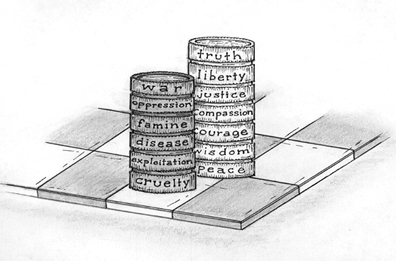
“Let the tournament begin!” © Linda Arkelian.
facts. On the contrary, violence, injustice, and oppression are as prevalent today as ever. Our long-expected better day may yet turn out to be a bitter one instead. At best, complacency will garner us more of the same — bloody conflict, squalor, and misery for the many, empty materialism for the few. Democratic government and entrenched human rights may continue their incremental erosion until they collapse, like a shelter whose foundation has deteriorated from neglect and misuse. Or, we may finally ignite the nuclear conflagration or global environmental catastrophe we daily court with our greed and indifference. We have much to fear — war, famine, disease, creeping tyranny, reckless poisoning of our environment. Terrorism is the fashionable bogey lately, the bête noire du jour, but danger it poses is, in the long run, the least of our worries. The question is: will we continue to allow selfish indifference to blind us as we shuffle aimlessly along the edge of the precipice; or, will we cast aside apathy and face our fears, fashioning the means to free ourselves from their yoke forever? Will we turn with relentless will and purpose to the task that needs doing — remaking the world into a place of truth, justice, liberty, and compassion? If so, we need to establish security, equity, fundamental freedoms, and tolerance — or, in a word, dignity — for all.
“Within a system which denies the existence of basic human rights, fear tends to be the order of the day. Fear of imprisonment, fear of torture, fear of death, fear of losing friends, family, property or means of livelihood, fear of poverty, fear of isolation, fear of failure. A most insidious form of fear is that which masquerades as common sense or even wisdom, condemning as foolish, reckless, insignificant or futile the small, daily acts of courage which help to preserve man’s self-respect and inherent human dignity.” (3)
I. Fundamental Freedoms
If we are to be truly free we have to advance and protect rights of Man. In the Western democracies, the main threat to those rights is our own indifference and (lately) our susceptibility to accepting their curtailment in the spurious name of security. It is far better to face the dangers posed by terrorism (and other, more mundane forms of crime) than to submissively cast aside the very things — our fundamental freedoms — that define who we are and set us above those who wield fear and violence. But it is not enough just to cherish those rights ourselves. We must be every bit as tireless in ensuring that the rigorous observance of fundamental rights is the governing principle of all mankind. If our rights are to mean anything, they cannot be for us alone.
The nature of fundamental rights is no mystery. They are enshrined in the constitutions of the West and in binding international conventions. They include the freedoms of conscience, religion, speech, and assembly; the rule of law; a free press; the citizen’s right to elect a responsible government in free and fair elections; and checks and balances on the executive, legislative, and judicial powers of government. Fundamental rights bar arbitrary arrest, and they require that arrested persons be promptly brought before a court and charged with a specific offense. (The principle of habeas corpus precludes secret detention or protracted imprisonment without trial.) Those charged with a crime are entitled to legal representation by counsel of their choice, access to visitors, and a fair and open trial. Every accused person has the right to hear the evidence against him and to face his accusers. He has the right not to incriminate himself. And, there is an absolute right not to be tortured, or to be otherwise subjected to cruel or inhuman punishment. Even that most basic and inalienable of human rights has been under attack since 9/11 — alarmingly, from high officials in the leading nation of the free world.
Fundamental rights were fought for and won at great cost, but we have become neglectful of them, forgetting their inestimable value and failing to safeguard them with the zealousness that is not only their due but also our duty as a free people.
II. Security
“Cultural conflicts are increasing and are… more dangerous today than at any other time in history. The end of the era of nationalism has been catastrophic. Armed with the same supermodern weapons, often from the same suppliers, and followed by television cameras, the members of various tribal cults are at war with one another.” (4)
“Strength [has] value only when it [serves] a just cause.” (5)
“Fear, like so many things, is a habit. If you live with fear for a long time, you become fearful.” (6)
To be free from fear, we must feel that we are secure. Yet we seem gripped
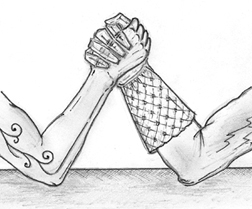
“The final contest: Virtue against power” © Linda Arkelian.
in a culture of fear, and it is fear rather than wisdom that guides too many of our choices. Too often rich and powerful nations seek security through their wealth and power alone, neglecting more important cornerstones of lasting security — things like justice and compassion. To be truly secure, we must put the lie to the notion that ‘Justice is for the weak, and the strong can do whatever they want.’ Lasting strength is rooted in justice. And, real security must mean security for all — for rich and poor, for weak and strong. No country, or group of countries, can create a lasting bastion of safety and tranquility for themselves to the exclusion of the less fortunate. To make exclusive claims on security for the few, with indifference to the suffering many, is to invite perpetual danger for ourselves and misery for everyone else. Instead, we must rededicate ourselves to collective security, to enlisting all of the nations of the world in safeguarding each other’s security. We can do that by putting aside unilateralism and returning to the long and difficult work of building a system of international institutions and laws that offer meaningful protection to all. The dangers posed by aggressive states, by terrorists, by nuclear proliferation (and the still not achieved comprehensive ban on the testing of nuclear weapons), by creeping environmental catastrophe, by existing pestilences like AIDS and looming pandemics like influenza, by the militarization of space, by human rights abuses and tyranny, by ideological extremism, and by economic exploitation of the poor by the rich — all of these dangers, and more, can best be addressed multilaterally. Where institutions are weak, or recalcitrance is strong, then the work will be difficult, but we must not shirk it. We can start with confidence-building measures, by, for example, foreswearing the unilateral use of force, consistently and vigorously demanding respect for human rights, and by unequivocally committing ourselves to human life and human dignity — through substantially increased foreign aid, a permanent cessation of arms sales, and a unilateral end to nuclear testing. We should dedicate ourselves to the proposition that physical security and economic justice are the due of all mankind and then work hard to make that goal a reality.
III. Equity
“Kindness… is in a sense the courage to feel concern for the people. It is undeniably easier to ignore the hardships of those who are too weak to demand their rights than to respond sensitively to their needs. To care is to accept responsibility, to dare… [to be] the strength of the helpless.” (7)
A secure world, a world without fear, is one with equality of opportunity. In the West, most of us take a comfortable life for granted; most of the world’s inhabitants are not so lucky. A comfortable life requires a good standard of living, with access to food, water, housing, health care, education, and
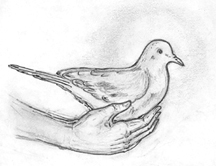
© Linda Arkelian
employment. It includes opportunities for both advancement and for recreation, and it needs unfettered access to ideas — in addition to the basic human rights and personal security discussed above. Of course, there’s more to life than just being “comfortable,” or we in the West would represent the pinnacle of human fulfillment instead of finding ourselves so often bereft of meaning and purpose. Comfort is not the destination, but it is a prerequisite for making the journey. Without an equitable distribution of the world’s resources and wealth, we cannot achieve a world without fear. The gross disparities — in wealth, education, and freedom — that beset this world fuel endless resentment, aggression, and conflict. A world where poverty, starvation, and squalid misery are the lot of many, while a fortunate few regard wealth as their birth-right, is an unjust world. If our goal truly is a better day, then we must adopt, as an urgent priority, the righting of that wrong, sacrificing, if need be, our own excess to eradicate the scarcity of others.
IV. Tolerance
“The quintessential revolution is that of the spirit…” (8)
“The truly reliable path to… peaceful coexistence… must be rooted in self-transcendence: transcendence as a hand reaching out to those close to us, to foreigners, to the human community, to all living creatures, to nature, to the universe; transcendence is a… need to be in harmony even with what we ourselves are not, with what we do not understand, with what seems distant from us…” (9)
For as long as Man has existed, his fiercest nemesis has been his own capacity and compulsion for devising categories which exclude others. It hardly matters whether the dividing line between “us” and “them” is nationality, religion, language, ethnicity, gender, class, or color. All of those differences obscure the fundamentals we share in common. Leftovers from tribalism, they denote the savage that lurks within us — the darkness that permits us to neglect, oppress, or destroy any who are deemed to be “other.” Unless we conquer that instinct within ourselves, it will be our undoing. Before we can create a culture of peace, we have to create a culture of tolerance and understanding. We can start with simple things, like ensuring that all school-children everywhere learn more than one language, by implementing widescale exchange programs between children (and young adults) of different linguistic, cultural, national, or religious backgrounds, and by ensuring that our school curricula immerse students in the culture and history of lands besides their own. Internationally, we must practice what we preach about abhorring ethnic conflicts. When one group rises in arms to enslave or slaughter another, we must intervene – promptly and vigorously. There must be no more Rwandas, if we truly want a better day. First and foremost, we must create a structure for tolerance — at home and abroad — teaching tolerance and enforcing it, where goodwill alone does not suffice. We need to prove by our consistent example that we will take responsibility for the world and oppose all its injustices — even these propelled by our own self-interest.
V. The Sleeper Must Awaken
“It has been given to me to understand how small this world is and how it torments itself with countless things it need not torment itself with, if only people could find within themselves a little more courage, a little more hope, a little more responsibility, a little more mutual understanding and love.” (10)
“For it is the dawn that has come, as it has come for a thousand centuries, never failing. But when that dawn will come, of our emancipation, from the fear of bondage and the bondage of fear, why, that is a secret.” (11)
Mankind has been sleepwalking through all of our existence. Will we awaken at last from our long, enervating slumber? Will we behold the havoc and
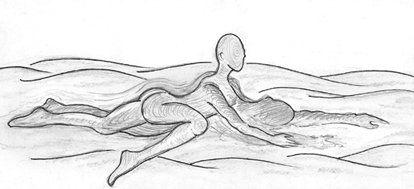
“Leaving our shadow-selves behind: The sleeper must awaken!” © Linda Arkelian.
suffering we have wrought across history? Will we confront the savage lurking within each one of us and say, finally, “Enough!” Will we take real responsibility at long last by declaring that what has always been — cruelty, injustice, and war — is acceptable no more? If we truly want a better day, to replace so many bitter ones, the answer must be yes. The sleeper must awaken.
John Arkelian is an author, journalist, and lawyer.
Linda Arkelian is a dancer, choreographer, teacher, and artist.
Text © 2004 by John Arkelian.
Illustrations © 2004 by Linda Arkelian.
Footnotes:
1. Aung San Suu Kyi, Freedom from Fear and Other Writings (New York: Viking, 1991) 184. 2. Eugene V. Debs (Sept. 14, 1918), cited in William Safire, Lend Me Your Ears: Great Speeches in History (New York: W.W. Norton & Co., 2004). 3. Aung San Suu Kyi, 184. 4. Vaclav Havel, The Art of the Impossible: Politics as Morality in Practice (Toronto: Knopf Canada, 1997) 168. 5. Aung San Suu Kyi, 190. 6. Ibid., 234. 7. Ibid., 172. 8. Ibid., 183. 9. Havel, 173. 10. Ibid., 229. 11. Alan Paton, Cry, the Beloved Country (1948).
Editor’s Note: The foregoing essay, “Freedom from Fear,” first appeared in our hard-copy magazine (Artsforum, Issue #11, Winter 2004/05) over seven years ago. Sadly, its plea for collective security and human rights is as desperately urgent — and as utterly unsatisfied — today as the day it was written. It is reprinted here as part of an occasional visit to our archives.
(March 2012)
****************************************************************
The Future of American Democracy
© By Congressman Dennis Kucinich and Russell Simmons
Congressman Dennis Kucinich
This is not a progressive issue or a conservative issue. This is not a Tea Party issue or a liberal issue. This is an American issue. Money is destroying our politics and our political system. The signs are everywhere. A “SuperPAC”** supporting Mitt Romney spent $3.5 million to knock Newt Gingrich out of the lead in Iowa. A SuperPAC supporting Newt Gingrich spent a greater amount of money to return the favor to Mitt Romney in South Carolina. Our electoral system has become such a joke that two late-night comedians are now actually participating in it and are generating great laughter just by demonstrating how it operates.
In the past, Congress has made two bipartisan efforts to control the impact of money on our elections, first in the early 1970’s and more recently with the Bipartisan Campaign Reform Act of 2002, known as “McCain-Feingold.” Both of these laws tried to restrict the influence of money on our elections. But after each of these efforts, the Supreme Court kicked down the door and allowed campaign money to flow more freely.
First, in Buckley v. Valeo, the Court held that money is the equivalent of “free speech” under the First Amendment, and that no act of Congress could restrict the amount of money that an individual could contribute to his or her own campaign or expend in support of another person’s campaign as long as that expenditure was “independent” of the campaign. This decision gave the “one percent” a voice in our elections that greatly exceeds the concept of “one citizen, one vote.”
Then, in January 2010, in Citizens United v. Federal Election Commission, the Supreme Court went off the deep end and ruled that corporations are “persons” under the First Amendment and that no act of Congress could restrict the amount of money a corporation could spend in an election. This decision gives all U.S. corporations (and all U.S. subsidiaries of foreign corporations) all the same rights to participate in our elections that individual U.S. citizens have, excepting only the right to actually vote.
The concept of giving corporations the same rights as individuals would have staggered our “founding fathers.” Corporations in their present form did not even exist in 1789, when the Bill of Rights was ratified. The Bill of Rights was written to protect individuals from the power of the federal government. It was later extended by the Fourteenth Amendment to protect individuals from similar abuses by state governments. Where in this “original intent” was there any expression that corporations should have the same rights as individuals to participate in our electoral process?
We must get money out of our politics and out of our electoral system. We must eliminate the influence of multi-national corporations and foreign corporations on the government of our country. Since the Supreme Court majority is obviously opposed to such reforms, the only way to correct our system is through a constitutional amendment that will take money out of our electoral system.
This week, a constitutional amendment was introduced in Congress that will require all federal campaigns — that is, campaigns for President, Vice-President, Senator and Representative — to be financed exclusively with public funds; it will prohibit any expenditures from any other source, including the candidate. This amendment will also preclude any expenditures in support of, or in opposition to, any federal candidate, so that special interest groups will not be able to influence elections either. This amendment does, however, maintain our historical “freedom of the press” and preserve the traditional role that the media have played in our electoral process.
It is clear: Money has become a corrupting influence in our political system. This is one of the most important issues of our time. We must rescue American democracy. Together, we are committed to protecting the future of our democracy, and that is why we have come together to promote this constitutional amendment. Whether you are a Republican, Democrat, or independent, we urge you to join us.
Dennis Kucinich is a member of the U.S. House of Representatives, where he has represented Ohio’s 10th Congressional District since 1997. A former mayor of Cleveland, Mr. Kucinich has twice been a Democratic candidate for the office of President of the United States.
Copyright © January 2012 by Congressman Dennis Kucinich and Russell Simmons.
Editor’s Note: In American electoral parlance, a “PAC” (or “political action committee”) is a private group set up to support particular candidates for political office and/or to promote one side of a particular public policy issue. Interest groups, unions, and corporations make their contributions to political parties and candidates through the mechanism of a PAC. Controversial decisions by the U.S. Supreme Court and the U.S. Federal Court of Appeals opened the door to the rise of so-called “super-PACs” — starting in the 2010 federal elections. “Super-PACs” can raise unlimited funds from corporations, unions, interest groups, and individuals. Technically, those entities are supposed to be “independent” from the candidate or party they are supporting; but said independence is more theoretical than real, and many “super-PACs” openly support particular candidates. Unlike traditional “PACs,” there is no limit on how much money “super-PACs” can donate. Both types of “PACs” are obligated to disclose their donors; however, “super-PACs” use a loophole to postpone said disclosure until after the applicable election is over, thereby evading meaningful scrutiny. JA
*****************************************************************
Is Greece finished?
© By Yanis Varoufakis
In one sense, Greece was finished the moment the Great Recession cut its growth rate (in the second quarter of 2009) from among the highest in Europe to almost zero. Given its high, and increasing, debt-to-GDP ratio, not to mention the recent run on Dubai’s private-cum-sovereign debt, Greece’s stalled economy precipitated a run on Greek bonds. The writing was on the wall: The huge bailout could only ever delay the inevitable default, especially so in view of the swinging government expenditure cuts that were the condition for the bailout; cuts that have led to a precipitous collapse of demand, a subsequent run on Greek banks (and a flight of deposits to Switzerland and Germany), a wholesale investment strike, and the overarching recession which has already pushed Greek GDP down by 15% since 2008/9. Add to the mix the July 21, 2011 EU Agreement (and in particular the sad reality that that Agreement was not worth the paper it was scribbled on), and what you get is the logical conclusion that Greece is about to default. And since default within a highly financially integrated eurozone is unthinkable, the same train of thought takes its ‘passengers’ straight to the junction where Greece decouples and parts ways with the eurozone.
In another sense, however, and even though most of the above analysis is correct, the conclusion reached in the previous paragraph misses the most crucial of points: Greece cannot exit the eurozone without setting in motion a brief sequence of catastrophic moves which will cause Germany to bail itself out of the eurozone before it itself loses its triple-A rating. (Why and how is something that I have explained on a previous occasion when Greece’s exit from the eurozone was touted.)
Of course, none of this means that the present path is sustainable. Greece’s debt will be downsized, if not liquidated, one way or another. A hard Greek default can only be prevented by means of steps that the current European leadership seems determined to avoid, even if the price of such avoidance is the euro’s collapse. So, the big question is whether the eurozone can survive with a member-state in a state of chronic default. In theory, it could be possible to have a member-state of a currency union that cannot meet its obligations to creditors and thus remains in some form of receivership until it can climb out of its hole. In practice, however, such a scenario is pure fiction when such a destabilizing event occurs within a currency union lacking all institutional mechanisms for recycling surpluses in a manner that might restore stability.
We hear that German Finance Minister Wolfgang Schauble is preparing his country’s banks for the shock of Greek default. Do not believe a word of it. He cannot pull this off, and he knows it. At some point, he thought that time would allow Germany’s banks to work out ways of insulating themselves from a Hellenic shock. Instead, they seem more vulnerable today than ever. So, what on earth is going on? What is Mr Schauble really doing? What plans is he trying to hatch?
As I have consistently argued, Greece will not be allowed to default before Germany first puts in place a decent plan for splitting Greece’s monetary system from that of the surplus countries. But if I am right that such a plan cannot involve the mere expulsion of Greece from the euro, as it will kick off a chain reaction that will eventually knock France out for a sixer, before returning to Frankfurt and Berlin to haunt the ‘planners,’ the only logical conclusion that I can come to is that, behind all the talk of a German plan to contain a Greek default or to push Greece out of the euro, lies the groundwork for a pragmatic plan that sees Germany bailing itself out. Such a plan would entail Germany rounding up countries it truly deems worthy of sharing its new currency with (the other three surplus countries of the existing eurozone, plus perhaps Poland, the Czech Republic, and even Estonia) and exiting in the most orderly manner possible; offering, for example, to the eurozone countries that will be left behind (fretting France in particular): a few gifts (e.g. Germany may choose to foot the bill for existing bailouts), an illusion of unity (e.g. suggesting that the new Germanic currency is also minted and administered by the European Central Bank – which will now be responsible for more than one currency at once), and some vague promises (of possible fusion of these currencies, once the ‘right’ discipline has been knocked into the hearts and minds of the undisciplined).
To sum up, when I hear that Germany is planning for a Greek exit for the eurozone, even for a Greek default, I immediately suspect that Germany is planning a controlled disintegration of the eurozone, and, at once, I fear that it will only manage to achieve an uncontrolled disintegration, whose end result will be massive recession in the European north and gargantuan stagflation in the European periphery. Or, as the Bard might have said, ‘For in that sleep of debt what dreams may come, When we have shuffled off this Greek coil, Must give us pause…’
Yanis Varoufakis teaches political economics at the University of Athens. Visit his blog at http://yanisvaroufakis.eu/
© 2011 by Yanis Varoufakis.
******************************************************************
Tear Down the Firewalls
© By Birgitta Jonsdottir
I am born on a small island at the edge of the world with only 315,000 people sharing it with me. My island has natural borders, with the roaring Atlantic Ocean creating a shield against the rest of the world. That shield can cause an intense sense of cultural and personal claustrophobia. Nepotism thrives and everything becomes predictable. You are either related to everyone you meet or you and another know someone mutual intimately. This can be a curse or a blessing, depending how you look at it. I never really fit in the box people tried to put me in, and I felt increasing discomfort with the labels attached to me by my relatives and by perfect strangers who had heard something about me through the grapevine. The only way out of this box — which had shaped itself around me much like the binding of feet to make them small or the placing of rings around a neck to make it long — was to hitch a ride on an iron bird. And so I did. I found the layers of expectations dissolve, and I discovered that I was not the person my environment had tried to make me believe I was. After many years of experimenting with new countries, new people, and the unknown, I was ready to settle on my island, because I had discovered that I don’t belong to any one nation. I am free to say, instead, that I belong to all of this planet — and that its borders are just an optical illusion.
One of the prime influences in shaping this view was my participation in co-creating the landscape of the new world online. In 1995, I started working with the shapers and pioneers in the internet landscape in Iceland and beyond. One of my passions was to merge creative spaces: music, poetry, and art all bleed well together in the multi-creative space of the internet. But that was not enough. After all, this was a new world, without borders and without limitations, other than the limitations of our imagination. We could shape it with impossible ideas that became reality because likeminded people found each other, no matter where they happened to be located in the real world. We could work together — trans-border, trans-culture, transgender, trans-party, trans-race. It was a world of transparency, almost beyond duality. It was as close to paradise as I could get in this human vessel. It was almost spiritual; it was as if the collective consciousness had taken on tangible shape in a virtual world that was influencing the real world at an increased speed every day. My dream was that this world we created with the free flow of ideas, information, and understanding could manifest itself outside the virtual.
The internet has given us the tools to empower ourselves in the real world, with knowledge beyond the cultural conditioning we acquire within our own culture. The internet has given us the tools to work together beyond traditional borders, and it has allowed us to create real windows into the real world that reach far beyond our cultural beliefs about other countries. However, this world beyond borders is now under serious threat, a threat that is growing at an alarming rate. I have seen the development of the internet since its early visual stage. I have seen how it can improve and enrich the quality of life with the free flow of information and expression. I have also seen how those who hold the reigns of power in our world have discovered that the internet needs to be tamed, like the rest of the world, and brought under their control — to be industrialized in the same manner that other media have been brought under control by industry and the state. My last hope of gathering momentum in stopping this development is through the free spirit within the wilderness of the internet — where the conditioning and the reigns of control have not been able to tame the free spirits who roam with the hackers’ manifesto singing in their hearts.
I have seen new stories and new myths emerge out of the language of the internet, where people speak together through Google and translate new languages; and I have seen the library of Alexandria materialize with free knowledge and torrents of information wash upon shores otherwise impossible to reach. I have seen the alchemy of stories take on real shape in a collective online effort; and the truth seeped into the real world. As the untouchables try to hide their secrets for the chosen few, those secrets keep spilling out in a whirlwind of letters in every digital corner of the world. They sweep through the streets of Iraq, Afghanistan, Egypt, Tunisia, Greece, Iceland, Hungary, Libya, and the United States — confirming that the rumors are true: “corpocracy” is the new global empire, and it thrives in local corruption.
The internet has given people access to information that should remain in the public domain; yet it is a trending policy to make everything secret by default, without a consensus about the process of deciding what needs to be kept secret. Transparency and open access to information are the only real pressures on governments to remain true democracies. If you don’t have freedom of information and expression, you are not living in a democracy; rather it’s the rule of dictatorship with many heads. Many people don’t realize that if we won’t have freedom of information online, we won’t have it offline.
The culture of free flow of information is still strong online, and every attempt to block, hinder, or erase information is met with increased creativity. Yet those of us who care for freedom of information have to step-up our quest to remove the gags, tear down the firewalls, and dissolve the invisible filter borders. The telecom companies have gained incredible power and tend to cave-in under government pressure, as we saw happen in Egypt in early 2011. We also saw Amazon cave-in under political pressure and kick WikiLeaks off its cloud. We have information refugees moving from one IP host to another and from one country to another, never knowing when the current IP host may be forced to kick them out. Information refugees usually publish material that is critical of governments or corporations. Corporation and specialized law-firms are trying to find the best country to serve as a medium to attack and gag journalists, writers, publishers, and the rest of the media. They have become so good at it that unwanted stories have vanished from the public domain. Modern book-burnings occur every day in every library in the world by a click of a button. Libel tourism, prior restraints, gag orders, out-of-court settlements, and tampering with our online historical records are altering our current history in real time and robbing us of the possibility to be informed about the activities of the most influential corporations and politicians in our world. We have to do everything in our power to stop this development — through lawmaking and creative resistance. The “Icelandic Modern Media Initiative” (IMMI) is an attempt to raise the standard and upgrade the current legal framework to strengthen freedom of information, speech, and expression in our world.
You can find more information about that initiative and its institution at http://immi.is. There are many other organizations that resist and inspire, among them, EFF, WikiLeaks, Index on Censorship, and Avaaz — to name a few. You can make a difference. Be inspired!
Birgitta Jonsdottir is a member of the Icelandic parliament and chairman of the board of directors for the International Modern Media Institute.
© 2011 by Birgitta Jonsdottir.
******************************************************************
War on the Middle Class in America
© By Senator Bernie Sanders
Mr. President, there is a war going on in this country, and I am not referring to the wars in Iraq or Afghanistan. I am talking about a war being waged by some of the wealthiest and most powerful people in this country against the working families of the United States of America, against the disappearing and shrinking middle class of our country.
The reality is many of the nation’s billionaires are on the warpath. They want more, more, more. Their greed has no end, and apparently there is very little concern for our country or for the people of this country if it gets in the way of the accumulation of more and more wealth and more and more power.
Mr. President, in the year 2007, the top one percent of all income earners in the United States made 23.5% of all income. That is apparently not enough. The percentage of income going to the top one percent has nearly tripled since the 1970s. In the mid-1970s, the top one percent earned about 8% of all income; in the 1980s, that figure jumped to 14%; in the late 1990s, that one percent earned about 19%. And today, as the middle class collapses, the top one percent earns 23.5% of all income — more than the entire bottom 50 percent. Today, if you can believe it, the top one-tenth of one percent earns about 12 cents of every dollar earned in America.
We talk about a lot of things on the floor of the Senate, but somehow we forget to talk about the reality of who is winning in this economy and who is losing. It is very clear to anyone who spends two minutes studying the issue that the people on top are doing extraordinarily well at the same time as the middle class is collapsing and poverty is increasing. Many people out there are angry, and they are wondering what is happening to their own income, to their lives, to the lives of their kids.
If you can believe this, since between 1980 and 2005, 80% of all new income created in this country went to the top one percent — 80% of all new income! That is why people are wondering: What is going on in my life? How come I am working longer hours for lower wages? How come I am worrying about whether my kids will have as good a standard of living as I had? From 1980 until 2005, 80% of all new income went to the top one percent.
After we bailed them out, Wall Street executives — the crooks whose actions resulted in the severe recession we are in right now; the people whose illegal, reckless actions have resulted in millions of Americans losing their jobs, their homes, and their savings — are now earning more money than they did before the bailout. And while the middle class of this country collapses and the rich become much richer, the United States now has by far the most unequal distribution of income and wealth of any major country on Earth.
Mr. President, when we were in school, we used to read the textbooks which talked about the banana republics in Latin America. We used to read the books about countries in which a handful of people owned and controlled most of the wealth of those countries. Well, guess what? That is exactly what is happening today in the United States. And apparently the only concern of some of the wealthiest people in this country is more and more wealth and more and more power — not all of them, by the way. Not all of them. There are many wealthy people in this country who understand that it is important is that all of us do well. And this is an issue — greed is an issue — we have to deal with.
In the midst of all of this growing income and wealth inequality in this country, we are now faced with the issue of what we do with the Bush tax cuts of 2001 and 2003. And if you can believe it, we have people here, many of my Republican colleagues, who tell us: ‘Oh, I am so concerned about our record-breaking deficit. I am terribly concerned about a $13.7 trillion national debt. I am terribly concerned about the debt we are going to be leaving to our kids and our grandchildren. But wait a minute. It is very important that we give, over a 10-year period, $700 billion in tax breaks to the top two percent.’ Oh yeah, we are concerned about the debt, we are concerned about the deficit, but we are more concerned that millionaires — people who earn at least $1 million a year or more — get, on average, $100,000 a year in tax breaks. So we have a $13.7 trillion national debt, and growing, we have growing income inequality — the top one percent earning more income than the bottom 50 percent — but the highest priority of many of my Republican colleagues is to make sure millionaires and billionaires get more tax breaks. I think that is absurd.
But it is not only income tax rates that we are dealing with; it is the estate tax as well. And let’s be clear. While some of my friends want to eliminate completely the estate tax — which has been in existence in this country since 1916 — every nickel of those benefits will go to the top three-tenths of one percent. If we did as some of my friends would like — eliminate the estate tax completely — it would cost us $1 trillion in revenue over a 10-year period, with all of the benefits going to the top three-tenths of one percent.
So I am sure that in a little while my friends will come to the floor and say: We are very concerned about the deficit, we are very concerned about the national debt, but do you know what we are more concerned about? Giving huge tax breaks to the wealthiest people in this country.
Mr. President, the tax issue is just one part of what some of our wealthy friends want to see happen in this country. The reality is that many of these folks want to bring the United States back to where we were in the 1920s, and they want to do their best to eliminate all traces of social legislation which working families fought tooth and nail to develop to bring a modicum of stability and security to their lives.
There are people out there — not all, but there are some — who want to privatize or completely eliminate Social Security. They want to privatize or cut back substantially on Medicare. Yes, if you are 75 years of age and you have no money, good luck to you getting your health insurance at an affordable cost from a private insurance company. I am just sure there are all kinds of private insurance companies out there just delighted to take care of low-income seniors who are struggling with cancer or another disease.
Furthermore, there are corporate leaders out there, and many Members of Congress, who not only want to continue but to expand our disastrous trade policies. My wife and I went shopping the other day — started our Christmas shopping — and we looked and we looked and virtually every consumer product that was out there in the stores was China, China, and China. We seem to be a country in which we have a 51st State named China which is producing virtually all of the products we as Americans consume.
Our trade policy has resulted in the loss of millions of good-paying jobs as large corporations and CEOs have said: Why do I want to reinvest in America when I can go to countries where people are paid 50 or 75 cents an hour? That is what I am going to do: To heck with the working people of this country. So not only are we saddled with this disastrous trade policy, but there are people who actually want to expand it.
While we struggle with a record-breaking deficit and a large national debt — caused by the wars in Iraq and Afghanistan, caused by tax breaks for the wealthy, caused by an unpaid-for Medicare Part-D prescription drug program, caused by the Wall Street bailout driving up the deficit, driving up the national debt — some people will say: ‘Oh my goodness, we have all those expenses, and then we have to give tax breaks to millionaires and billionaires, but we want to balance the budget. Gee, how are we going to do that?’
Obviously, we know how they are going to do that. They are going to cut back on health care, they are going to cut back on education, they are going to cut back on child care, and they are going to cut back on ‘Pell programs.’* We just don’t have enough money for working families and nannies. We are going to cut back on food stamps. We are surely not going to expand unemployment compensation. We have a higher priority, Mr. President: We have got to, got to, got to give tax breaks to millionaires. I mean, that is what this place is all about, isn’t it? They fund the campaigns, so they get what is due them.
Amazingly enough, we have the CEOs on Wall Street and the large financial institutions that want to rescind or slow down many of the provisions — the very modest provisions — in the financial reform bill. I voted for the financial reform bill, but I will tell you clearly that it did not go anywhere near far enough. But it went too far for our Wall Street friends and their lobbyists, who are all over here. And for the hundreds of millions of dollars Wall Street spends on this place, they want to rescind, or slow down, some of the reforms.
These people want to cut back on the powers of the EPA and the Department of Energy so that Exxon-Mobil can remain the most profitable corporation in world history while oil and coal companies continue to pollute our air and our water. Last year, Exxon-Mobil made $19 billion in profit. Guess what? They paid zero in taxes. They got a $156 million refund from the IRS. I guess that is not good enough. We have to give the oil companies even more tax breaks.
So I think that is where we are. We have to own up to it. There is a war going on. The middle class is struggling for existence, and they are taking on some of the wealthiest and most powerful forces in the world whose greed has no end. And if we don’t begin to stand together and start representing those families, there will not be a middle class in this country.
Bernie Sanders is a United States Senator (Independent) from Vermont. Senator Sanders delivered the foregoing speech on the floor of the United States Senate on Tuesday, November 30, 2010. The edited version appearing here is reprinted with permission.
© 2010 by Sen. Bernie Sanders.
* The U.S. Federal Pell Grant Program provides need-based grants to low-income undergraduate and certain post-baccalaureate students to promote access to post-secondary education.
*******************************************************************
At Arm’s Length
© By Justine Ponomareff
“There is a completely blurred line between spectator and participant.” (Emily Haines of Metric)
As a society, we are removed from nature. We watch it exist behind a glass wall or a television screen. That’s what we are, a society of observers. We are comfortable observing. We go to the zoo, turn on the television, and sit amongst the audience. We are content doing these things. But when an animal shatters the image of pleasant obedience to which our society is so accustomed, shock ensues. We are used to animals adhering to the limitations we set for them, and when these limitations are ignored, it becomes apparent that observing is not as harmless as we’d like to believe.
Quesero the Spanish bull made three attempts before managing to heave his half tonne body over the arena’s barrier, and then over a wire barrier and into the stands. In a state of desperation he began to rampage through the crowd. This was only three months ago during a ‘recortes’ in Northern Spain, an event that involves men getting as close to the bull as possible without getting harmed. The stands were filled with thousands of spectators, many of whom were taunting and heckling the bull before he escaped. The people who paid to see this display of bravado, who sat, watched, and cheered for every sad and confused pass Quesero made, were not expecting to be forced into a state of accountability. Their jeering was replaced with sheer panic as the bull ran rampantly through the stands, injuring forty. These people were not injured because this bull was vicious, but because they chose to support an event that confuses and torments bulls, making spectacles of them. The crowd didn’t expect to become a spectacle themselves – an example of what can happen when animals have reached their breaking point. Quesero was shot for doing what his instincts told him to — charging his tormentors, which in the confines of the arena would have earned him applause.
Only a month later, across the world in Japan, a dolphin named Kuru made her own desperate bid for freedom. But she was not seeking the same sort of freedom as Quesero. During a marine show the dolphin leapt out of her tank, landing on the floor in front of the rows of spectators. It is fair to assume that a collective gasp and a sudden hush followed this unexpected occurrence; seeing a dolphin out of the water is to see them in their most vulnerable state, and it’s extremely unnerving. In the wild, dolphins swim hundreds of miles in a single day. In captivity they swim circles around a tiny tank and turn tricks for our delight. They smile in that oh-so-sapient way because it’s what humans want. They are such bright creatures, but it seems to be wasted on us. We think that by clapping we are showing appreciation for their athleticism and grace; but the only way to honour beauty is to let it be. And humans seem to find it so hard to just let the natural world be; we need to package it and put it on a pedestal. And, to the audience’s relief, Kuru was rescued and put back on her pedestal — probably the last thing that she wanted. We go to the marine show to see a beautiful animal flip, jump, spin, and, of course, smile. But we don’t expect to see them deliberately leap out of the one thing that is keeping them alive. We don’t expect a dolphin to leave the water, the one thing separating us from them. No distance between us and the entertainment, that’s what we really find unnerving.
These are just two recent examples of animals ignoring the restraints that humans cherish. This has been happening for thousands of years, and with the invention of television, internet, and now YouTube, observing has become that much more convenient and private. But if it is this uncomfortable to be placed in the unfamiliar and unfavorable role of participant, why are animals still used for entertainment? Because we all want a show. We want a show badly enough to ignore the ‘incidents’ that test our comfort levels and blur our boundaries. To us, none of this is madness, it’s just something that happens, and then we’re onto the next thing. It doesn’t matter what that thing may be, as long as we’re liking it we feel good. Instant gratification and self-preservation: it’s when the two start conflicting that we suddenly start caring. And, even then, it’s never our fault. Instead, these incidents are the result of a ‘rogue’ animal who had abnormal or vicious tendencies.
Most of the time, it’s safe to poke and prod from a distance; we came, we paid, we watched. It’s rare that we are forced into that state of accountability — rare enough that we can retain our sense of moral integrity. But sometimes the whale pins their trainer to the bottom of the tank. Sometimes the tiger mauls their tormentor. Sometimes an angry bull rampages through a crowd. Sometimes a circus elephant crumbles under the weight of a lifetime of abuse. When these things happen, we witness the impact of the limitations we place on animals. We may not be the matador, the trainer, the provoker, or the ringmaster, but we’re the ones condoning this exploitation. Whether or not we choose to acknowledge it, the things we observe have consequences.
Justine Ponomareff is a writer and prospective student of journalism.
© 2010 by Justine Ponomareff.
******************************************************************
We all Live in One Big Disney World
© By Peter Berg
Why do people still drive all the way to Florida and visit Disney World when they can enjoy the same unreal theatre, called life, at home? These are strange times and they are getting stranger by the day.
Mass media, politicians, economists, and businessmen are telling us that we are only in a temporary crisis. Economic growth is just around the corner. Meanwhile, governments all over the world borrow record amounts of money for which future generations will be on the hook. Nobody states the ugly truth: this debt will never be paid back. Instead, we start the printing press, so much so that even the famous Public Debt Clock in New York ran out of digits. South of the border, they are now finding themselves in more than $13,500,000,000,000 of federal debt. This is equivalent to about $40,000 for every citizen of the country but, more importantly, about $80,000 for every working citizen — never mind the personal, state, or municipal debts that need to be added to this figure.
Debts are a bet about future economic growth. Without growth, default is looming. Unfortunately, our species has exceeded the carrying capacity of the planet. The Earth cannot sustain the rates of resource flows that we are demanding. We have literally run up against the limits of our biosphere and, hence, the limits to growth. Our very monetary system predominantly based on virtual money rather than coins and notes, is at stake. It is a very telling development that nobody, especially economists, has a clue any longer what is happening to our world. Meanwhile, events are unfolding at an accelerating pace, often so surreal in nature that just five years ago we thought they were impossibilities.
Miscommunication and misinformation is adding to the sense of being at a loss, a feeling that many of us experience these days. For example, a couple of months ago, it was announced that the U.S. Federal Reserve is buying government debts! How is that even possible when the government is borrowing from the Federal Reserve (a conglomerate of twelve private banks) in the first place? It must be imprecise bankers’ jargon, the validity of which is no longer questioned. How can you buy something you are in turn owing to someone else? A negative price? Surely, they must mean that the Federal Reserve is issuing debts to the government, i.e. lending money. Or else, as one person put it: “The only hope is that this debt chases itself in circles until it devours itself and disappears into nothingness!” It all sounds a bit desperate to me.
It is a sad reality that there are no sufficient public funds to retire the baby boomers while we maintain the same standard of living. And, no, substantial economic growth will not return, unless it comes in disguise, namely inflation. Canada has avoided the most severe consequences of the global meltdown so far. However, are we not following other nations into Lalaland when we place all our bets on an over-inflated housing market that enslaves people through 30-year mortgages? Why should Canadian home prices not come down as the U.S. economy continues to struggle and the bailout money ends? After all, it is just meant to be a stimulus — not more, not less. If we do not start making stuff in this country again, how will we create true wealth? It will certainly not be achieved by the new and so-called ‘creative class.’ Ph.D.s in psychology do not make any goods.
One might say that reality is what one observes and not what one is told. As the first decade of the 21st century is drawing to a close, we can observe the converging trends of global resource scarcity, population increase, and rising food prices. The pressure on our planet is growing. Despite of these developments, we prefer to watch celebrity news than to pay attention to a flooded Pakistan. We cheer for UFC fighters, gladiators in a socio-economic system that is approaching its end of growth, and online gambling is being launched in Ontario. In these times of crisis, the level of entertainment is reaching new lows while the distraction of the masses is reaching new highs. Perhaps, the reason is that we want to be entertained and lied to, just like a child who wants Disney World to be true.
Dr. Peter Berg is an associate professor of physics at the University of Ontario Institute of Technology (UOIT) and director of its Energy and the Environment Program. He is currently writing a book on energy, the environment, and the economy in the 21st century.
© 2010 by Peter Berg.
******************************************************************
Full-Body Airport Scanners: Intrusive Surveillance and a False Sense of Security

Kate Hanni (photo by M. Steinbacher)
© By Kate Hanni
On December 25, 2009, when the media reported on Umar Farouk Adbulmutallab’s attempt to detonate an explosive device aboard a Northwest airliner bound for Detroit, images of 9/11 were once again conjured up in the collective minds of Americans across the country. More significant was the national groan from millions of air travelers who anxiously anticipated the next wave of invasive and ineffective security procedures to be implemented by the U.S. Transportation Security Administration (TSA).
Since 9/11, the flying public has been subjected to myriad new rules as lines at security checkpoints have reached unbearable levels at many of the nation’s busiest airports. Air travelers have been subjected to supplemental gate pat-downs, the removal of shoes and belts, and restrictions on liquids and gels. Additionally, the TSA and security personnel abroad have touted the use of state-of-the-art x-ray machines and contraband detection methods. Despite these so-called “advances” in airport security training and technology, no person or machine detected the explosives on Abdulmutallab’s person Christmas day, more than eight years after the most brazen and fatal airline hijacking in history.
Once again, federal officials are back to square one in the airport security arena, despite nearly a decade of effort and investing billions of dollars. Now the TSA, backed by the federal government, believes that full-body scanners manufactured by Rapiscan hold the absolute answer to the world’s airport security woes. And let’s not forget the ringing endorsement of these scanners by former Secretary of Homeland Security Michael Chertoff, as he put on his best Billy Maysesque performance for the weekly talk shows. It all sounds perfect. Does that mean that passengers nationwide can now breathe a collective sigh of relief? Well, not quite. It turns out that Chertoff failed to mention that he is a paid consultant for Rapiscan. Fortunately, he was exposed when CNN anchor Campbell Brown questioned him on the air, forcing him to disclose his financial relationship with the company.
Despite the government’s ironclad guarantee that full-body scanners are the answer, despite the fact that the TSA has already purchased 150 Rapiscan units and is poised to purchase 300 more at a cost of $76 million to the taxpayers, and despite Michael Chertoff’s assertion that these scanners are the pinnacle of airport security evolution, there is still no consensus that these machines are even capable of detecting explosives like the ones carried by Abdulmutallab. When President Obama’s top counterterrorism aide, John Brennan, was asked on Meet the Press whether full-body scanners would have detected Abdulmutallab’s explosives, he responded, “I think it’s an unknown.” That’s hardly a ringing endorsement. So, what this all means is that an “unknown” is providing the impetus for a $76 million shopping spree at the taxpayers’ expense?
Fortunately, there are several experts who believe there are simpler, less invasive and more cost effective solutions for early detection of airport security breaches. Dr. Kenneth G. Furton, Professor of Chemistry at the International Forensic Research Institute at Florida International University is one such expert. Dr. Furton has done extensive research on the reliability of canines in the detection of forensic specimens and is convinced that the use of canines as contraband detectors is a far more effective, and certainly less expensive, tactic for sniffing out (pardon the pun) explosive materials than the use of full-body scanners. In a 2005 research article on the reliability of canine detection, published in The Canadian Journal of Police & Security Services, Dr. Furton made this assertion, “Overall, detector dogs still represent the state of the art in real-time detection of items of forensic interest. There will likely be no replacement for the use of detector dogs in the foreseeable future unless numerous compromises are made in terms of speed, accuracy, sensitivity, selectivity, reliability and mobility.” Furthermore, Dr. Furton maintains that research has shown that canines have the ability to detect explosives in a far less intrusive manner than full-body scanners.
Despite extensive research to support his assertions, even Dr. Furton believes that there is not one end-all, be-all way to prevent terrorists from smuggling explosives on board commercial airliners. What’s best, he concludes, is a multi-layered approach to airport security that is efficient, accurate, cost effective and minimally invasive to passengers. The Rapiscan full-body scanner displays none of those traits. In fact, though it can depict a person’s unclothed body with shocking detail (a virtual strip search), it is only capable of detecting objects within one-tenth of an inch of the skin on a human body. Translation: A terrorist who conceals explosives in a body cavity, crevice, adult diaper, feminine protection, or a myriad of other ways, will walk through a full-body scanner completely undetected. Yet the TSA wants to order mass quantities of an invasive technology that sees the human body, but can’t see objects hidden in it. And speaking of “invasive,” James Carafano, a homeland security expert at the Heritage Foundation assured the Washington Post that the scanners “cover up the dirty bits.” Pardon our ignorance, Mr. Carafano, but wouldn’t a terrorist be likely to hide an explosive utilizing one of those “dirty bits” if s/he had that piece of information?
The bottom line in all of this is that despite the TSA’s rush to judgment, there is no one-size-fits-all solution to improving airport security and it is irresponsible of the government to freely spend tax payer money on new technology without research to support its effectiveness. Moreover, Americans aren’t willing to be humiliated every time they fly, particularly if these scanners won’t even improve security. If the flood of messages from FlyersRights.org’s members is any indication as to the general state of mind of the nation’s air travelers regarding the use of full-body scanners, then the airlines may need to brace themselves for a very lean 2010.
Kate Hanni is Executive Director of the “Coalition for Airline Passengers’ Bill of Rights” in the United States. Visit that organization at: www.flyersrights.org
This article was originally published in “U.S. News and World Report” and is republished here with the permission of its author.
***************************************************
Twenty-one Observations on the Human Condition
© By John Arkelian
Illustrated by Linda Arkelian
(1) Death by Taser?
In October 2007, Robert Dziekanski, a 40-year old immigrant who spoke only Polish, arrived at the Vancouver Airport after 24 hours in transit, expecting to be met by his mother. Instead, he was met by neglect and indifference by airport staff who left the inexperienced traveler to his own devices for more than 10 hours — stranded in an area just shy of the main arrivals space. Had the staff done their jobs, by being proactive and showing some initiative (not to mention compassion), they would have found a way to communicate with Mr. Dziekanski and to unite him with his mother, who had been waiting nearby. Instead, he was overlooked, and he grew increasingly confused, frustrated, and emotionally agitated as the hours passed. That’s when he was confronted by four RCMP officers who proceeded to taser him five times. They shot him with darts carrying a painfully incapacitating electrical current, and they continued to do so again and again, even when he was writhing on the ground in agony. And so he died. It was an utterly unnecessary death, one that has left the credibility of the RCMP in tatters and the reputation of Canada badly tarnished. Suggestions that one bedraggled man posed any danger at all to a quartet of armed policeman (even if he was brandishing a simple office stapler) are not borne out by the videotape evidence or by plain old common sense. It’s clear that the police officers used excessive force. The very least that should happen to them is an immediate end to their careers in law enforcement. They should probably face criminal charges as well. (Take your pick: perjury, assault causing death, obstruction of justice, and/or manslaughter.) As for the infernal device that they so recklessly used on Mr. Dziekanski, the taser should either be withdrawn from service, or it should at least be immediately (and permanently) designated as a potentially lethal weapon, with its use narrowly restricted to those last-resort situations in which a police officer is lawfully entitled to discharge a firearm.
(2) A Study in Grace Under Pressure
In November 2008, a CBC journalist was freed after spending a month in a dark hole in the ground as the captive of kidnappers in Afghanistan. Her composure and modesty when she told her harrowing story in the days that followed her release made Melissa Fung a picture of serenity and grace.
(3) A Turquoise Light in the Darkness
There’s other good news from Afghanistan, and it takes the form of a place called Turquoise Mountain. It’s a school for adults that offers three-year courses in Afghan arts and crafts, things like woodworking, calligraphy, and ceramics. (There were over 650 applicants for 33 places in its calligraphy program alone.) Its raison d’etre is to create jobs, restore pride, and train self-sufficient artisans. It seeks, in short, to make a difference on the ground — and to restore the old-quarter of Kabul into the bargain. Canada is one of the supporters of Turquoise Mountain, donating $1 million over three years to its worthy work. With unending reminders of violence, misogyny, and backwardness coming out of the benighted place we call Afghanistan, the positive contribution made by Turquoise Mountain shines like a beacon of hope in a morass of darkness.
(4) A Tempest in a Constitutional Teacup
Remember the political fracas back in late November and early December 2008 that swirled around an impending vote of non-confidence and the cobbling together of a coalition of opposition parties intent on unseating the minority Conservative government in Ottawa? It all started when Stephen Harper (and his fellow ideologue Jim Flaherty) seized an opportunity to do potentially lethal damage to their political opponents by announcing an abrupt end to the public funding on which opposition parties depend for their very existence. It was partisan maliciousness writ large. And it irresponsibly precipitated a domestic political crisis when the entire world was already in the grip of a financial calamity. Two of the opposition parties, with the passive support of the third, found common cause and announced their intention to defeat the government in a confidence vote a few days later, with a view to taking its place as a coalition government that had the support of a majority of Members of Parliament.
The Conservatives responded with wild accusations that the opposition parties were engaged in some sort of coup, aiming to subvert democracy by supposedly overturning the result of the recent federal election. Such assertions were baseless, insofar as they conveniently ignored the obvious fact that that same election had left the opposition parties, collectively, with a majority of the seats in Parliament. But the fear-mongering didn’t end there; on the contrary, there were insidious suggestions that the proposed coalition government smacked of sedition or even treason. Legally and constitutionally, that was sheer nonsense, of course. But, it was dangerous nonsense that sought to deliberately mislead citizens (who ought to have known better) about the way our democratic system works. Even the normally reliable CBC irresponsibly echoed the ‘constitutional crisis’ alarums that were so cynically sounded by the government. One night’s special news coverage had anchorman Peter Mansbridge sitting in front of a graphic of angry storm clouds (atop Parliament Hill) that looked like a furious onslaught by forces of darkness straight out of Tolkien’s Mordor.
Prime Minister Harper took abuse of process a big step further when he went to Governor General Michaelle Jean to ask her to “prorogue” Parliament, that is, to temporarily suspend it for several weeks. While our constitutional system permits a Prime Minister to do that, it has never before been done for the purpose of avoiding a confidence vote and thereby artificially propping-up a government that is about to lose such a vote. So, the unelected Governor General met in secret with the head of a minority government and accepted his “advice” about proroguing Parliament, apparently without even imposing any conditions. Talk about carte blanche! One thing did proceed according to convention: We never heard a peep from the Governor General herself on the matter. It seems she’s a latter-day Oracle of Delphi, whom only the self-appointed High Priest can consult.
(5) The Leaders We Deserve?
It’s said that people get the government (and leaders) they deserve. If so, we must be a pretty reprehensible lot, given the manifold deficiencies in character, integrity, and vision of those we keep electing to public office. It’s the rule of the petty philistines, people who know the price of everything and the value of nothing. Consider the case of Stephen Harper. Petulant, humorless, mean-spirited, narrowly partisan, and cold, he’s got a small condescending voice that sounds for all the world like that of an impatient misanthropist talking down to naughty children. Should enough of us tire of him, who is likely to take his place? Why, none other than Michael Ignatieff, who positively exudes an air of being ‘to the manor born.’ And why shouldn’t he? He only deigned to return to Canada from his self-imposed exile of over 30 years in order to make a presumptuous bid for the highest office in the land. And he’s well on his way, having been anointed leader of the Liberal Party without the inconvenience of even having to wage a leadership campaign. A leading British newspaper, the Guardian, calls Ignatieff a “blowhard.” Much more troubling is his lamentable track-record at Harvard as an apologist both for torture (he preferred the empty euphemism “coercive interrogation”) and for the Bushites’ war-under-false-pretenses in Iraq. One would have thought that a track record like that, combined with his choice to spend most of his adult life outside of this country, should have dissuaded any sensible political party from crowning him as their leader, let alone doing so by acclamation.
It’s sad that the Liberals made such short work of their previous leader, Stephane Dion. It’s true that he was short on charisma and came across awkwardly in English. But he also conveyed intelligence and integrity. And, how common are those qualities in politics? Rightly or wrongly, Dion too often came across as ineffectual; but, more importantly, he also struck us as a decent man. If only decency counted for more than superficial polish. What was decidedly indecent were the vicious personal attacks to which Dion was subjected by Harper’s Conservatives from the moment he was elected leader and the anonymous disloyalty to which he was treated by members of his own party.
(6) The Leaders They Deserve?
There was something disconcerting about the endless American Presidential campaign, something that left us asking, ‘Are these the best candidates they can come up with?’ When Barack Obama won that election on November 4, 2008, to an unseemly chorus of hosannas, he was at once hailed as a “transformational” President. But, surely, that is hyperbolic and premature. The fact is that he is a mostly unproven leader. Yes, he is an eloquent, dignified, and, at times, inspirational speaker. But, before he was elected, all of that inspiration came from style, not from substance or a record of achievement. Could it be that Obama is a blank slate, onto which we are projecting our individual and collective hopes and yearnings? He appealed to a widespread desire for “change,” but, really, how vague can you get? And the near adulation that accompanied his candidacy and victory is troubling. It’s bad enough that we bestow such adulation upon music stars, film stars, sports stars, and other so-called celebrities; it’s far worse to bestow it upon political leaders. If they earn it, our leaders deserve our respect, but never our idolatry.
Much has been made of the fact that Americans elected their first black President. It is cited as a great milestone, and, given the long legacy of racism, it does have a certain historical resonance. On the other hand, while slavery and its hundred year aftermath of racial segregation and bigotry were terrible things, they ceased to be pervasive attributes of the United States years ago. We would have come immeasurably further as a society if skin color were so irrelevant as to deserve no mention at all. The color of someone’s skin is no reason to vote for or against them. If we were truly color-blind, as we ought to be in such matters, we would not think skin tone was even worth mentioning. Yet, in his victory speech, Obama declared that, “America is a place where all things are possible.” That’s a commendable proposition as far as it goes, but not when he was seemingly citing his own election as evidence. It smacks of hubris, when what we need most in our leaders are humility and compassion.
Credible sources have suggested that Obama very deliberately chose to run for President while he was still a relatively unknown commodity. Had he put off his run for the highest office in the land, he’d have inevitably accumulated political baggage — simply by taking positions, one way or the other, on the controversial issues he’d encounter as a Senator. Running for President sooner rather than later meant doing so before he’d acquired a longer track record on which he could be judged. But, is that in the interests of the electorate? Whether they are merely pragmatic or politically cynical, such machinations seem out of keeping with the idealism Obama seems to espouse. GIven the choice between Obama and John McCain, it’s true that Obama was the more appealing candidate. However, a free people should demand more from its election campaigns than bread and circuses. We crave celebrity and spectacle, and we are mostly content to do without a thoughtful exchange of substantive ideas. Those are not the attributes of a society that values its freedom and takes its democratic responsibilities seriously.
(7) Bailing Out the Sinking Ship of State?
Ever since the financial crisis reared its ugly head last fall, we’ve been engaged in a staggeringly expensive bail-out. In the case of the United States, the tally comes to many hundreds of billions of dollars. Indeed, in the waning days of the Bush Administration, Treasury Secretary Henry M. Paulson, Jr. was prancing about with buckets of money like a latter-day Daddy Warbucks. (He even looked the part.) Meanwhile, politicos, journalists, and the rest of us have blindly accepted the official bipartisan line — that doomsday was upon us and that no expense, however massive, could be spared in the attempt to extinguish the inferno with oceans of money. Not enough voices asked if the doomsday scenario was real. Not enough of us considered other potential options. If so many financial institutions were teetering on the edge of the precipice, maybe we should have at least entertained the idea of letting them fail. Instead of pouring public money into a bottomless pit, we might have rid ourselves of those businesses that were brought down by their own reckless greed and mismanagement and instead helped healthy new banks, insurers, and investment companies take their place.
If, after a sober analysis of all available options, we nevertheless chose to prop-up some or all of the falling dominos, our enormous commitment of public resources ought to have come with iron-clad conditions attached: (1) There should have been a purge of the upper echelons of all of the affected companies. Those responsible should have been dismissed — and without severance pay. (2) There should have been vigorous prosecution of any criminality involving the reckless or negligent mismanagement of the financial assets of the affected companies. (3) New laws should have criminalized the kinds of financial speculation by banks and other corporations that precipitated this crisis in the first place (a crisis that has ravaged the savings of countless ordinary men and women). (4) New laws should have permanently prohibited executive bonuses and perks and established sharp reductions in executive compensation. (When the head of one failed financial institution appeared before a U.S. Senate committee last fall, a question arose over many hundreds of millions of dollars the man received as remuneration in one year. Was it $800 million or a “mere” $250 million? It was theater of the absurd! No one ‘deserves’ to make hundreds of millions of dollars, or, indeed, anything close to it — private sector or not!) (5) There should have been (but wasn’t) a fool-proof guarantee of absolute transparency in the use of bail-out monies. The question is: Why didn’t governments — here, there, or anywhere — think of, and implement, these conditions before they opened the floodgates and let the torrents of money flow?
(8) Running on Empty?
Canada and the United States have also committed hundreds of millions of dollars to saving the ailing automotive giants General Motors and Chrysler from imminent collapse. It’s a huge expenditure of public monies, with no guarantee that it will succeed. Yes, it would be a blow to lose the manufacturing and ancillary jobs represented by these one-time industrial behemoths. But, it might be cheaper just to help the affected workers. Besides, if the automotive industry bail-out doesn’t include iron-clad guarantees for the long-term protection of jobs (and it doesn’t!), then why bother?
(9) Spending Our Way to Oblivion?
The government of the United States was operating with a budget deficit of $455 billion in 2008. That means its expenditures exceeded its revenues by nearly a half-trillion dollars. That deficit may reach $1 trillion this year. Meanwhile, as of last fall, the U.S. government had a total debt of $10 trillion. For any country, no matter how rich and powerful, to exceed its means by those staggering amounts is a sure recipe for disaster. The United States’ indebtedness is out of control and that’s a clear and present danger to the security of that great nation and to the rest of the free world. The fact that much of that debt is held by China, a totalitarian tyranny with an ideology that is implacably hostile to our way of life, makes the situation intolerably more dangerous.
(10) Torture in America
The United States should prosecute all those responsible for torturing prisoners at home or abroad. That’s hardly likely to happen, of course. Although President Obama did authorize the release of documents which further documented the Bush Administration’s shameful readiness to indulge in such grotesque violations of human rights, Obama’s own record elsewhere is less commendable. For one thing, he’s okay with “rendition,” the unlawful practice of transporting captives to a third country for torture there. And, alas, he’s back-tracking on his promise to abolish the so-called “extraordinary tribunals” (which would more accurately be called kangaroo courts) set up by his predecessor to try some of the inmates at Guantanamo Bay. Why is he back-tracking? Well, for the nefariously pragmatic reason that the torture and other abuses suffered by those prisoners while in American custody would result in a real court excluding any “evidence” obtained through such improper denial of rights. In short, they don’t have enough untainted evidence on most of these “suspects” to convict them in a fair trial; but, they don’t want to just let them go, either.
(11) The More Things Change, the More They Remain the Same…
With the United States, Great Britain, and (too few) other allies, Canada has been expending a great deal of blood and money in an effort to remake Afghanistan. At last count, 120 Canadians have sacrificed their lives in the conflict there. And, according to Parliament’s chief budget officer, the war there is costing Canada $6.5 million a day. By 2011, it will have cost us $18.1 billion. (Incidentally, that’s more than twice what was predicted; and Parliament has no effective oversight over that massive expenditure.) Imagine the embarrassment, then, when our local allies on the ground, the Afghan government of Hamid Karzai, signed-off this spring on the “Shia Personal Status Law,” a mind-boggling bit of backwardness that would allow members of that country’s Shiite minority to rape their wives with impunity and prohibit Shiite women from working, traveling, getting an education, or even receiving medical care without their husbands’ permission. And, in the event of a marriage break-up, only fathers or grandfathers would be eligible for custody! It was an attempt to curry favor with the country’s Shiites (or, at least, Shiite males); and, it was reluctantly withdrawn for ‘further study’ by the Karzai government only when it attracted a chorus of condemnation in the West, We should make it clear to the Karzai government (and to everyone else in Afghanistan) that our military and developmental assistance activities there are unalterably conditional upon their vigorous support for, and protection of, human rights. Yet, puzzlingly, no one from our government threatened to withdraw our support if Afghan authorities failed to observe those basic tenets of civilized behavior. We did not overtly make our continued presence in that country contingent on its government permanently withdrawing the odiously misogynistic new law, even though our parliamentarians did (correctly) describe that new law as “regressive,” “horrifying,” and “unacceptable.”
(12) Troubles in Pakistan
Since 9/11, Pakistan has received $11 billion in U.S. aid; yet it remains an unreliable ally at best. It has never managed (or really tried?) to close its porous border with Afghanistan, over which Taliban militants daily cross with impunity on their way to and from the ambushing of allied forces. It has not apprehended the top Taliban and al-Qaeda leaders who are thought to be sheltering within its borders. It has not closed the so-called ‘religious schools’ that indoctrinate the young with poisonous hatred. It celebrates as a national hero a scientist who endangered all of us by transferring nuclear secrets and material to rogue states. It tolerates the presence of Islamists in its powerful military intelligence service. And it periodically tries to placate extremists by giving them free-rein in parts of the country. The latter reckless practice backfired this spring. Taliban militants were granted control over one territory (the Swat Valley) in exchange for peace. They wasted no time in imposing harsh ‘sharia law,’ beheading opponents, publicly flogging women, and burning girls’ schools. But that didn’t satisfy them for long, and they soon advanced beyond their designated zone into the neighboring Bruner District, a mere 100 kilometers from Pakistan’s capital, Islamabad. Under pressure from Washington, Pakistan girded its loins and sent in its army, but not before thoughtful people the world over had to shudder at the prospect of Pakistan’s nuclear arsenal falling into radical hands.
We’ve said it before, and we’ll say it again: The West ought to have taken whatever action was necessary to prevent Pakistan, and its next-door nemesis, India, from acquiring nuclear weapons. With their track record of recurring conflict (they’ve fought three full-scale wars), and South Asia’s vulnerability to terrorist infiltration, it’s not a region where nuclear weapons can safely reside. Belatedly taking corrective measures, by obliterating Pakistan’s nuclear arsenal, will become an urgent necessity should radicals ever take control of that country.
(13) Lawlessness on the High Seas
Piracy has become endemic off the coast of Somalia, in the busy shipping lanes of the Gulf of Aden (through which more than 20,000 ships pass each year) and across a million square miles of the Indian Ocean. The toll Somali pirates are taking on commercial shipping far exceeds their resources; they usually operate in groups of ten, aboard small, but fast-moving, boats called skiffs. Like terrorists, they provide an object lesson in “asymmetrical warfare,” in which a small, determined, and adaptable force can thwart a huge conventional one. One commentator has said that we need “a more scrappy, street-fighting navy” to deal with this problem. And, there are other options. Why not, as another commentator has suggested, place small armed contingents of marines from allied countries aboard randomly selected merchant vessels and give them the mandate to use deadly force to repel borders? That way, pirates would never know if their next intended prey was ready to fight back. We can also make new international law, by arresting and prosecuting would-be pirates instead of merely seizing their weapons and releasing them. And, in a constructive vein, we must do everything in our power to restore stability to Somalia and provide real opportunities for its long-suffering people. That means putting an end to our plundering of its fish stocks and the despoiling of its waters with toxic wastes. (By 2006, 700 foreign ships were vacuuming-up $100 million worth of fish from Somalia’s 3,300 km long coastline.) But, if a judicious use of force to repel borders; substituting prosecutions for capture and release; and a genuine, concerted effort to rebuild that country do not suffice, the West needs to consider more aggressive measures, up to and including the systematic sinking by an allied fleet of every Somali ocean-going vessel in harbor or at sea.
(14) Human Trafficking
The trafficking of human beings — usually for the purpose of enslaving young women as involuntary prostitutes — runs rampant in many places, including the supposedly civilized West. This new slave trade was the subject of a recent documentary “Sex Slaves,” produced by investigative journalists from PBS’s “Frontline” and the CBC. In too many places, apathy or corruption stays the hand of law enforcement agencies. That has to change — urgently. Human trafficking, that is, slavery, is an abomination that befouls our very notion of civilization. Only one response to possible: A concerted, implacable international effort to eradicate this evil and rescue its victims.
(15) A Study in Civic Responsibility
It’s never wise to judge a book by its cover. That goes for beauty pageant winners, too. Nazanin Afshin-Jam, a former Miss Canada, has commendably become an activist for the rights of women and children in Iran, the country from which her father hails. In April, Ms. Afshin-Jam boldly confronted the Iranian President Mahmoud Ahmadinejad outside U.N. offices in Switzerland on the subject of torture. (In the aftermath of the highly suspect Iranian election results in June 2009, he could as justly be questioned about the legitimacy of his own return to power.) If only more of us would take up the responsibility of holding to account the oppressive and corrupt.
(16) Lord Black of the Hoosegow
Why, oh why, does the National Post continue to give the better part of a full page to its erstwhile owner every Saturday? Conrad Black is a convicted felon, serving time in a federal penitentiary; yet there he is each week, expounding on world events like nothing untoward had befallen him. There’s even a photograph of the man, looking (to the right of course) like the lord of all he surveys. At the very least, shouldn’t the newspaper insist on him appearing in a convict’s striped garb rather than a former media tycoon’s more costly apparel? The weekly column’s presence in a major newspaper tacitly implies that we should forget Black’s criminality and disgrace. He certainly thinks we should. Every now and then, he opines on his present predicament: “Readers will be aware that I am at the moment, technically a criminal in the United States, thanks to the perversities of the country’s justice system.” Technically? There’s nothing very “technical” about being tried, convicted, and sentenced — despite having the best legal talent that only money can buy. (Why is it that white collar criminals so often seem able to field the best, and most expensive, defense teams, while their victims can almost never afford such high-priced help?) But, Black does not seem inclined to meaningful self-reflection, humility, or remorse. He says he’s “planning the relaunch of my career when this lengthy and tiresome persecution is over,” and he even casts his criminal behavior in a heroic mold: “But someone has to resist the putrefaction of justice… and if someone of my means doesn’t, then who will?” It is long past time to retire Black’s column. It’s not as though there aren’t lots of other qualified commentators ready and able to take his place.
(17) Freedom from Fear
‘Putrefaction of justice’ is a term that would more aptly be applied to the on-going ordeal of Nobel Peace Prize laureate Aung San Suu Kyi. Burma’s military dictatorship has had her under house arrest for years. Now, they’re aiming to move her to other accommodations, namely a prison, through the expedient of trumped-up charges that she gave shelter to a foreigner who appeared at her door. The cruel clique that tyrannizes Burma needs to be made ever more acutely aware of the utter revulsion with which they are regarded by the civilized world. It’s enough to make one wax nostalgic for the now-discredited notion of regime change.
(18) In Memory of the Brave Victims of Tiananmen
Ah, revulsion. It’s a good word to describe how we feel about one of the Burmese dictatorship’s only friends — their fellow tyrants in China. June 3rd was the 20th anniversary of the 1989 Tiananmen Square massacre in Beijing. Lest we forget, it consisted of the brutal slaughter of unarmed civilian protesters who wanted nothing more than freedom. The regime launched a battlefield assault on its own citizens — with tanks, assault rifles, and fixed bayonets. As many as 3,000 unarmed civilians were brutally killed. All that from the ruthless tyrants with whom we in the West are more than happy to do business — and to whom we’ve recklessly allowed ourselves to become heavily indebted.
(19) Gangsta Culture?
While gang-related gunfights aren’t exactly commonplace on the streets of Toronto, the appalling fact is that they have occurred, sending a spray of bullets in all directions and too often claiming innocent bystanders (like 15-year old Jane Creba in 2005) as their victims. Such violent free-for-alls look like something out of an ugly Holllywood movie about thugs and killers. But there’s nothing make-believe about this violence, and its presence on our streets is intolerable. What to do about it? That’s where we need to muster the resolve to venture down a politically incorrect path. It is all but taboo to discuss the minority status of criminal offenders, lest we set in motion such ills as racial profiling. But, the trouble is that gun violence in Toronto seems to be disproportionately associated with young men who have close ties (apparently as first or second generation immigrants) to a particular part of the world. Is that impression accurate? If it is, then perhaps we need to consider the uncomfortable option of ending immigration from that part of the world. Does that mean that everyone from that part of the world commits crimes? Of course not! Would a ban on immigration from that part of the world penalize everyone for the criminal misconduct of a few? Unfortunately, yes. But, might such selectivity in immigration choices nevertheless be justifiable in the name of preserving the safety and lives of Canadians? Possibly, yes. We already pick and choose who enters Canada. Adding a new criterion, based on the higher incidence of violent criminal offenders who come here from particular parts of the world — if such a higher incidence of criminality is in fact borne out by statistical evidence — is no different from applying other standards as to who we’ll take a chance on and who we won’t.
(20) Funny Money?
A man who used to be the highest ranking official in the land. Another man claiming to represent powerful (mostly foreign) business interests. Private meetings in hotel rooms in New York and Montreal. Envelopes stuffed with thousand dollar bills. Hundreds of thousands of dollars in cash changing hands without a paper trail. Failure to report those monies to taxation authorities for several years. Disputed claims as to the amounts paid and the services rendered. Failure by one to reveal the existence of a business relationship with the other while being questioned on a matter involving other alleged dealings between the two. What’s not “above board” about all of that?
(21) The New Rajahs
Once upon a time, princes in India were known as rajahs, and their guiding principle was to take from the poor in order to give to themselves. Well, today, too many politicians and senior bureaucrats in Britain and Canada have shamelessly taken up that princely mantle, determined, it seems, to spare us no outrage in improving their own lot at our expense. Piracy, alas, isn’t confined to the coast of Somalia. It’s alive and well and wearing a suit and tie right here in the West; while the notion of integrity seems to have been reduced to a laughing-stock by those we entrust with managing our public and private affairs.
This spring in Britain, scandal threatened to shake confidence in the very system of government itself, when it came to light that dozens of Members of Parliament were grossly abusing their privilege of claiming reimbursement of work-related expenses. By mid-May, 80 of 646 legislators had been implicated, and the number continues to rise. The list of private expenses which they brazenly billed to the public coffers is enough to make us shudder in outrage. It includes: X-rated movies, a bathtub plug, hanging plant baskets, cat food, toilet seats, horse manure, wine racks, rat poison, swimming pool maintenance, piano tuning, cleaning services (paid by the Prime Minister to his own brother!), a pizza cutter, chandeliers, dry rot repairs at a seaside holiday home, and repairs to a moat on a country estate! One M.P. used taxpayers’ money to add an $88,750 extension to her flat so her brother could move in. It’s a mind-boggling litany of selfishness, greed, and abuse of power. Every M.P. implicated should be thrown out of office and prosecuted, though it’s not entirely clear whether, technically, they broke any laws!
There’s no reason to be smug on this side of the pond. Last fall, a Toronto Star investigation documented high-priced travel by federal politicians and civil servants. For example, former Agriculture Minister Chuck Strahl spent $84,000 on airfare and hotels for himself and eight aides to attend World Trade Organization talks in Switzerland. Former Environment Minister John Baird gave Strahl a run for our money by blowing $61,000 on travel to Bali for a U.N. conference on climate change. Baird’s own airfare for that trip cost us $10,920, though an Albertan cabinet minister spent only $3,200 to fly to the same conference. Meanwhile, then Health Minister Tony Clement burned through $30,000 on a trip to Africa to deliver a $150,000 cheque to health clinics Canada is supporting there. Although Clement flew economy, his two aides preferred executive class seats at $11,000 each. Too bad they didn’t just mail the cheque. There are more examples — lots more — of such reckless extravagance. The truth is that it’s nothing new. Politicians have long felt entitled to travel like princes, staying at posh five-star hotels and wining and dining themselves at our expense. No one is suggesting that they should stay in dumps when they travel; but there is no need for them to stay in palaces, either. Frankly, a Holiday Inn would do. We should not be expected to pay for opulent travel, regal accommodations, or gourmet dining by men and women who are supposed to be working on our behalf.
Lately, this brand of grasping self-entitlement has come home to roost in Ontario, where senior staff at “eHealth Ontario,” the agency established to convert health records in this province into electronic format, have enriched themselves and a coterie of consultants. Enormous salaries, self-approved bonuses, at least $2 million in untendered contracts given to cronies and associates, and huge bills for frivolous tasks tell us that there is indeed something rotten in the state of Ontario, too. One consultant was paid the princely sum of $2,700 a day but still billed taxpayers $1.69 for her tea and $3.99 for her “Choco-Bite” snacks. (And, by the way, why are we paying such outrageous sums for consultants instead of hiring staff to do the same work?) Another consultant flew home to Edmonton 31 times in five months, at a cost (to us) of nearly $21,000. Meanwhile, a former aide to Premier Dalton McGinty was paid $327 an hour to write to another aide. In a triumph of understatement, McGinty conceded that he could “understand why people are upset.” The agency’s CEO left in disgrace, but with severance pay worth $317,000, when she ought to have been fired for cause, without severance, and with a relentless impartial investigation into the unpardonably self-serving and irresponsible financial largesse bestowed by her agency upon its own senior staff and their friends. If our elected representatives continue to acquiesce in such obvious misconduct, they are no better than the officials at ‘eHealth’ who seem to have been more concerned with enriching themselves and their friends than in serving the public interest. Heads should be rolling (figuratively speaking) and charges should be being laid. So why aren’t they?
John Arkelian is a former diplomat who represented Canada in London and Prague. He is also a writer, lawyer, international affairs analyst, professor of media law, and editor-in-chief of Artsforum Magazine.
Linda Arkelian has danced with the Royal Winnipeg Ballet, as well as the Anna Wyman and Judith Marcuse dance companies. She is a choreographer, teacher, and artist.
Text © 2009 by John Arkelian.
Illustrations © 2009 by Linda Arkelian.